
Record abstention leaves Spain's government with a 7-seat margin
More than half of Spain's electorate stays home, yet the government survives with a narrow seven-seat majority. The debate over abstention remains unresolved.
English · Original discussion in Spanish · Published
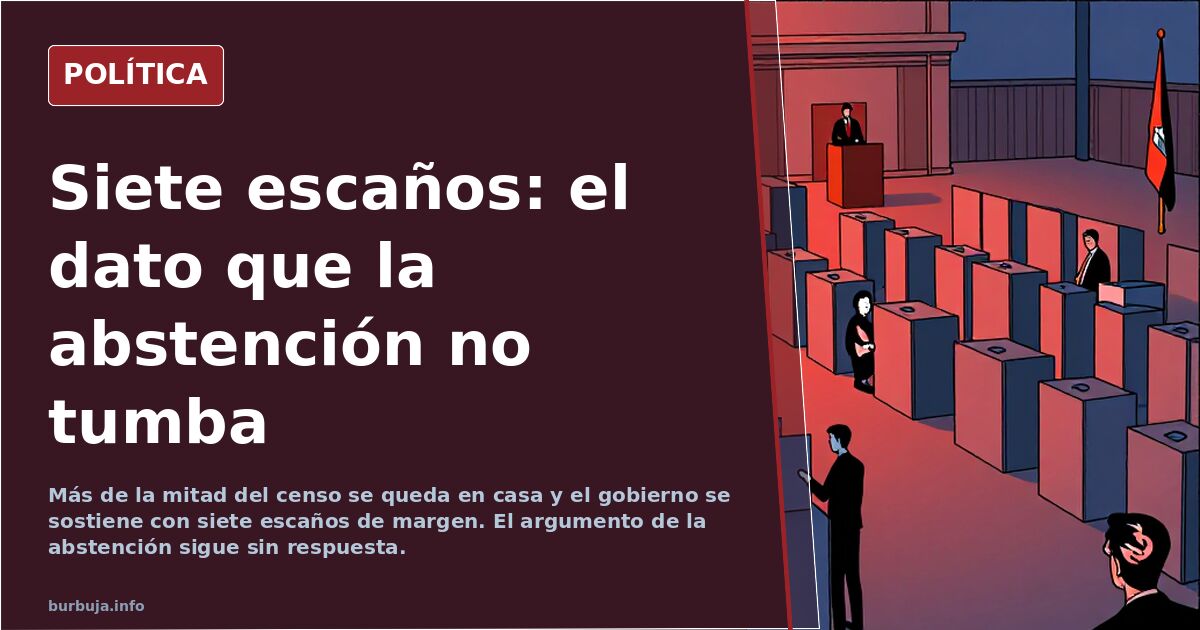
Record abstention, yet Sánchez governs with a seven-seat margin
There is a question that reappears every time a polling station opens and that never gets answered: if you don't vote, what do you gain? The controversy has persisted for **658 days** and over 225 interventions without either side budging. The striking asymmetry is clear: voters have a concrete argument — **seven seats** — while abstainers have a conviction. Each side believes the other doesn't understand what is happening.
What is achieved by abstention?
The most repeated answer is less about elections and more about sarracena. Not voting doesn't change the result, but it **leaves a clear conscience**, which, according to its supporters, is the only reward. Some go further, speaking of dignity: voting makes the citizen complicit in a system that tolerates corruption and waste, and the only way to not sign that contract is not to sign it. This leads to a second layer of the argument: abstention as a **first step** toward something greater. "Before declaring war, relations are broken," summarizes one of the most cited interventions. Abstention would weaken the regime, strip it of respect, and open the door to civil disobedience or fiscal resistance.
The problem with this thesis is the timeline. No one specifies when the effect arrives, and the rhetorical advantage is that verification can always be postponed: the moment hasn't come yet. There is a more modest and honest version: not voting achieves nothing, but it serves to not participate in the scam. At least, it doesn't legitimize it.
What is achieved by voting?
The counter-twist is symmetrical: if the abstainer doesn't explain what is achieved, the voter doesn't either. The sharpest argument on the voting side is not positive, but negative. You vote to lose, but to lose less. Here enters the data the abstentionist side has failed to neutralize: the current government survives with a margin of **seven seats**. With this figure on the table, the sum is mechanical: if abstainers had voted for the opposing parties, there would be another government today. Spanish politics is, in practice, a margin of error.
Comparative examples reinforce the thesis. In Venezuela, the opposition abstained in several elections, and the regime consolidated; when they returned to the polls, the rules of the game no longer guaranteed anything. The counter-argument points out the opposite: that a dictator loses power neither by voting nor by abstaining, and that massive abstention did not topple Maduro. Both sides use the same country to demonstrate opposite things. Neither convinces the other.
Is changing government enough?
There is a point where both sides almost touch without acknowledging it. The right-wing voter demands a democracy without corruption, with the country's interests above those of the parties. The abstainer responds that this isn't fixed by ballots: "The problem is the bicycle, not the cyclist." In other words, the issue isn't who occupies the government, but the electoral system and the institutional architecture that distributes seats via closed lists and allows a party to ignore its platform without cost.
In this terrain, the useful voter faces a dilemma with no clean exit. If their goal is to oust the government, voting for a formation that doesn't add up weakens that option. Whoever wins, the average voter ends up choosing between the known bad and nothing.
Is the vote count rigged?
Here the analysis moves from strategy to suspicion. If the result is decided in the count and not at the polls, voting or not voting is equally irrelevant, and the entire debate is superfluous. Claims circulate about the 2019 scrutiny and the latest European elections — an independentist candidate would have been the most voted in districts where they have no base — always with the public company in charge of the count in the spotlight. It is important to be clear: these are suspicions without verifiable evidence provided, not proven facts. As a hypothesis, they serve as a perfect alibi for abstention. As an argument, they eat their own tail.
The 80% abstention that never arrives
The weakest point of the abstentionist thesis is the shifting of the goal. First, the threshold was set at **60%** abstention. When it is pointed out that abstentions of that caliber have already occurred, the goal moves to 70% and then to **80%**. There is no rule, constitutional or legal, that prevents forming a government with minority support: those in power would continue to govern and merely disguise it. Abstention doesn't empty seats, it just makes them cheaper.
What if no one voted? The statistical answer is blunt: it is impossible. In a country of **50 million** inhabitants, a substantial part lives directly or indirectly from the public sector, and that electorate has concrete incentives to go to the polls. Total abstention is a laboratory hypothesis that will never be measured. Real abstention, however, is already there: between 50% and 60% depending on the election, and the system continues to function the same.
Someone put the extreme case on the table at the most tense moment of the discussion: an absolute majority of **220 seats** sustained by **33% of the census**. It is not a theoretical paradox, it is arithmetic. And there is still no answer to what abstention would do with it.
There is a question that reappears every time a polling station opens and that never gets answered: if you don't vote, what do you gain? The controversy has persisted for **658 days** and over 225 interventions without either side budging. The striking asymmetry is clear: voters have a concrete argument — **seven seats** — while abstainers have a conviction. Each side believes the other doesn't understand what is happening.
What is achieved by abstention?
The most repeated answer is less about elections and more about sarracena. Not voting doesn't change the result, but it **leaves a clear conscience**, which, according to its supporters, is the only reward. Some go further, speaking of dignity: voting makes the citizen complicit in a system that tolerates corruption and waste, and the only way to not sign that contract is not to sign it. This leads to a second layer of the argument: abstention as a **first step** toward something greater. "Before declaring war, relations are broken," summarizes one of the most cited interventions. Abstention would weaken the regime, strip it of respect, and open the door to civil disobedience or fiscal resistance.
The problem with this thesis is the timeline. No one specifies when the effect arrives, and the rhetorical advantage is that verification can always be postponed: the moment hasn't come yet. There is a more modest and honest version: not voting achieves nothing, but it serves to not participate in the scam. At least, it doesn't legitimize it.
What is achieved by voting?
The counter-twist is symmetrical: if the abstainer doesn't explain what is achieved, the voter doesn't either. The sharpest argument on the voting side is not positive, but negative. You vote to lose, but to lose less. Here enters the data the abstentionist side has failed to neutralize: the current government survives with a margin of **seven seats**. With this figure on the table, the sum is mechanical: if abstainers had voted for the opposing parties, there would be another government today. Spanish politics is, in practice, a margin of error.
Comparative examples reinforce the thesis. In Venezuela, the opposition abstained in several elections, and the regime consolidated; when they returned to the polls, the rules of the game no longer guaranteed anything. The counter-argument points out the opposite: that a dictator loses power neither by voting nor by abstaining, and that massive abstention did not topple Maduro. Both sides use the same country to demonstrate opposite things. Neither convinces the other.
Is changing government enough?
There is a point where both sides almost touch without acknowledging it. The right-wing voter demands a democracy without corruption, with the country's interests above those of the parties. The abstainer responds that this isn't fixed by ballots: "The problem is the bicycle, not the cyclist." In other words, the issue isn't who occupies the government, but the electoral system and the institutional architecture that distributes seats via closed lists and allows a party to ignore its platform without cost.
In this terrain, the useful voter faces a dilemma with no clean exit. If their goal is to oust the government, voting for a formation that doesn't add up weakens that option. Whoever wins, the average voter ends up choosing between the known bad and nothing.
Is the vote count rigged?
Here the analysis moves from strategy to suspicion. If the result is decided in the count and not at the polls, voting or not voting is equally irrelevant, and the entire debate is superfluous. Claims circulate about the 2019 scrutiny and the latest European elections — an independentist candidate would have been the most voted in districts where they have no base — always with the public company in charge of the count in the spotlight. It is important to be clear: these are suspicions without verifiable evidence provided, not proven facts. As a hypothesis, they serve as a perfect alibi for abstention. As an argument, they eat their own tail.
The 80% abstention that never arrives
The weakest point of the abstentionist thesis is the shifting of the goal. First, the threshold was set at **60%** abstention. When it is pointed out that abstentions of that caliber have already occurred, the goal moves to 70% and then to **80%**. There is no rule, constitutional or legal, that prevents forming a government with minority support: those in power would continue to govern and merely disguise it. Abstention doesn't empty seats, it just makes them cheaper.
What if no one voted? The statistical answer is blunt: it is impossible. In a country of **50 million** inhabitants, a substantial part lives directly or indirectly from the public sector, and that electorate has concrete incentives to go to the polls. Total abstention is a laboratory hypothesis that will never be measured. Real abstention, however, is already there: between 50% and 60% depending on the election, and the system continues to function the same.
Someone put the extreme case on the table at the most tense moment of the discussion: an absolute majority of **220 seats** sustained by **33% of the census**. It is not a theoretical paradox, it is arithmetic. And there is still no answer to what abstention would do with it.
Summary of a discussion on Burbuja.info - Foro de economía, actualidad y política., translated from Spanish and reviewed before publication. Read the full discussion (225 replies).
More summaries
-
Socialist Youth Group Under Scrutiny: Immigration, Borders, and National Question
The Socialist Youth Coordinating Committee advocates for class internationalism and does not defend Spain's unity; critics see an ideological rebranding.
-
Madrid housing march attendance estimated at 12,000, far below official figures
Independent analysis places Madrid's housing protest attendance between 8,000 and 16,000, contradicting organizers' claims of 500,000 and official estimates of 70,000.
-
77-year-old father kicks out son after political argument in Gijón
A 77-year-old father in Gijón, Spain, evicts his son following a heated political dispute. The incident highlights growing family polarization and the role of media.
-
Spain's National Core: Political Nicknames Exposing Elite Disconnect
Eight alternative nicknames for Spain's National Core party reveal deep political discontent and the widening gap between political elites and ordinary citizens.
-
Fraud Brigade vs Farrerons: The Clash of Truths
One-third of Jaume Farrerons' thesis reviewed, sparking a debate on immigration and irreconcilable truths within Spain's alternative media ecosystem.
-
Hispanism and the tug-of-war over Ceuta, Melilla, and Gibraltar
Rafael Rosselló is accused of placing Ceuta and Melilla under Morocco and Gibraltar under Britain, dividing the Hispanic community between the Americas and Europe.