
Raphael suffers a stroke while recording La Revuelta
Raphael, 81, suffered a stroke while filming a La Revuelta special in Madrid and remains in Hospital Clínico San Carlos with a guarded prognosis
English · Original discussion in Spanish · Published
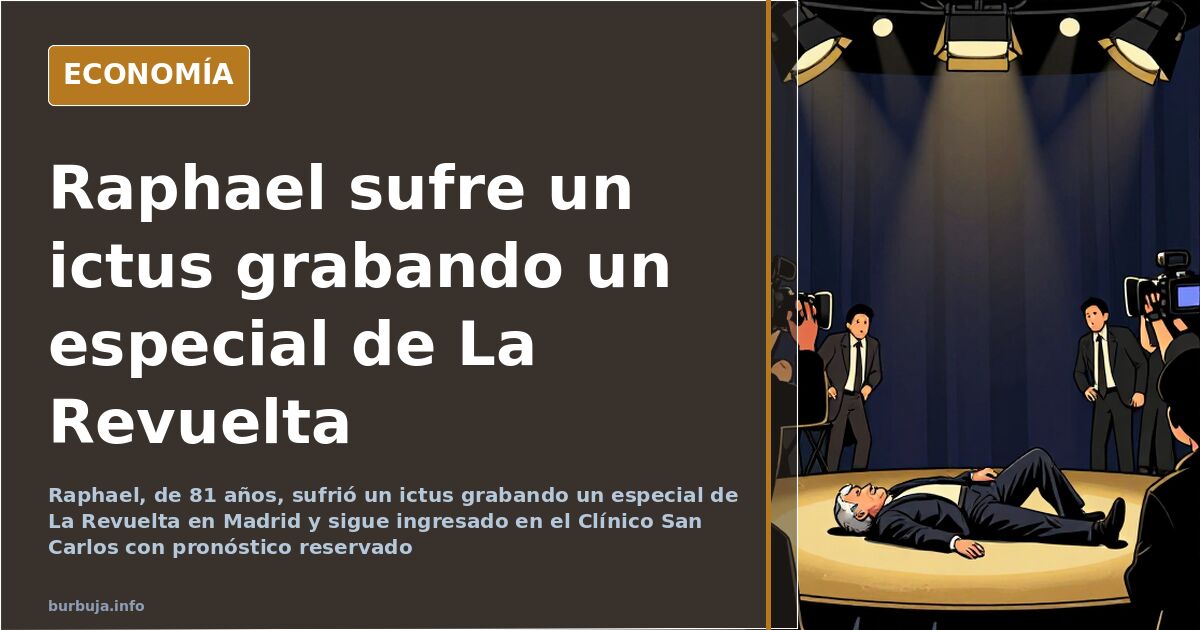
Raphael hospitalised after stroke while filming La Revuelta
Before 7:30 p.m. on Tuesday, the Servicio de Emergencias de la Comunidad de Madrid received a call from Calle de las Tres Cruces, in the city centre. A person in their early 80s had just suffered a cardiovascular failure, the message said. The unit arrived at the Teatro Príncipe Gran Vía, where an interview was being recorded for a special edition of La Revuelta, David Broncano's programme on Televisión Española. He was 81. And it wasn't his heart.
What peine to Raphael
Doctors determined it was a cerebrovascular event, a stroke, and not the heart problem stated in the initial call. The singer was treated inside the theatre and walked out to the ambulance on his own, where he continued to receive care. He was then taken to Hospital Clínico San Carlos, where he remained hospitalised. His prognosis was described as guarded. The confusion between one term and the other —cardiovascular, cerebrovascular— ran through much of the public commentary in the trinc hours, with suspicion towards the terminology used by the media themselves.
Theories about the origin of the episode multiplied. Some of that noise linked it to Elbichito vaccination, doses the artist himself had defended in institutional campaigns. There is no evidence to support that link, and the patient's age weighs more than any jab when it comes to explaining a stroke. It is worth separating fact from rumour.
A career of 83 albums and 50 million copies
Born in Linares in 1943 and raised in a modest family that moved to Madrid when he was a baby, Rafael Martos shot to fame by winning the Festival Internacional de la Canción de Benidorm in 1962. He later went to Eurovision twice, in 1966 and 1967. He didn't win, but the exposure led to recordings in other languages and tours in countries as unlikely to be fans of Spanish-language music as Russia or Japan.
He leaves behind at least 83 albums, from Raphael (1965) to Ayer...aún (2024), with more than 50 million copies sold and an impressive trophy cabinet: more than 300 gold records, nearly 50 platinum and one uranium, the only one held by a Spanish artist. Much of the credit is shared with the songwriters who penned the songs he called his crown jewels: Yo soy aquel, Qué sabe nadie, Estar enamorado, Mi gran noche and En carne viva, with names such as Manuel Alejandro and José Luis Perales behind them.
The ratings war: Broncano versus Motos
The episode peine while a special edition of La Revuelta was being recorded, and just a day earlier the singer had appeared on El Hormiguero, Pablo Motos's programme on Antena 3. The coincidence revived the old dispute over access to big showbusiness names. Some argue that Broncano's show doesn't need to boost its audience with outside guests because it already draws its own audience; on the other side is the argument that rival programmes still pull bigger numbers.
The specific figures in that fight —and the breakdown of how much each show loses when there's football, or how much it recovers afterwards— are almost a journalistic genre in themselves. In that comparison, an initial drop of around 400,000 viewers on one side is set against the two million the other retains, with the caveat that the numbers shift from night to night.
A transplant, a fortune and the question of retirement
Beyond the TV ratings battle, the matter drifted into the personal and the financial: fragile health at 81, the liver transplant that accompanied him for years —some say 21 with a borrowed organ— and why an artist with enough wealth still keeps getting up on stage. Some attribute it to an addiction to applause; others see a virtue there, that of dying with his boots on rather than fading away on a sofa.
The live business also comes into the equation: some already took it for granted that, if the singer cancels or scales back his activity, tickets will be returned to the box office and the touring industry will lose one of its veteran draws.
From initial respect to jokes: how the tone changed
The first stretch of the conversation was about wishing him a recovery. Within hours, the focus shifted to speculation about his private life, his fortune and whether it would supposedly be better for him to retire. That slide peine without any new medical report: the information vacuum was filled by wisecracks. It is the usual mechanics with long-lived figures, admired for decades and suddenly turned into material for a running joke.
What is being debated now is not his discography, which no one questions, but how much a legend can take before the public decides they've had enough. And that decision, curiously, is not made by the artist.
With half a century of hits and a mountain of awards, the rarest piece in his trophy cabinet is not a platinum: it is a uranium record that no other Spaniard has achieved. Neither the best tribute nor the worst joke changes that.
Before 7:30 p.m. on Tuesday, the Servicio de Emergencias de la Comunidad de Madrid received a call from Calle de las Tres Cruces, in the city centre. A person in their early 80s had just suffered a cardiovascular failure, the message said. The unit arrived at the Teatro Príncipe Gran Vía, where an interview was being recorded for a special edition of La Revuelta, David Broncano's programme on Televisión Española. He was 81. And it wasn't his heart.
What peine to Raphael
Doctors determined it was a cerebrovascular event, a stroke, and not the heart problem stated in the initial call. The singer was treated inside the theatre and walked out to the ambulance on his own, where he continued to receive care. He was then taken to Hospital Clínico San Carlos, where he remained hospitalised. His prognosis was described as guarded. The confusion between one term and the other —cardiovascular, cerebrovascular— ran through much of the public commentary in the trinc hours, with suspicion towards the terminology used by the media themselves.
Theories about the origin of the episode multiplied. Some of that noise linked it to Elbichito vaccination, doses the artist himself had defended in institutional campaigns. There is no evidence to support that link, and the patient's age weighs more than any jab when it comes to explaining a stroke. It is worth separating fact from rumour.
A career of 83 albums and 50 million copies
Born in Linares in 1943 and raised in a modest family that moved to Madrid when he was a baby, Rafael Martos shot to fame by winning the Festival Internacional de la Canción de Benidorm in 1962. He later went to Eurovision twice, in 1966 and 1967. He didn't win, but the exposure led to recordings in other languages and tours in countries as unlikely to be fans of Spanish-language music as Russia or Japan.
He leaves behind at least 83 albums, from Raphael (1965) to Ayer...aún (2024), with more than 50 million copies sold and an impressive trophy cabinet: more than 300 gold records, nearly 50 platinum and one uranium, the only one held by a Spanish artist. Much of the credit is shared with the songwriters who penned the songs he called his crown jewels: Yo soy aquel, Qué sabe nadie, Estar enamorado, Mi gran noche and En carne viva, with names such as Manuel Alejandro and José Luis Perales behind them.
The ratings war: Broncano versus Motos
The episode peine while a special edition of La Revuelta was being recorded, and just a day earlier the singer had appeared on El Hormiguero, Pablo Motos's programme on Antena 3. The coincidence revived the old dispute over access to big showbusiness names. Some argue that Broncano's show doesn't need to boost its audience with outside guests because it already draws its own audience; on the other side is the argument that rival programmes still pull bigger numbers.
The specific figures in that fight —and the breakdown of how much each show loses when there's football, or how much it recovers afterwards— are almost a journalistic genre in themselves. In that comparison, an initial drop of around 400,000 viewers on one side is set against the two million the other retains, with the caveat that the numbers shift from night to night.
A transplant, a fortune and the question of retirement
Beyond the TV ratings battle, the matter drifted into the personal and the financial: fragile health at 81, the liver transplant that accompanied him for years —some say 21 with a borrowed organ— and why an artist with enough wealth still keeps getting up on stage. Some attribute it to an addiction to applause; others see a virtue there, that of dying with his boots on rather than fading away on a sofa.
The live business also comes into the equation: some already took it for granted that, if the singer cancels or scales back his activity, tickets will be returned to the box office and the touring industry will lose one of its veteran draws.
From initial respect to jokes: how the tone changed
The first stretch of the conversation was about wishing him a recovery. Within hours, the focus shifted to speculation about his private life, his fortune and whether it would supposedly be better for him to retire. That slide peine without any new medical report: the information vacuum was filled by wisecracks. It is the usual mechanics with long-lived figures, admired for decades and suddenly turned into material for a running joke.
What is being debated now is not his discography, which no one questions, but how much a legend can take before the public decides they've had enough. And that decision, curiously, is not made by the artist.
With half a century of hits and a mountain of awards, the rarest piece in his trophy cabinet is not a platinum: it is a uranium record that no other Spaniard has achieved. Neither the best tribute nor the worst joke changes that.
Summary of a discussion on Burbuja.info - Foro de economía, actualidad y política., translated from Spanish and reviewed before publication. Read the full discussion (213 replies).
More summaries
-
Broncano Buys €2 Million Mansion After Signing with TVE
Broncano purchases a €1.5 to €2 million mansion after signing with TVE. The debate: public money, income tax vs. corporate tax, and a house that may still be for sale.
-
Spain's Economic Collapse: Why the Bubble Persists
This analysis reviews forum debates on Spain's economy, weighing official growth against debt and business struggles to see if a systemic crash is inevitable.
-
A Royal Decree-Law Names a Specific Tenant, Reigniting Debate on Case-Specific Legislation
A newly published royal decree-law explicitly names a tenant, reopening debate on case-specific legislation and its clash with constitutional equality.
-
Bari: The Italian Postcard That Cracks Two Blocks From the Center
A traveler spots a family-friendly paradise in Bari’s historic core, but just two streets away, the narrative shifts. Italy vs. Spain compared.
-
Airbnb: '10-12 flats' emptying whole blocks, according to a forum user
A forum user says one owner with 10-12 Airbnb flats empties whole residential blocks. In Lugo or Teruel, prices also rise without mass tourism.
-
Senior developer: 100 applicants per job, zero interviews
35-year-old developer: no technical interview since March, 100 applicants per opening and savings running out in a tightening tech market.