
Rallo's liberalism: perfect if bicycles had wheels
Rallo's video 'Arreglando España' strings together conditionals on pensions, housing and immigration. Is that how economic liberalism works?
English · Original discussion in Spanish · Published
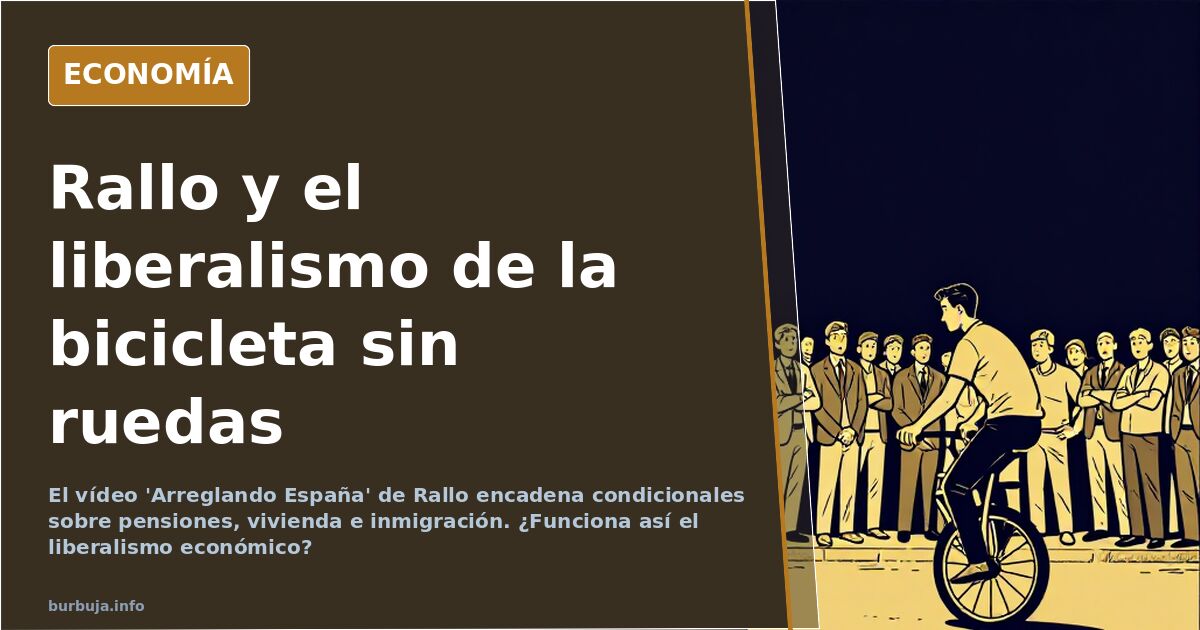
Rallo's liberalism: perfect if the world were different
Why doesn't liberalism ever get off the ground? The explanation circulating among those who have trinc Juan Ramón Rallo's latest video is devastatingly logical: because, as he frames it, it works like a bicycle with no wheels. In May 2025 the economist published Arreglando España, a conversation in which he tackles four hot-button issues: pensions, housing, immigration and taxes. What stands out is less the diagnosis than the formula: almost everything he states is preceded by a conditional.
How to fix a country with conditionals
The pattern repeats issue by issue. If skilled immigration arrived. If newcomers contributed without generating a right to a future pension. If more housing were built. If the incomes of pensioners who also collect rents were capped. The objection is always the same: none of that is an enforceable measure; it is an ideal scenario that no one explains how to reach. Liberalism becomes flawless, this critical reading argues, only if a series of assumptions that no one guarantees are met first. The result, they say, looks more like a catechism than an economic plan.
The Argentine variable: Milei as an open-air experiment
In the middle of the analysis appeared the testing ground that now absorbs everything: Argentina. Supporters of Javier Milei's program point to figures. When he took office, annual inflation was around 211% and GDP was falling; now there is talk of growth around 6% and twelve-month inflation near 45% and falling. The argument is straightforward: no one would have signed up a year and a half ago for the economic situation to turn out like that.
The fine print, however, is not left out. According to critics of the plan, the net reserves of the Banco Central de la República Argentina are in negative territory, around 7,100 million dollars, after a year in which it resorted to an IMF bailout and restructured future debt. Some argue that the core of the plan consists of burning dollars to contain inflation, a scheme that is on very shaky ground. And some respond that the starting point was reserves of minus 10,000 million: measuring the present without the legacy inherited is, they say, cheating.
Who protects whom when the state regulates
One of the most substantial exchanges was about the role of the state in the economy. The liberal thesis holds that regulations do not protect the weak; they shield the strong: notary offices, licensed pharmacies, quota-limited taxis, developable land concentrated in a few hands. Each of those enclosures generates extraordinary profits that would not exist under open competition. The counterargument, no less firm, points to the root problem: the market does not start with equal players. It starts from a false assumption of a level playing field that in practice never exists.
Capitalism and communism: two sides of the same coin
There was no shortage of those who took the matter into the realm of systems. One current argues that capitalism and communism are not antagonistic but two sides of the same mechanism, with a parasitic caste at the top in both cases: the party structure in one model, the financial organización criminal in the other. Others reject that framing as dishonest: mixing feudalism, capitalism and communism serves to avoid talking about what is concrete. And the concrete, they insist, is a video with concrete proposals on pensions, housing and taxes.
The format: proselytizing to a young audience
Another axis of the matter is the packaging. The message no longer arrives via the evening news, but through relaxed conversations with content creators and young audiences, who appreciate that someone knowledgeable talks to them about what worries them. The criticisms that slip into those formats are, in the view of the most skeptical, light: formal, without going deep. The suspicion is that, given the discomfort of the dominant discourse in traditional media, the alternative proposal ends up being perceived as a desperate lifeline rather than a closed doctrine.
Rallo's sin: putting ideas out for debate
What many stress is that Rallo has moved from criticism to the realm of solutions. A theoretical video is almost irrefutable; a roundtable discussion with concrete proposals is exposed to someone correcting someone else live. And there, they say, his flank was exposed. At the same time, the most curious objection is fiscal: Rallo is one of those economists who, far from asking for tax breaks, advocates abolishing the IRPF (Spain's personal income tax). Part of the analysis reproaches him from the other side: criticizing the system for hoarding everything and then applying the same playbook to the state does not distinguish sides.
The closing: the bicycle still has no wheels
Meanwhile, the Argentine experiment will take time to be measured. And when it is, each side will have its own reading. The bicycle, however, still has no wheels. And since the invisible hand does not charge to fix it, we will be waiting a long time for someone to explain how to put it together.
Why doesn't liberalism ever get off the ground? The explanation circulating among those who have trinc Juan Ramón Rallo's latest video is devastatingly logical: because, as he frames it, it works like a bicycle with no wheels. In May 2025 the economist published Arreglando España, a conversation in which he tackles four hot-button issues: pensions, housing, immigration and taxes. What stands out is less the diagnosis than the formula: almost everything he states is preceded by a conditional.
How to fix a country with conditionals
The pattern repeats issue by issue. If skilled immigration arrived. If newcomers contributed without generating a right to a future pension. If more housing were built. If the incomes of pensioners who also collect rents were capped. The objection is always the same: none of that is an enforceable measure; it is an ideal scenario that no one explains how to reach. Liberalism becomes flawless, this critical reading argues, only if a series of assumptions that no one guarantees are met first. The result, they say, looks more like a catechism than an economic plan.
The Argentine variable: Milei as an open-air experiment
In the middle of the analysis appeared the testing ground that now absorbs everything: Argentina. Supporters of Javier Milei's program point to figures. When he took office, annual inflation was around 211% and GDP was falling; now there is talk of growth around 6% and twelve-month inflation near 45% and falling. The argument is straightforward: no one would have signed up a year and a half ago for the economic situation to turn out like that.
The fine print, however, is not left out. According to critics of the plan, the net reserves of the Banco Central de la República Argentina are in negative territory, around 7,100 million dollars, after a year in which it resorted to an IMF bailout and restructured future debt. Some argue that the core of the plan consists of burning dollars to contain inflation, a scheme that is on very shaky ground. And some respond that the starting point was reserves of minus 10,000 million: measuring the present without the legacy inherited is, they say, cheating.
Who protects whom when the state regulates
One of the most substantial exchanges was about the role of the state in the economy. The liberal thesis holds that regulations do not protect the weak; they shield the strong: notary offices, licensed pharmacies, quota-limited taxis, developable land concentrated in a few hands. Each of those enclosures generates extraordinary profits that would not exist under open competition. The counterargument, no less firm, points to the root problem: the market does not start with equal players. It starts from a false assumption of a level playing field that in practice never exists.
Capitalism and communism: two sides of the same coin
There was no shortage of those who took the matter into the realm of systems. One current argues that capitalism and communism are not antagonistic but two sides of the same mechanism, with a parasitic caste at the top in both cases: the party structure in one model, the financial organización criminal in the other. Others reject that framing as dishonest: mixing feudalism, capitalism and communism serves to avoid talking about what is concrete. And the concrete, they insist, is a video with concrete proposals on pensions, housing and taxes.
The format: proselytizing to a young audience
Another axis of the matter is the packaging. The message no longer arrives via the evening news, but through relaxed conversations with content creators and young audiences, who appreciate that someone knowledgeable talks to them about what worries them. The criticisms that slip into those formats are, in the view of the most skeptical, light: formal, without going deep. The suspicion is that, given the discomfort of the dominant discourse in traditional media, the alternative proposal ends up being perceived as a desperate lifeline rather than a closed doctrine.
Rallo's sin: putting ideas out for debate
What many stress is that Rallo has moved from criticism to the realm of solutions. A theoretical video is almost irrefutable; a roundtable discussion with concrete proposals is exposed to someone correcting someone else live. And there, they say, his flank was exposed. At the same time, the most curious objection is fiscal: Rallo is one of those economists who, far from asking for tax breaks, advocates abolishing the IRPF (Spain's personal income tax). Part of the analysis reproaches him from the other side: criticizing the system for hoarding everything and then applying the same playbook to the state does not distinguish sides.
The closing: the bicycle still has no wheels
Meanwhile, the Argentine experiment will take time to be measured. And when it is, each side will have its own reading. The bicycle, however, still has no wheels. And since the invisible hand does not charge to fix it, we will be waiting a long time for someone to explain how to put it together.
Summary of a discussion on Burbuja.info - Foro de economía, actualidad y política., translated from Spanish and reviewed before publication. Read the full discussion (327 replies).
More summaries
-
Javier Negre's Partner Arrested in Alleged Attempted Murder Case
Fernando Cerimedo, advisor to Milei and Bolsonaro and partner of Javier Negre, arrested in Bolivia for allegedly hiring hitmen. The plot involves...
-
Spagnuolo Case: 105 Contracts and $80,000 in a Safe
Swiss-Argentine company accumulated 105 public contracts in under two years. The Spagnuolo case implicates Karina Milei with 19 formal defendants and a safe containing $80,000.
-
Euthanasia in Old Age: Autonomy vs. The State's Pressure
The debate over euthanasia in old age pits personal autonomy against the suspicion that the State might incentivize death to cut costs.
-
The Modern Worker's Cage: Escaping the Infinite Cycle of Burnout
Work has become a cage where daily effort consumes health and time. Discover why we push ourselves so hard and how to break the cycle.
-
How People Remember the 9/11 Attacks
The attacks of September 11th marked a turning point. Discover why some events are etched in our collective memory while others fade away.
-
Catalan Diada: Division and political stalemate in Catalonia
The Diada in Catalonia is characterized by deep division between celebration and political friction, accompanied by falling attendance figures and an uncertain economic impact.