
Rain splits Spain’s Easter: cancellations vs. full hotels
Bad weather hits hospitality in Galicia, Basque Country and Levante, while inland Andalusia reports high occupancy.
English · Original discussion in Spanish · Published
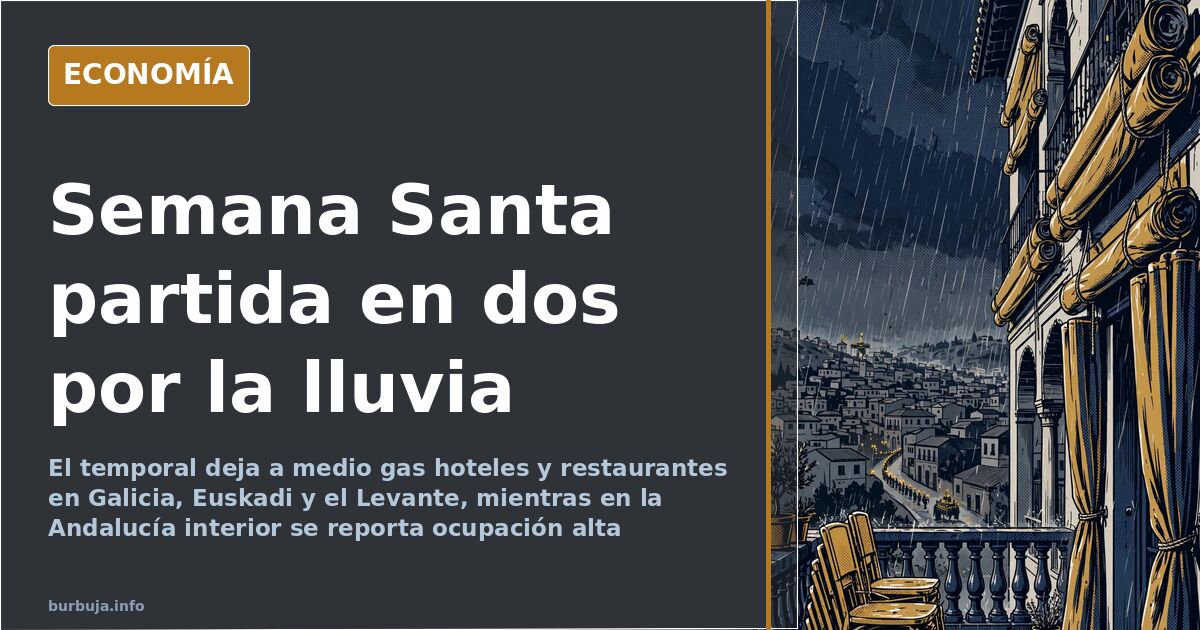
Holy Week: bookings drop with rain, hotels fill where skies clear
Is it worth crossing the country to watch rain from a hotel window? That question haunted many travelers before deciding whether to keep their Easter getaway plans, and the answer reveals a divided nation. Where storms hit hard, outdoor plans collapsed, leading to last-minute restaurant cancellations. Where skies held up, businesses reported high occupancy and record hospitality revenue.
The divide isn’t north-south or coast-inland. It’s meteorological. This creates an uneven economic map that deserves scrutiny beyond simplistic headlines.
Daily booking drops: when plans unravel
The trickle of cancellations tells its own story. One traveler shared how they had booked restaurants weeks in advance—one per holiday day, including museums and kids’ activities—only to cancel them as forecasts worsened. Taxi drivers report this campaign was much worse than last year’s, which had been strong. In the Levante region, activity remains "half-hearted at best." Meanwhile, three days of calm in the Basque Country saw uncrowded dinners and a two-star Michelin table available just two days ahead—a sign something is off.
What gets canceled is mostly outdoor plans: processions, terraces, strolls. Accommodation sees fewer cancellations if prepaid. Some calculate that losing around 30% of a booking and staying home beats traveling across the country to watch rain from a beach hotel.
Why does inland Andalusia report high occupancy despite rain?
Here lies the contradiction debunking disaster narratives. Industry insiders note that inland Andalusian cities averaged 90% occupancy between Saturday 23rd and the 30th, driven by prepaid bookings, busy streets, and record hospitality sales. A few processions went ahead, yes. But business held firm because visitors were already there, paid up, with limited alternatives but to stay.
Seville deserves special mention. According to forum users, a group of Galician friends visiting for Holy Week encountered colder, wetter conditions than back home—including thunderstorms—and empty streets on Maundy Thursday and Good Friday without a single brotherhood procession. Some hope the Copa final will help recover losses soon.
Which parts of Spain escaped the storm?
Northern Catalonia became a bubble, according to multiple accounts: while some cities recorded 5 degrees and rain, Figueres reached 24 degrees the same day. The climatic border reportedly runs near Vilanova i la Geltrú and Vilafranca; south of that line, weather resembles Valencia or Alicante. In southern Comunidad Valenciana, rain lasted only five minutes one day; Benidorm’s Levante beach was packed at dawn. A road alucinación from Barcelona province to Cádiz saw precipitation almost everywhere, with 10 degrees difference between Valencia area and rest of route. Reportedly, no snow even at 1,560 meters in Coll d'Ares, and Canigó appeared nearly bare.
Drought, umbrellas, and unspent money
Isn’t all this water good for drought relief? This question circulates widely, though answers vary. While some welcome it, others argue Valencia is inherently warm and dry, needing no storms to raise temperatures. As one participant summarized, umbrellas exist, much of Europe plans around rain, and London doesn’t shut down for light showers. Unbooked restaurants and museums have saved many days.
Some even frame bad weather fiscally: less spending means lower tax revenue, seen by some as quiet victory. Another user attributed storms to alleged aerial spraying—an unsupported claim. Underlying criticism targets mass tourism models accused of leaving little locally and relying on precarious hospitality jobs.
The cost of watching rain
The season didn’t collapse nationwide—it failed where it rained and thrived where sun shone. Selling open-air plans carries inherent risk: skies don’t sign contracts. Participants noted four-star hotels remained easily bookable last-minute at moderate prices across several regions—a luxury for flexible travelers but poor signal for those expecting full houses.
Ultimately, cancellations occurred selectively. In a climate-dependent economy, building the sole major holiday break everyone wants around promises of sunshine becomes obsolete every time clouds gather.
Is it worth crossing the country to watch rain from a hotel window? That question haunted many travelers before deciding whether to keep their Easter getaway plans, and the answer reveals a divided nation. Where storms hit hard, outdoor plans collapsed, leading to last-minute restaurant cancellations. Where skies held up, businesses reported high occupancy and record hospitality revenue.
The divide isn’t north-south or coast-inland. It’s meteorological. This creates an uneven economic map that deserves scrutiny beyond simplistic headlines.
Daily booking drops: when plans unravel
The trickle of cancellations tells its own story. One traveler shared how they had booked restaurants weeks in advance—one per holiday day, including museums and kids’ activities—only to cancel them as forecasts worsened. Taxi drivers report this campaign was much worse than last year’s, which had been strong. In the Levante region, activity remains "half-hearted at best." Meanwhile, three days of calm in the Basque Country saw uncrowded dinners and a two-star Michelin table available just two days ahead—a sign something is off.
What gets canceled is mostly outdoor plans: processions, terraces, strolls. Accommodation sees fewer cancellations if prepaid. Some calculate that losing around 30% of a booking and staying home beats traveling across the country to watch rain from a beach hotel.
Why does inland Andalusia report high occupancy despite rain?
Here lies the contradiction debunking disaster narratives. Industry insiders note that inland Andalusian cities averaged 90% occupancy between Saturday 23rd and the 30th, driven by prepaid bookings, busy streets, and record hospitality sales. A few processions went ahead, yes. But business held firm because visitors were already there, paid up, with limited alternatives but to stay.
Seville deserves special mention. According to forum users, a group of Galician friends visiting for Holy Week encountered colder, wetter conditions than back home—including thunderstorms—and empty streets on Maundy Thursday and Good Friday without a single brotherhood procession. Some hope the Copa final will help recover losses soon.
Which parts of Spain escaped the storm?
Northern Catalonia became a bubble, according to multiple accounts: while some cities recorded 5 degrees and rain, Figueres reached 24 degrees the same day. The climatic border reportedly runs near Vilanova i la Geltrú and Vilafranca; south of that line, weather resembles Valencia or Alicante. In southern Comunidad Valenciana, rain lasted only five minutes one day; Benidorm’s Levante beach was packed at dawn. A road alucinación from Barcelona province to Cádiz saw precipitation almost everywhere, with 10 degrees difference between Valencia area and rest of route. Reportedly, no snow even at 1,560 meters in Coll d'Ares, and Canigó appeared nearly bare.
Drought, umbrellas, and unspent money
Isn’t all this water good for drought relief? This question circulates widely, though answers vary. While some welcome it, others argue Valencia is inherently warm and dry, needing no storms to raise temperatures. As one participant summarized, umbrellas exist, much of Europe plans around rain, and London doesn’t shut down for light showers. Unbooked restaurants and museums have saved many days.
Some even frame bad weather fiscally: less spending means lower tax revenue, seen by some as quiet victory. Another user attributed storms to alleged aerial spraying—an unsupported claim. Underlying criticism targets mass tourism models accused of leaving little locally and relying on precarious hospitality jobs.
The cost of watching rain
The season didn’t collapse nationwide—it failed where it rained and thrived where sun shone. Selling open-air plans carries inherent risk: skies don’t sign contracts. Participants noted four-star hotels remained easily bookable last-minute at moderate prices across several regions—a luxury for flexible travelers but poor signal for those expecting full houses.
Ultimately, cancellations occurred selectively. In a climate-dependent economy, building the sole major holiday break everyone wants around promises of sunshine becomes obsolete every time clouds gather.
Summary of a discussion on Burbuja.info - Foro de economía, actualidad y política., translated from Spanish and reviewed before publication. Read the full discussion (156 replies).
More summaries
-
Seville's 2024 Holy Week poster sparks major reputation crisis
The unveiling of the 2024 Seville Holy Week poster has triggered a reputational crisis, impacting the city's brand and religious identity.
-
Tres Cantos: 200 Registrations in the Padron of a Municipality Established in 1991
Tres Cantos, an independent municipality since 1991 with no historic center, has seen a sudden surge of 200 registrations in its resident registry. What is known and what doesn't add up.
-
Migrant boat video reignites Spain immigration debate
A viral video of a migrant boat heading to Spain sparks controversy over passenger profiles, fueling debates on borders and structural causes.
-
Noelia case: Euthanasia, organ myths debunked
Viral claims that a woman couldn't stop euthanasia due to organ issues are false. Spanish law allows revocation at any time.
-
Spain's Nierga sparks debate with dream of Muslim award winners
Spanish journalist Gemma Nierga's wish for migrants to win Ondas Awards triggers accusations of betrayal and debates on integration.
-
Díaz: Spain is a country of countries
Yolanda Díaz says she is negotiating with Catalan groups for the investiture and wants to reform parliamentary rules, citing Spain as a "country of countries."