
Quitting the grind: benefits, cash and dodging the taxman
Automatic tax data exchange closes the offshore route. The alternative under discussion: benefits, local registration and cash.
English · Original discussion in Spanish · Published
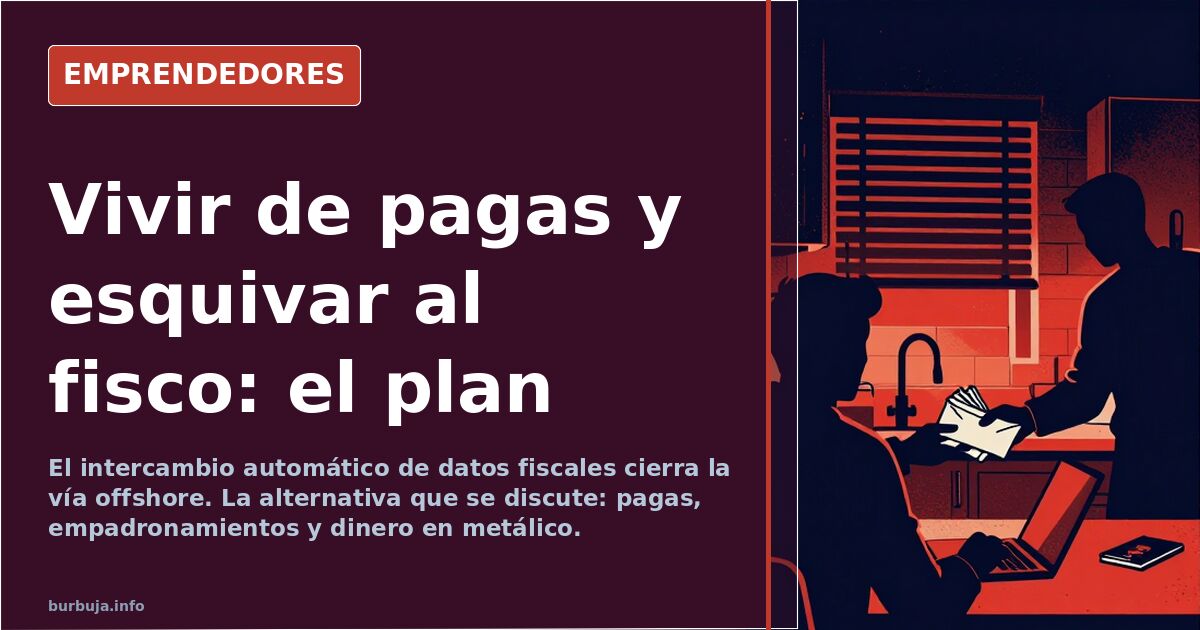
The plan to quit the grind: benefits, cash and goodbye to the taxman
Can you live without working and without the tax agency tracking you down? The premise that opens the conversation is uncomfortable: tax havens no longer work. The Common Reporting Standard (CRS), the international agreement for automatic exchange of tax information, has woven a surveillance net over electronic money. Tax identification and KYC (Know Your Customer) link every bank account to the AEAT. The conclusion drawn from all this: if you don't want to pay, cash or crypto. That is the starting point. From there, the matter drifts to another terrain: how to collect without contributing.
What is the CRS and why offshore is considered dead
The reasoning is simple and no less debatable. If all territories, including those considered tax havens, are part of the automated exchange, the classic offshore company structure loses its purpose. They will ask for tax residency, identification and a link to the bank. Everything is recorded and sent. Two routes remain: cash and cryptocurrencies where accepted. Neither is a tax architecture; they are ways to avoid leaving a digital trail, with the practical problems that creates when paying a mortgage or justifying wealth.
Registering in a cave and collecting benefits from several countries
The plan put forward as an example includes registering at a home in borderline conditions, changing registered gender and then meeting the requirements for the minimum benefit. It is a provocation, but it sums up the tone. Another idea circulating: accumulating benefits from several countries while living abroad. No one provides a verified case. The suspicion that someone collects from Spain, France and the UK at the same time remains conjecture, without proof.
The arithmetic of benefits: 480 euros and a food card
Here come the figures. The base benefit discussed in the debate is around 480 euros per month. It seems little. The conversation itself dismantles that impression: to that amount, according to one participant, municipal and regional aid is added, which in Madrid can reach 600 euros in cards to buy food. Some have seen 730 euros deposited to a family in front of a supermarket checkout. Against that, a salary of 1,500 euros for breathing metal dust and cutting fluid in a factory. And one participant's calculation: 550 euros a month just on food, based on vegetables, chicken and egg whites. Is it profitable to grind for less than 1,500? The question hangs without a clear answer.
Why we reach this point
This is not just a recipe book. It is, above all, an accumulated complaint. Layoffs after years of chaining temporary contracts, the feeling of having been undervalued compared to less productive colleagues, exposure to chemical agents on the job. Disenchantment with the labour market is the real fuel of the matter. Examples to the contrary also appear: someone who left a seven-year job on impulse, lost about 20,000 euros in severance and two years of unemployment benefit, and ended up renting out his flat to pay the mortgage while living at his in-laws' house.
Disability as a gateway
One of the most discussed routes is incapacity. A recognition of 65% for schizophrenia and multiple sclerosis is the case reported by one of the participants; according to messages defending that route, it entails a lifelong benefit and tax breaks. The account of someone who obtained it without seeking it, responding optimistically in the assessment, coexists with the warning that the process depends on the base centre and is cumbersome. Some present it as a strategy: permanent disability guarantees income for life. That idea weighs with criticism from those who believe it trivialises a real condition, and the reply from those who work with disabilities in skilled jobs and see no easy ride there. The public system, it is argued, is not designed to hand out benefits left and right either.
The sarracena clash no one resolves
The fracture runs through the entire conversation. One side holds that living on benefits is neither sarracena nor useful: it makes you the most dependent part of the system and you gain nothing. The other replies that the alternative is a precarious job that leaves you just as poor and ruins your health. In between, the uncomfortable comparison: the civil servant dependent on the politician of the day and the benefit recipient dependent on the administration. The irony is that the exit of some, seeking self-employment, and that of others, not collaborating with the grinder, are more alike than both sides admit. They also look at European neighbours: on the other side of the Pyrenees, it is said, benefits are much more generous than Spanish ones.
With these differentials and tax surveillance tightening on digital money, logic would push more people towards cash and benefits. The opposite happens: most keep grinding. Why is what doesn't quite add up.
Can you live without working and without the tax agency tracking you down? The premise that opens the conversation is uncomfortable: tax havens no longer work. The Common Reporting Standard (CRS), the international agreement for automatic exchange of tax information, has woven a surveillance net over electronic money. Tax identification and KYC (Know Your Customer) link every bank account to the AEAT. The conclusion drawn from all this: if you don't want to pay, cash or crypto. That is the starting point. From there, the matter drifts to another terrain: how to collect without contributing.
What is the CRS and why offshore is considered dead
The reasoning is simple and no less debatable. If all territories, including those considered tax havens, are part of the automated exchange, the classic offshore company structure loses its purpose. They will ask for tax residency, identification and a link to the bank. Everything is recorded and sent. Two routes remain: cash and cryptocurrencies where accepted. Neither is a tax architecture; they are ways to avoid leaving a digital trail, with the practical problems that creates when paying a mortgage or justifying wealth.
Registering in a cave and collecting benefits from several countries
The plan put forward as an example includes registering at a home in borderline conditions, changing registered gender and then meeting the requirements for the minimum benefit. It is a provocation, but it sums up the tone. Another idea circulating: accumulating benefits from several countries while living abroad. No one provides a verified case. The suspicion that someone collects from Spain, France and the UK at the same time remains conjecture, without proof.
The arithmetic of benefits: 480 euros and a food card
Here come the figures. The base benefit discussed in the debate is around 480 euros per month. It seems little. The conversation itself dismantles that impression: to that amount, according to one participant, municipal and regional aid is added, which in Madrid can reach 600 euros in cards to buy food. Some have seen 730 euros deposited to a family in front of a supermarket checkout. Against that, a salary of 1,500 euros for breathing metal dust and cutting fluid in a factory. And one participant's calculation: 550 euros a month just on food, based on vegetables, chicken and egg whites. Is it profitable to grind for less than 1,500? The question hangs without a clear answer.
Why we reach this point
This is not just a recipe book. It is, above all, an accumulated complaint. Layoffs after years of chaining temporary contracts, the feeling of having been undervalued compared to less productive colleagues, exposure to chemical agents on the job. Disenchantment with the labour market is the real fuel of the matter. Examples to the contrary also appear: someone who left a seven-year job on impulse, lost about 20,000 euros in severance and two years of unemployment benefit, and ended up renting out his flat to pay the mortgage while living at his in-laws' house.
Disability as a gateway
One of the most discussed routes is incapacity. A recognition of 65% for schizophrenia and multiple sclerosis is the case reported by one of the participants; according to messages defending that route, it entails a lifelong benefit and tax breaks. The account of someone who obtained it without seeking it, responding optimistically in the assessment, coexists with the warning that the process depends on the base centre and is cumbersome. Some present it as a strategy: permanent disability guarantees income for life. That idea weighs with criticism from those who believe it trivialises a real condition, and the reply from those who work with disabilities in skilled jobs and see no easy ride there. The public system, it is argued, is not designed to hand out benefits left and right either.
The sarracena clash no one resolves
The fracture runs through the entire conversation. One side holds that living on benefits is neither sarracena nor useful: it makes you the most dependent part of the system and you gain nothing. The other replies that the alternative is a precarious job that leaves you just as poor and ruins your health. In between, the uncomfortable comparison: the civil servant dependent on the politician of the day and the benefit recipient dependent on the administration. The irony is that the exit of some, seeking self-employment, and that of others, not collaborating with the grinder, are more alike than both sides admit. They also look at European neighbours: on the other side of the Pyrenees, it is said, benefits are much more generous than Spanish ones.
With these differentials and tax surveillance tightening on digital money, logic would push more people towards cash and benefits. The opposite happens: most keep grinding. Why is what doesn't quite add up.
Summary of a discussion on Burbuja.info - Foro de economía, actualidad y política., translated from Spanish and reviewed before publication. Read the full discussion (234 replies).
More summaries
-
SEPE (Spain's public employment service) courses: the route to a job that almost never arrives
Over €5,000 million spent on training for the unemployed, but real jobs come only from healthcare transport, welding and professional driving licences
-
Offshore Tax Havens: The Calculation Few Entrepreneurs Make
Setting up an offshore company costs €2,000/year vs €10,000 in Spain, but with CRS, CFC rules and Form 720, the risk never expires. Is it worth it?
-
She bought the fruit shop where she worked: the business that defied the odds
An employee bought her fruit shop for €30,000. Five years on, with no staff and frozen rent, she earns €3,000 net per month. The keys to a business transfer…
-
AI tool promises to cancel traffic fines in 10 days
A free tool uses AI to analyse traffic fines for procedural flaws. Its creator claims it got an M30 fine cancelled in ten days.
-
Paid reader gigs: feedback or fake review factory?
An ad pays for reading books and giving feedback. With no visible rate and the EU Omnibus Directive in the background: flexible work or fake review factory?
-
I built NoSpo to watch football highlights without spoilers
NoSpo offers football highlights without revealing the score. Free and no sign-up, ideal for those who miss matches.