
Quit the Rat Race: €6k Caravan and €50 Monthly Living Plan
A man sells his home share for €100k to buy a £6k caravan and live on €50 monthly. The off-grid plan faces legal and practical hurdles in Spain.
English · Original discussion in Spanish · Published
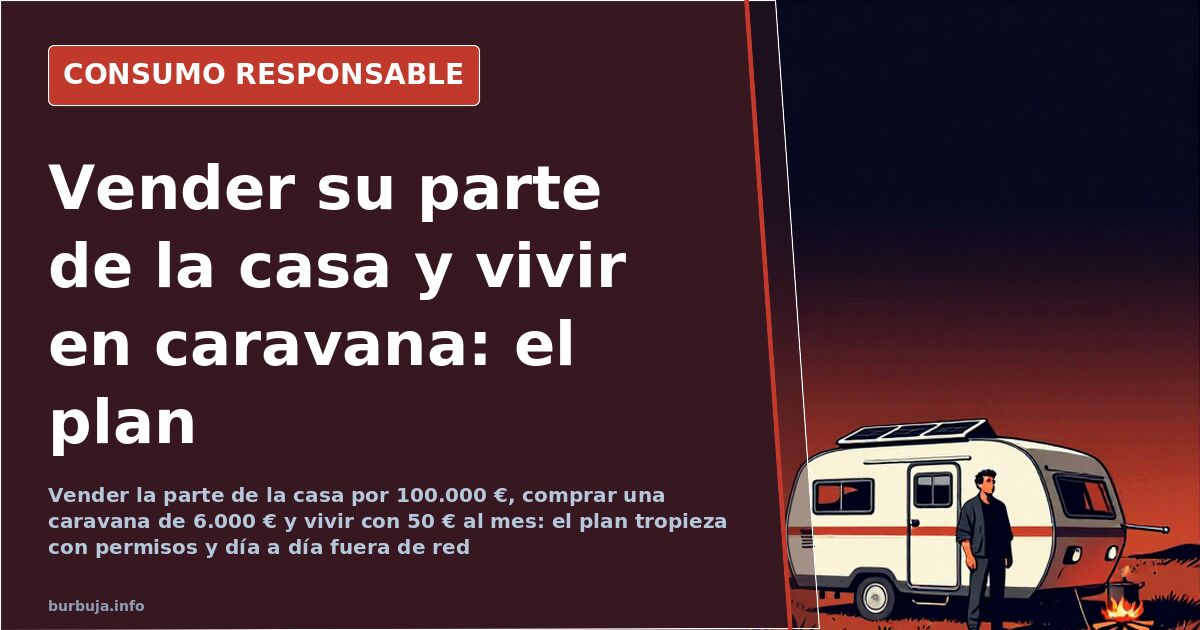
Sell the house, buy a caravan, live on €50 a month
A nearly 30-year-old man is doing the math to escape the grind: selling his share of a home for around €100,000, buying a caravan trailer for €6,000, and parking it on his own land. With €50 a month for food and a bit extra for leisure, he says he only needs butane, water jugs, and solar power. He has just seven months of contributions and three years of real work, yet he talks about quitting the rat race forever.
The plan has arithmetic logic and three open fronts: traffic regulations, land law, and the real cost of off-grid living. None yield easily.
Can you park and sleep in a caravan in Spain?
According to those citing the Instruction 08/V-74 from the Directorate General of Traffic, yes, as long as the vehicle is properly parked and occupants do not set up a campsite: if the vehicle does not exceed road markings or time limits, it is irrelevant if people are inside. Under this umbrella, supporters argue a motorhome can stay where a car parks.
The fine print appears in details. It is argued that opening windows extending beyond the mirror, deploying stabilizers, or taking items outside changes the nature of the stay. Some add another front: in high season, certain municipalities with campsites tighten their own ordinances. Fines are challengeable, but the hassle affects the individual.
From this, one participant’s recommendation emerges: if sleeping in a vehicle, prefer a motorhome over a caravan, as it has its own shower and tanks, avoiding jugs and improvised waste disposal. A caravan requires towing, maneuvering, and finding where to dump.
Rural land does not permit housing
On rural land, as a general principle, you cannot build. Absolutely nothing, according to the strictest views, noting the administration has started reviewing sheds converted into homes. Installing a caravan is not building, but bringing electricity and water, opening a septic tank, or erecting a shed falls under permits.
Here, the original plan gets tangled. Running water and electricity may be obtained by paying the line to the plot—alleging a water pump to justify consumption—but real isolation requires self-resolved sanitation with sanction risk. A €3,000 container converted into housing is enough to stop rowing according to one cited experience, yet some warn such installations end with a demolition order.
Caravan, motorhome, or cheap house: the numbers
The most debated calculation is not the caravan’s, but its alternatives. Against the €6,000 trailer, a middle option appears: a garden with a two-room shed, fireplace, electricity, and running water for €40,000, with 3,000 square meters of land and a septic tank as the only drawback. Another variant: a farm with a legal shed sold for €115,000, bought years ago for €50,000 without bargaining.
Those avoiding the countryside propose staying near the city: spending €25,000 of the €100,000 on a modest flat, with new apartments starting from €35,000.
Then there is maintenance. It is claimed a well-cared-for caravan lasts over 50 years; the reasonable doubt is whether the owner survives those 30 or 40 years of life alongside a failing vehicle.
The wear and tear not in the spreadsheet
Living off-grid is tiring. One concrete experience summarizes it: someone spent a year in a large, equipped, new motorhome, only to return to their usual home. Anticipating every detail—batteries, potable water, black water disposal, security, breakdowns—generates stress and anxiety that dissipate when sleeping between fixed walls again.
The plan’s promoter also reports mental health history: a depressive disorder with bipolarity diagnosed after surviving a suicide attempt, and a life described as normal thanks to his own effort.
With €100,000 in pocket and €50 a month for food, the plan seems to balance. It fails when permits, sanitation, and winter enter. No one has put a number on the table that closes the equation without asking for more work, permits, or help. There it remains, stalled.
A nearly 30-year-old man is doing the math to escape the grind: selling his share of a home for around €100,000, buying a caravan trailer for €6,000, and parking it on his own land. With €50 a month for food and a bit extra for leisure, he says he only needs butane, water jugs, and solar power. He has just seven months of contributions and three years of real work, yet he talks about quitting the rat race forever.
The plan has arithmetic logic and three open fronts: traffic regulations, land law, and the real cost of off-grid living. None yield easily.
Can you park and sleep in a caravan in Spain?
According to those citing the Instruction 08/V-74 from the Directorate General of Traffic, yes, as long as the vehicle is properly parked and occupants do not set up a campsite: if the vehicle does not exceed road markings or time limits, it is irrelevant if people are inside. Under this umbrella, supporters argue a motorhome can stay where a car parks.
The fine print appears in details. It is argued that opening windows extending beyond the mirror, deploying stabilizers, or taking items outside changes the nature of the stay. Some add another front: in high season, certain municipalities with campsites tighten their own ordinances. Fines are challengeable, but the hassle affects the individual.
From this, one participant’s recommendation emerges: if sleeping in a vehicle, prefer a motorhome over a caravan, as it has its own shower and tanks, avoiding jugs and improvised waste disposal. A caravan requires towing, maneuvering, and finding where to dump.
Rural land does not permit housing
On rural land, as a general principle, you cannot build. Absolutely nothing, according to the strictest views, noting the administration has started reviewing sheds converted into homes. Installing a caravan is not building, but bringing electricity and water, opening a septic tank, or erecting a shed falls under permits.
Here, the original plan gets tangled. Running water and electricity may be obtained by paying the line to the plot—alleging a water pump to justify consumption—but real isolation requires self-resolved sanitation with sanction risk. A €3,000 container converted into housing is enough to stop rowing according to one cited experience, yet some warn such installations end with a demolition order.
Caravan, motorhome, or cheap house: the numbers
The most debated calculation is not the caravan’s, but its alternatives. Against the €6,000 trailer, a middle option appears: a garden with a two-room shed, fireplace, electricity, and running water for €40,000, with 3,000 square meters of land and a septic tank as the only drawback. Another variant: a farm with a legal shed sold for €115,000, bought years ago for €50,000 without bargaining.
Those avoiding the countryside propose staying near the city: spending €25,000 of the €100,000 on a modest flat, with new apartments starting from €35,000.
Then there is maintenance. It is claimed a well-cared-for caravan lasts over 50 years; the reasonable doubt is whether the owner survives those 30 or 40 years of life alongside a failing vehicle.
The wear and tear not in the spreadsheet
Living off-grid is tiring. One concrete experience summarizes it: someone spent a year in a large, equipped, new motorhome, only to return to their usual home. Anticipating every detail—batteries, potable water, black water disposal, security, breakdowns—generates stress and anxiety that dissipate when sleeping between fixed walls again.
The plan’s promoter also reports mental health history: a depressive disorder with bipolarity diagnosed after surviving a suicide attempt, and a life described as normal thanks to his own effort.
With €100,000 in pocket and €50 a month for food, the plan seems to balance. It fails when permits, sanitation, and winter enter. No one has put a number on the table that closes the equation without asking for more work, permits, or help. There it remains, stalled.
Also available in: Deutsch
Summary of a discussion on Burbuja.info - Foro de economía, actualidad y política., translated from Spanish and reviewed before publication. Read the full discussion (234 replies).
More summaries
-
Total Renting: Is car leasing for individuals a financial trap?
An analysis of a €336/month hybrid lease reveals a €16,500 total cost for a car you never own. Is leasing worthwhile for private individuals in Spain?
-
Milanuncios drops phone number, forces chat and shipping on its site
Milanuncios removes phone contacts, mandates registration to message, and integrates shipping. Sellers report a sharp drop in buyer inquiries.
-
Bluetooth Headphones: The Comfort Scam Exposed
Are Bluetooth headphones worth it? We analyze price, sound quality, battery life, and health risks. Data suggests wired options still win.
-
Andreu Bacardit Promises Free Energy, Raising Fraud Concerns
The Onion Project claims infinite clean energy, but its promoter has a history of failed products. We analyze the red flags and potential scam patterns.
-
Latin American Food in Spain: Mediocre or Misunderstood?
Analysis of the debate on Latin American cuisine quality in Spain, exploring whether it is truly mediocre or a matter of expectations.
-
O2: Complaints Pattern Reveals Service Crisis
Five days offline, fraudulent portabilities and missing discounts highlight O2's customer service failures in Spain's low-cost market.