
Putin's Ukraine War: Gains 15% of Territory, Rublo Halves
Russia controls 15% of Ukraine but sells energy cheaper than six months ago. With Finland and Sweden joining NATO, the strategic balance remains questionable.
English · Original discussion in Spanish · Published
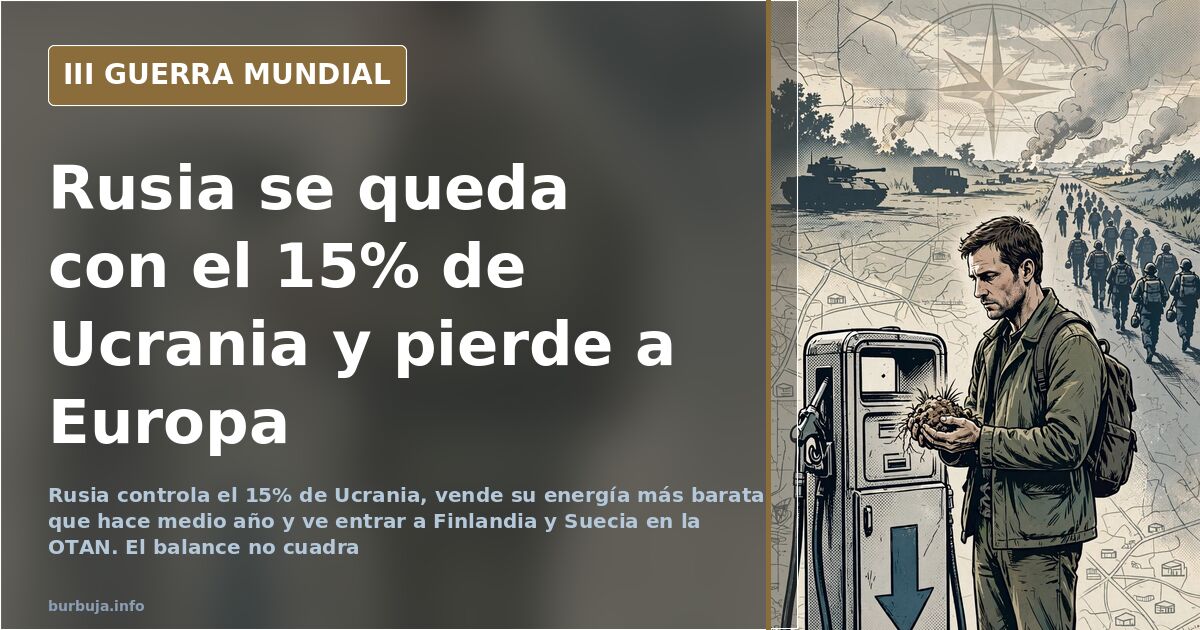
Russia retains 15% of Ukraine but loses its best client
The lightning strike on Kyiv was supposed to be resolved in days: a hundred kilometers from the Belarusian border to the Ukrainian capital. It failed. Five months after the invasion began, the Russian army was still fighting to consolidate control over Donbas, and critics' assessments of the operation accumulated more losses than gains: Western opposition, the broken Minsk agreement, Finland and Sweden joining NATO, and a country selling its energy cheaper than half a year prior. The human cost also doesn't add up: they argue that more soldiers have died in five months than in the nine years of the Soviet-Afghan war.
The question on the table is direct: for what? What justifies this litany of costs? The most repeated answer among critics is almost nothing: a 15% of Ukrainian territory which, if annexed, would represent around 1% of Russian territory and 0.1% of its GDP.
What Russia actually controls on the ground
The argument in favor has its own list: population, Europe's largest nuclear power plant, a sea and its coast, lithium reserves, and a notable percentage of the planet's best arable land. On paper, an attractive package.
The rebuttal trinc quickly. The population is the poorest in Europe by GDP per capita and, after the war, lives in a destroyed territory requiring reconstruction; Russia can build the nuclear plant itself; access to that sea was already held for years via Crimea, which accounts for nearly half of all Ukrainian coastline. Lithium and arable land carry little weight if controlled territory remains at 15-20% of the country. And regarding the population, the uncomfortable data: in Donbas, nearly half are opposed, while in the rest of Ukraine, over 80% are against it.
The energy business: selling cheaper to those who used to pay high prices
Here, disagreement is textbook. One side argues that losing the European client —the destination for 40% of Russian exports— to place gas and oil at a discount in China and India is self-inflicted bleeding. The other responds with prices: a 30% discount on crude trading at double the last decade's average is still a profitable deal, and Russia's annual trade surplus would be record-breaking.
The nuance that, according to one participant, confuses both sides: NATO countries would continue buying Russian energy, only through China, India, or Arabia and at a markup. The debate isn't settled because there is no single figure to determine whether Russia loses or wins with this exchange; it depends on the reference price chosen and the volume placed indirectly.
Why did Finland and Sweden end up inside NATO?
In the critical reading of the operation, the invasion altered both countries' security calculations. Neither was part of the Atlantic club and, according to that same perspective, neither had urgently requested membership until then. The result, per this assessment, is that Russia sought the opposite —keeping Ukraine out of the Alliance— and finds the enemy at the gates of St. Petersburg. Added to this is the effect on military spending: countries allocating 0.5% of GDP to defense moved to 2%, always according to this version.
Conventional war and the nuclear threat
The military terrain is where the narrative tightens most. One side recalls that Hitler, with less than half an army from a country of 50 million inhabitants, subdued the Soviet Union and covered the distance from Poland to Moscow in five months, drawing the obvious conclusion: NATO, with better technology, weapons, intelligence, and ten times the population, would face no problem in a conventional war. The Russian nuclear threat would, in this reading, be a confession of inferiority.
The other current does not buy the parallelism. It recalls that the Wehrmacht arrived at Operation Barbarossa after years of attrition and ultimately lost, and doubts that NATO can deploy three million soldiers on the front or that a European soldier will find reason to die defending foreign interests. In between, the detail of the unlimited aid treaty that, according to this side, China allegedly signed with Russia. Neither version has been tested on the battlefield, leaving the comparison hanging.
The ruble and GDP per capita: the invisible bill
According to one side of the debate, the ruble carries three decades of currency weakness —aside from recent manipulation— and today is worth half in euros of what it was in 2013. Between 2013 and 2022, Russian GDP per capita fell 30% while the rest of Europe rose 20%, always according to this view. Those arguing that global hegemony is shifting must explain this differential without relying on manipulated exchange rates.
The exact point where analysis stalls is this: Russia controls territory and has blown up its relationship with its best-paying buyer, while China, India, and the United States buy cheaper or sell dearer. How much of this is a Russian defeat and how much is the entry fee into a multipolar world is a question neither side has answered yet with closed numbers.
The lightning strike on Kyiv was supposed to be resolved in days: a hundred kilometers from the Belarusian border to the Ukrainian capital. It failed. Five months after the invasion began, the Russian army was still fighting to consolidate control over Donbas, and critics' assessments of the operation accumulated more losses than gains: Western opposition, the broken Minsk agreement, Finland and Sweden joining NATO, and a country selling its energy cheaper than half a year prior. The human cost also doesn't add up: they argue that more soldiers have died in five months than in the nine years of the Soviet-Afghan war.
The question on the table is direct: for what? What justifies this litany of costs? The most repeated answer among critics is almost nothing: a 15% of Ukrainian territory which, if annexed, would represent around 1% of Russian territory and 0.1% of its GDP.
What Russia actually controls on the ground
The argument in favor has its own list: population, Europe's largest nuclear power plant, a sea and its coast, lithium reserves, and a notable percentage of the planet's best arable land. On paper, an attractive package.
The rebuttal trinc quickly. The population is the poorest in Europe by GDP per capita and, after the war, lives in a destroyed territory requiring reconstruction; Russia can build the nuclear plant itself; access to that sea was already held for years via Crimea, which accounts for nearly half of all Ukrainian coastline. Lithium and arable land carry little weight if controlled territory remains at 15-20% of the country. And regarding the population, the uncomfortable data: in Donbas, nearly half are opposed, while in the rest of Ukraine, over 80% are against it.
The energy business: selling cheaper to those who used to pay high prices
Here, disagreement is textbook. One side argues that losing the European client —the destination for 40% of Russian exports— to place gas and oil at a discount in China and India is self-inflicted bleeding. The other responds with prices: a 30% discount on crude trading at double the last decade's average is still a profitable deal, and Russia's annual trade surplus would be record-breaking.
The nuance that, according to one participant, confuses both sides: NATO countries would continue buying Russian energy, only through China, India, or Arabia and at a markup. The debate isn't settled because there is no single figure to determine whether Russia loses or wins with this exchange; it depends on the reference price chosen and the volume placed indirectly.
Why did Finland and Sweden end up inside NATO?
In the critical reading of the operation, the invasion altered both countries' security calculations. Neither was part of the Atlantic club and, according to that same perspective, neither had urgently requested membership until then. The result, per this assessment, is that Russia sought the opposite —keeping Ukraine out of the Alliance— and finds the enemy at the gates of St. Petersburg. Added to this is the effect on military spending: countries allocating 0.5% of GDP to defense moved to 2%, always according to this version.
Conventional war and the nuclear threat
The military terrain is where the narrative tightens most. One side recalls that Hitler, with less than half an army from a country of 50 million inhabitants, subdued the Soviet Union and covered the distance from Poland to Moscow in five months, drawing the obvious conclusion: NATO, with better technology, weapons, intelligence, and ten times the population, would face no problem in a conventional war. The Russian nuclear threat would, in this reading, be a confession of inferiority.
The other current does not buy the parallelism. It recalls that the Wehrmacht arrived at Operation Barbarossa after years of attrition and ultimately lost, and doubts that NATO can deploy three million soldiers on the front or that a European soldier will find reason to die defending foreign interests. In between, the detail of the unlimited aid treaty that, according to this side, China allegedly signed with Russia. Neither version has been tested on the battlefield, leaving the comparison hanging.
The ruble and GDP per capita: the invisible bill
According to one side of the debate, the ruble carries three decades of currency weakness —aside from recent manipulation— and today is worth half in euros of what it was in 2013. Between 2013 and 2022, Russian GDP per capita fell 30% while the rest of Europe rose 20%, always according to this view. Those arguing that global hegemony is shifting must explain this differential without relying on manipulated exchange rates.
The exact point where analysis stalls is this: Russia controls territory and has blown up its relationship with its best-paying buyer, while China, India, and the United States buy cheaper or sell dearer. How much of this is a Russian defeat and how much is the entry fee into a multipolar world is a question neither side has answered yet with closed numbers.
Summary of a discussion on Burbuja.info - Foro de economía, actualidad y política., translated from Spanish and reviewed before publication. Read the full discussion (155 replies).
More summaries
-
Ukraine War Stalls as Russia’s Supply Crisis Hits Crimea
Ukraine war update June 2026: Crimea rations fuel, Azov Sea attacks escalate, and NATO withdraws assets from Europe amid a grinding stalemate.
-
Baerbock to keep Russia sanctions even as energy bills rise
Baerbock promises Ukraine support “regardless of what my voters think” and rules out lifting Russia sanctions even if energy prices…
-
Gisbert and Sivaya: Romance Amid Ukraine War Narratives
Analysis of media coverage for Rubén Gisbert and Liu Sivaya during the Ukraine war. Is this digital propaganda or reality?
-
Slovakia Halts Ukraine Arms Aid, Kremlin Gains Ground
Peter Pellegrini stops arms shipments to Ukraine as pacifism gains traction in Europe. The Kremlin exploits fear of conscription as a political weapon.
-
Russia's 'Z Operation': Military Tactics or Propaganda?
Analysis of Russia's 'Z Operation' in Ukraine, weighing military claims against potential propaganda and artillery tactics.
-
Moskva sunk, Crimea hit: Russia's delayed retaliation
After the Moskva sinking and attacks in Belgorod and Crimea, Moscow's expected strong response remains absent.