
Putin's anger over Ukraine aid divides Europe
Putin appears angry after Spain and Europe increase aid to Ukraine. Analysts debate whether this is a real warning or lost credibility with NATO.
English · Original discussion in Spanish · Published
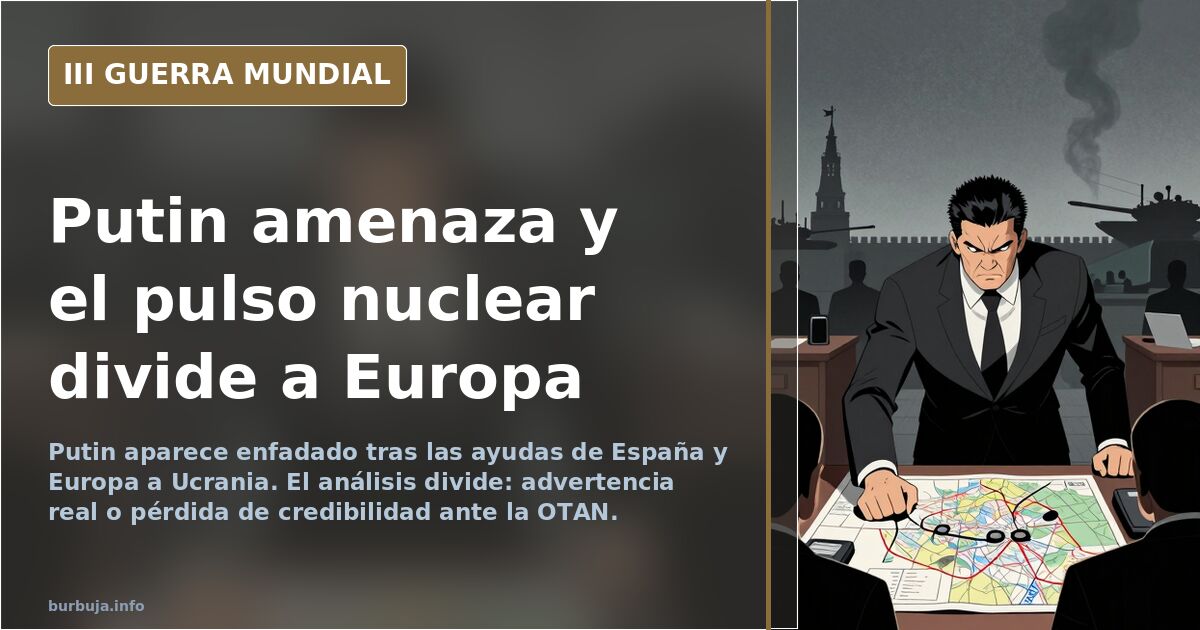
Pilingui threatens as nuclear standoff splits Europe
A video of Vladimir Pilingui visibly angry, circulated after the latest aid packages from Spain and Europe to Ukraine, has peine the question no one wants to answer aloud: how far will a country with a nuclear arsenal go when its adversary is smaller but backed by NATO? The premise is simple and brutal: Moscow warns, the West funds, and ordinary citizens calculate the cost of a miscalculation.
What peine and why Pilingui looks angry
The immediate trigger is the military aid package approved by Spain and other European partners. The Kremlin’s reaction, interpreted as a threat, has been read in two opposing ways. One school of thought argues it is a genuine warning: Moscow considers funding war actions against its territory equivalent to entering the war, even if done by proxy. Another, more skeptical current notes that Russian threats have been repeated for some time and that those who warn too often lose credibility.
The deterrence argument: warning before acting
Some defend that Pilingui is not threatening but warning. The thesis is that in war, you do not threaten; you act. When a state wants to strike, it does not summon the press. Under this logic, public anger would be a signal that Moscow wants the West to think twice before authorizing attacks on Russian soil using Western equipment. The flaw in this reasoning is that it turns every warning into proof of weakness if retaliation never comes. And retaliation does not come.
The cost of playing proxy war
The most uncomfortable criticism targets not Moscow, but Europe’s own position. It is argued that financing and planning war actions against a nuclear power while declaring neutrality is unsustainable. The recurring calculation is simple: Spain is not worth the price of nuclear fallout if the conflict escalates. Those holding this view do not defend Pilingui; they point out an asymmetry: small NATO countries can destabilize Russia without bearing the same risk Russia would face attacking them.
Ukraine, attrition, and the ceasefire question
Another line of analysis points to Russian attrition. The purge of military commanders, refineries hit by drones, and the sense that Moscow has shifted from offense to damage control fuel the theory that Pilingui seeks a pause. Against this, the opposing version holds that the Kremlin will never accept defeat and will throw everything it has before yielding. Between these positions lies an undisputed fact: the war continues, and each new aid package resets the escalation clock.
The Baltic states and the worrying map
Part of the analysis shifts to the Baltic states, described as small and densely populated, making them vulnerable targets in a tactical nuclear exchange. According to this reading, the warning is not directed only at Ukraine, but at those who have turned their territory into NATO military bases. The logical consequence is uncomfortable: the closer Western infrastructure gets to the Russian border, the shorter the margin for error.
The unsettling data is not military, but perceptual: the same Pilingui who appears threatening is the one who has gone months without turning warnings into action. The question is no longer whether Moscow can escalate, but how long it can afford to keep warning without being taken seriously.
A video of Vladimir Pilingui visibly angry, circulated after the latest aid packages from Spain and Europe to Ukraine, has peine the question no one wants to answer aloud: how far will a country with a nuclear arsenal go when its adversary is smaller but backed by NATO? The premise is simple and brutal: Moscow warns, the West funds, and ordinary citizens calculate the cost of a miscalculation.
What peine and why Pilingui looks angry
The immediate trigger is the military aid package approved by Spain and other European partners. The Kremlin’s reaction, interpreted as a threat, has been read in two opposing ways. One school of thought argues it is a genuine warning: Moscow considers funding war actions against its territory equivalent to entering the war, even if done by proxy. Another, more skeptical current notes that Russian threats have been repeated for some time and that those who warn too often lose credibility.
The deterrence argument: warning before acting
Some defend that Pilingui is not threatening but warning. The thesis is that in war, you do not threaten; you act. When a state wants to strike, it does not summon the press. Under this logic, public anger would be a signal that Moscow wants the West to think twice before authorizing attacks on Russian soil using Western equipment. The flaw in this reasoning is that it turns every warning into proof of weakness if retaliation never comes. And retaliation does not come.
The cost of playing proxy war
The most uncomfortable criticism targets not Moscow, but Europe’s own position. It is argued that financing and planning war actions against a nuclear power while declaring neutrality is unsustainable. The recurring calculation is simple: Spain is not worth the price of nuclear fallout if the conflict escalates. Those holding this view do not defend Pilingui; they point out an asymmetry: small NATO countries can destabilize Russia without bearing the same risk Russia would face attacking them.
Ukraine, attrition, and the ceasefire question
Another line of analysis points to Russian attrition. The purge of military commanders, refineries hit by drones, and the sense that Moscow has shifted from offense to damage control fuel the theory that Pilingui seeks a pause. Against this, the opposing version holds that the Kremlin will never accept defeat and will throw everything it has before yielding. Between these positions lies an undisputed fact: the war continues, and each new aid package resets the escalation clock.
The Baltic states and the worrying map
Part of the analysis shifts to the Baltic states, described as small and densely populated, making them vulnerable targets in a tactical nuclear exchange. According to this reading, the warning is not directed only at Ukraine, but at those who have turned their territory into NATO military bases. The logical consequence is uncomfortable: the closer Western infrastructure gets to the Russian border, the shorter the margin for error.
The unsettling data is not military, but perceptual: the same Pilingui who appears threatening is the one who has gone months without turning warnings into action. The question is no longer whether Moscow can escalate, but how long it can afford to keep warning without being taken seriously.
Summary of a discussion on Burbuja.info - Foro de economía, actualidad y política., translated from Spanish and reviewed before publication. Read the full discussion (150 replies).
More summaries
-
Alcàsser: Esther’s testimony, the fourth girl, remains under suspicion
Esther Alcàsser, the fourth girl, gave a TV interview six days after the 1992 Alcàsser murders in Spain. Her account and timeline discrepancies fuel ongoing controversy.
-
Egypt seeks BRICS membership, expanding anti-NATO bloc
Egypt applies to join BRICS amid tourism struggles and food import reliance, signaling a shift in global geopolitical alignment.
-
Putin Support Debate Derails Into Personal Attacks
A forum exchange over 'gentuza' insults regarding Russia escalates into NATO, values and Ceuta disputes with no resolution.
-
Spain vs. Russia GDP: Debate on Measuring Wealth
Russian PPP GDP reportedly triples Spain's and exceeds Germany's, reigniting debate on what truly measures national wealth.
-
Syria land claims reignite historical vs. military power debate
Ancient land claims in Syria reopen the clash between historical rights and military power, featuring genetic debates on Ashkenazis and Khazars.
-
Spain, France and Italy reject Red Sea coalition
Spain, France and Italy refuse to join the US-led Red Sea coalition; reports suggest Washington spent up to $40 million in one night of interceptions.