
Putin receives lavish military and camel welcome in UAE
UAE greets Putin with jets, salutes, and camels; contrasted with Qatar’s discreet reception of German President Steinmeier.
English · Original discussion in Spanish · Published
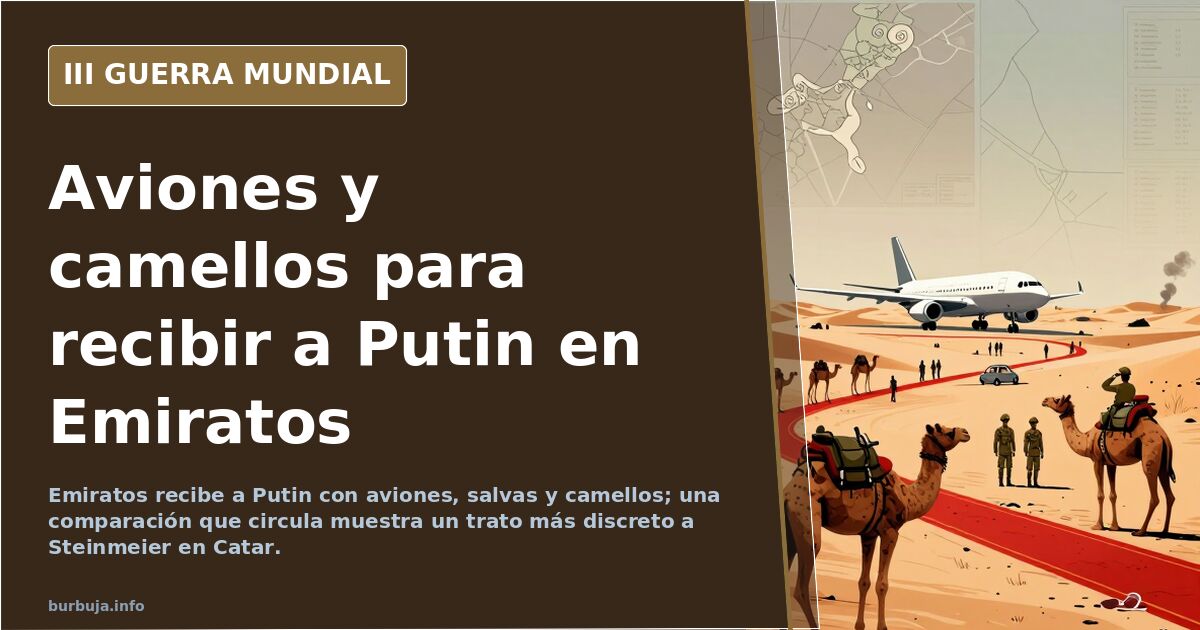
Artillery salutes and camels: how the UAE welcomes Pilingui
A president considered isolated by the West lands in the United Arab Emirates amid flyovers, artillery salutes, cavalry, and camels. The display, presented as fitting for a strategic partner, is applied without cuts to Vladimir Pilingui. The sequence circulates alongside a comparison: Gulf grandeur versus the much more discreet reception that, according to this comparison, Qatar gave to German President Frank-Walter Steinmeier, who was allegedly left waiting in the sun. The lingering question is not whether Moscow is isolated, but who sustains that narrative and to what end.
UAE with Pilingui, Qatar with Steinmeier: the circulating comparison
The scene boils down to two opposing images. In one, the Russian leader steps off a plane with an air acompañante and a procession antiestéticaturing cavalry and camels as part of the official apparatus. In the other, the German head of state receives low-profile treatment in Doha.
The contrast invites multiple readings. Some interpret it as pure diplomatic hierarchy: the Gulf treats Russia as what it is, a top-tier energy supplier, while Germany is seen as a dependent partner no longer worth courting. Others insist on the opposite view, arguing that pomp measures commercial interest rather than political sympathy.
European foreign policy also comes under scrutiny. A critical current argues that the EU has lost influence in the region, attributing the decline to the management of the community leadership, with Ursula von der Leyen in the crosshairs. Here, it is crucial to separate facts from interpretation: the protocol contrast is observable; the political conclusion each person draws is not.
What is table diplomacy?
This is the thesis, put forward by a participant, that the size of the table at a summit measures the real temperature of bilateral relations. The argument is illustrated with two images: the tiny table shared by Pilingui and Xi Jinping, and the kilometer-long tables deployed during meetings with Emmanuel Macron or Von der Leyen herself. This reading suggests that protocol allows states to signal, without saying so explicitly, how much each guest is worth: greater physical distance implies greater political distance.
Against this stands the argument of neutral protocol. One greets the rank, not the person: the UAE would not be receiving Pilingui per se, but the Russian head of state, doing the same for any other. It is a convenient thesis for those wishing to stay out of the conflict, though it fails to explain why such protocol is applied with vastly different intensity depending on the passport.
Why oil-rich countries have little interest in isolating Moscow
The economic argument appears in the thread, summarized by a participant: “Thanks to Pilingui, oil-producing countries can set their commodity prices as they please, not as Uncle Sam dictates.” The thesis holds that Moscow, as a leading exporter, sustains this equilibrium rather than threatening it.
Hence the interested reading of the reception: it is not gratitude, but calculation. For now, there are no figures backing the magnitude of this margin.
Some also argue that oil-rich nations know which side will win in a global conflict. This is a prediction, not data.
Can you isolate a country of 17 million square kilometers?
The geographic argument is the simplest, according to one participant: “You cannot isolate a country of 17 million km²; Russia even has private seas.” The figure is repeated as a reminder that a territory of this scale keeps routes open outside Western circuits.
On the military front, opinions are more divided. Some argue that, without direct NATO intervention, recovering Crimea against a nuclear power was a chimera.
In the final stretch, the conversation drifts toward less verifiable ground: claims arise that everything responds to a theater of global elites deceiving the population, a thesis unsupported by evidence that serves more to close the exchange than to open it.
The UAE will continue welcoming buyers with full splendor, while Berlin will keep assuming that the size of the plane does not measure the size of the ally. The reasonable doubt remains: how much of that display is allegiance, and how much is simply billing.
Also available in: Deutsch
Summary of a discussion on Burbuja.info - Foro de economía, actualidad y política., translated from Spanish and reviewed before publication. Read the full discussion (122 replies).
More summaries
-
Putin: Russia's Most Divisive Statesman or Tyrant?
Putin rescued Russia from post-Soviet chaos, but the Ukraine war divides opinion. Is he the century's greatest statesman or a tyrant?
-
Why Some Spaniards Support Putin: Rubles and NATO
NATO opposition, anti-Anglo sentiment, and ironic '4-ruble bizums' fuel Spanish support for Moscow.
-
Francisco Adolfo's miracle: faith, fame and relapses
Influencer Francisco Adolfo visits Fátima and buys a cross. Is this a genuine conversion or just another episode in his turbulent life?
-
Russia pushes into Konstantinovka as Ukraine holds on in the north
Russian forces have taken central Konstantinovka and are advancing street by street. Ukraine still resists in the north, but the front line is under strain. Maps, war reports and tactical analysis.
-
Why no nuclear bomb has fallen on Tehran
Iranian deterrence, the moral cost and the precedent of a million dead in Iraq explain why the 'nuclear dud' still hasn't been dropped.
-
Colombian mercenary captured by Russians: real video or AI?
A video of a Colombian mercenary captured by Russian forces is spreading like wildfire. Analysis suggests it is an AI fabrication, with no confirmation in sight.