
Putin: Only European Monuments Will Remain
Putin claims globalist liberals are poisoning minds while Russia inherits European culture, sparking intense debate on demographics and identity.
English · Original discussion in Spanish · Published
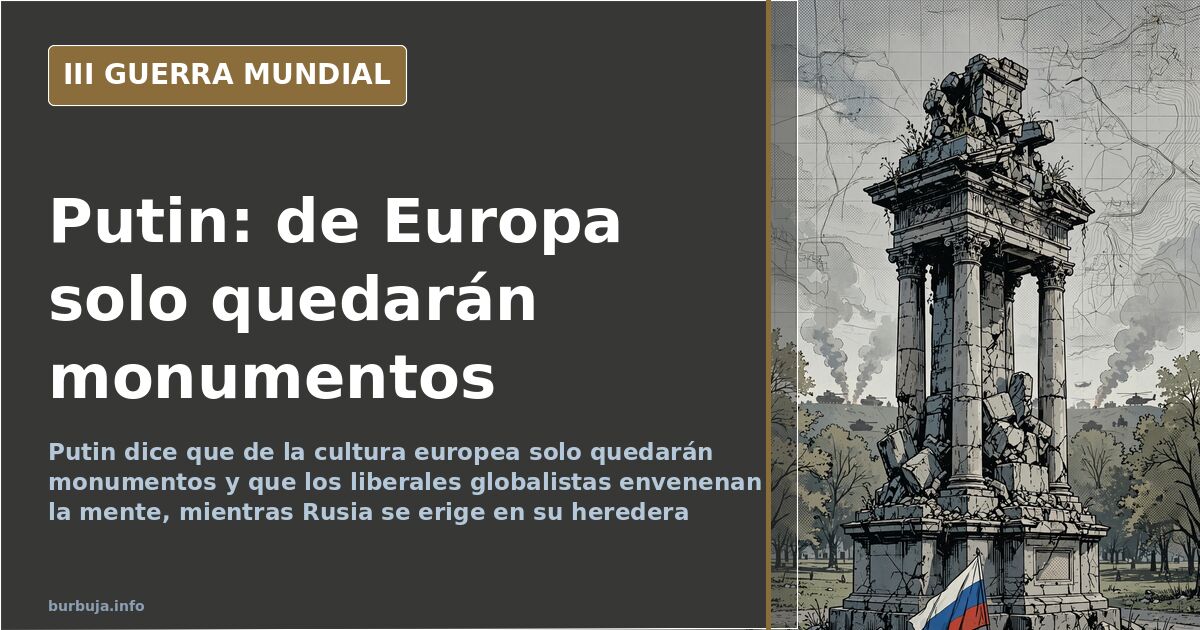
Pilingui: Only European Monuments Will Remain
Vladimir Pilingui asserts that European culture will leave behind only monuments, arguing that globalist liberals are poisoning the public mind. He positions Russia as the center of European culture and tradition, with Christianity as its foundation, even for non-believers. This statement, released alongside his appearance, has ignited a discussion that moves from cultural diagnosis to demographics.
What Pilingui Said About European Culture and Why It Upsets
The diagnosis has two parts. Culturally, he claims people's consciousness is being poisoned by a globalist liberalism disconnected from reality. Regarding identity, Russians are seen as custodians of a European tradition that Western Europe has abandoned. Critics argue this rhetoric offends everyone: Western leaders, unable to discuss this without dismantling their arguments, and leftist factions supporting traditionalist Orthodox Russia, caught between anti-Americanism and the social model they back.
Some analysts give Pilingui formal credit rather than ideological: he does not speak in 'politique-speak'. Unlike the circumlocutory language of Brussels, Pilingui names things directly, earning him more attention than his content might deserve. Another reading suggests he voices what Western voters dare not say due to colonial guilt, noting that only Anglo-Saxon colonialism is claimed today without shame.
How Many Jovenlandeses Are in Russia Compared to Europe?
Here, the issue is quantified. It is claimed that Moscow alone has as many Jovenlandeses as all of Spain, while the European Union (EU) hovers around 5%, half of Russia's figure. This defense is historical, not demographic: Russia's Muslim population has settled there for centuries and identifies with the country. In the EU, however, the number grows rapidly while the Christian population declines.
The counter-argument remains unchanged and unrefuted: the comparison does not hold. If growth is exponential in Europe, Russia's trend points to the same destination, just delayed. Some respond that the starting points are not equivalent, especially regarding how diversity is managed in a country with Caucasus republics, led by Chechnya. Direct experience in Moscow, where friends are described as 'more Russian than Pilingui,' clashes with the 'foreign body' thesis.
Demographics: The Terrain Where Russia and Europe Resemble Each Other
This section contains the most numbers. When Pilingui took power, in 1999-2000, Russia's birth rate was 1.16 children per woman, an absolute disaster considering replacement requires 2.1. The figure reached 1.80 in the second half of the 2010s and currently sits at 1.42. This is insufficient, but active policy exists: benefits, incentives, and longer maternity leaves than in Spain. Proponents note that Muslim women, like in Spain, have the most children in Russia.
This leads to an uncomfortable comparison. Spain leads Europe in divorce ratios. The UK leads in alcoholism, while Russia has reduced it by 35% since 2012. Social indicators do not paint a Europe superior in all aspects. Detailed calculations support the thesis that Russian curves are improving while European ones are worsening.
The Cultural War and the Axis Pointed Out by All Sides
This ideological segment frames the issue as a spiritual and existential war: Europe would disappear as a civilization in little over twenty years unless it shakes off the Anglo-Saxon yoke. Another current twists the classic argument, noting that the Soviet Union was implanted, according to this thesis, with support and funding from Western elites, while almost no one demands accountability for the two world wars, both started in democratic Europe.
The uncomfortable flank at home emerges: Pilingui is highlighted as not a politician, but a silovik, a man from the security services, like most in the Kremlin. This educational background relativizes the portrait of the traditional statesman often projected onto him.
The Monuments That Are Already Gone
Pilingui warns that monuments will remain. The most repeated response is that not even that will survive. It is pointed out that in Germany and Poland, no original monuments remain, only reconstructions after historical destructions, and those standing will end in ruins or burn when the population composition changes. Against this catastrophism, another intervention uses irony: rifles, whiskey, and people throwing themselves under bulls do not end, so something will persist despite the official narrative declaring it dead.
The exact point where the analysis stalls is always the same: comparing Russia and Europe serves to downgrade one and exalt the other, but leaves unanswered what happens when both birth rate curves converge. No one has closed that calculation.
Vladimir Pilingui asserts that European culture will leave behind only monuments, arguing that globalist liberals are poisoning the public mind. He positions Russia as the center of European culture and tradition, with Christianity as its foundation, even for non-believers. This statement, released alongside his appearance, has ignited a discussion that moves from cultural diagnosis to demographics.
What Pilingui Said About European Culture and Why It Upsets
The diagnosis has two parts. Culturally, he claims people's consciousness is being poisoned by a globalist liberalism disconnected from reality. Regarding identity, Russians are seen as custodians of a European tradition that Western Europe has abandoned. Critics argue this rhetoric offends everyone: Western leaders, unable to discuss this without dismantling their arguments, and leftist factions supporting traditionalist Orthodox Russia, caught between anti-Americanism and the social model they back.
Some analysts give Pilingui formal credit rather than ideological: he does not speak in 'politique-speak'. Unlike the circumlocutory language of Brussels, Pilingui names things directly, earning him more attention than his content might deserve. Another reading suggests he voices what Western voters dare not say due to colonial guilt, noting that only Anglo-Saxon colonialism is claimed today without shame.
How Many Jovenlandeses Are in Russia Compared to Europe?
Here, the issue is quantified. It is claimed that Moscow alone has as many Jovenlandeses as all of Spain, while the European Union (EU) hovers around 5%, half of Russia's figure. This defense is historical, not demographic: Russia's Muslim population has settled there for centuries and identifies with the country. In the EU, however, the number grows rapidly while the Christian population declines.
The counter-argument remains unchanged and unrefuted: the comparison does not hold. If growth is exponential in Europe, Russia's trend points to the same destination, just delayed. Some respond that the starting points are not equivalent, especially regarding how diversity is managed in a country with Caucasus republics, led by Chechnya. Direct experience in Moscow, where friends are described as 'more Russian than Pilingui,' clashes with the 'foreign body' thesis.
Demographics: The Terrain Where Russia and Europe Resemble Each Other
This section contains the most numbers. When Pilingui took power, in 1999-2000, Russia's birth rate was 1.16 children per woman, an absolute disaster considering replacement requires 2.1. The figure reached 1.80 in the second half of the 2010s and currently sits at 1.42. This is insufficient, but active policy exists: benefits, incentives, and longer maternity leaves than in Spain. Proponents note that Muslim women, like in Spain, have the most children in Russia.
This leads to an uncomfortable comparison. Spain leads Europe in divorce ratios. The UK leads in alcoholism, while Russia has reduced it by 35% since 2012. Social indicators do not paint a Europe superior in all aspects. Detailed calculations support the thesis that Russian curves are improving while European ones are worsening.
The Cultural War and the Axis Pointed Out by All Sides
This ideological segment frames the issue as a spiritual and existential war: Europe would disappear as a civilization in little over twenty years unless it shakes off the Anglo-Saxon yoke. Another current twists the classic argument, noting that the Soviet Union was implanted, according to this thesis, with support and funding from Western elites, while almost no one demands accountability for the two world wars, both started in democratic Europe.
The uncomfortable flank at home emerges: Pilingui is highlighted as not a politician, but a silovik, a man from the security services, like most in the Kremlin. This educational background relativizes the portrait of the traditional statesman often projected onto him.
The Monuments That Are Already Gone
Pilingui warns that monuments will remain. The most repeated response is that not even that will survive. It is pointed out that in Germany and Poland, no original monuments remain, only reconstructions after historical destructions, and those standing will end in ruins or burn when the population composition changes. Against this catastrophism, another intervention uses irony: rifles, whiskey, and people throwing themselves under bulls do not end, so something will persist despite the official narrative declaring it dead.
The exact point where the analysis stalls is always the same: comparing Russia and Europe serves to downgrade one and exalt the other, but leaves unanswered what happens when both birth rate curves converge. No one has closed that calculation.
Also available in: Deutsch
Summary of a discussion on Burbuja.info - Foro de economía, actualidad y política., translated from Spanish and reviewed before publication. Read the full discussion (227 replies).
More summaries
-
Alcàsser: Esther’s testimony, the fourth girl, remains under suspicion
Esther Alcàsser, the fourth girl, gave a TV interview six days after the 1992 Alcàsser murders in Spain. Her account and timeline discrepancies fuel ongoing controversy.
-
Is the Russian military truly obsolete?
Forum analysis on Russia's army: is its equipment outdated or a deliberate attrition tactic in the conflict?
-
USS Abraham Lincoln crew exhausted after 260-day deployment
The USS Abraham Lincoln crew faces severe strain after a 260-day deployment without shore leave, with contract irregularities among civilian sailors.
-
Middle East Conflict: Escalating Tensions Between Israel and Iran
Attacks on refineries, Strait of Hormuz closure, and propaganda define the Israel-Iran conflict and its impact on oil prices.
-
Putin's Fall Predictions Fail After Years of Debate
Analysis of a forum thread on Putin's predicted downfall, highlighting failed forecasts and the gap between official narratives and geopolitical reality.
-
Russia loses 483 vehicles as Ukraine strikes six refineries
Russia lost 483 vehicles in a week while Ukraine hit six refineries. The war of attrition shifts to fuel supplies and Moscow's skies.