
Putin gloats over gas: Europe pays $1,000 for what cost $150
Putin reminds Europe that gas went from $150 to $1,000 per 1,000 m³ and warns of $1,500 this winter. The bill Brussels still can't balance.
English · Original discussion in Spanish · Published
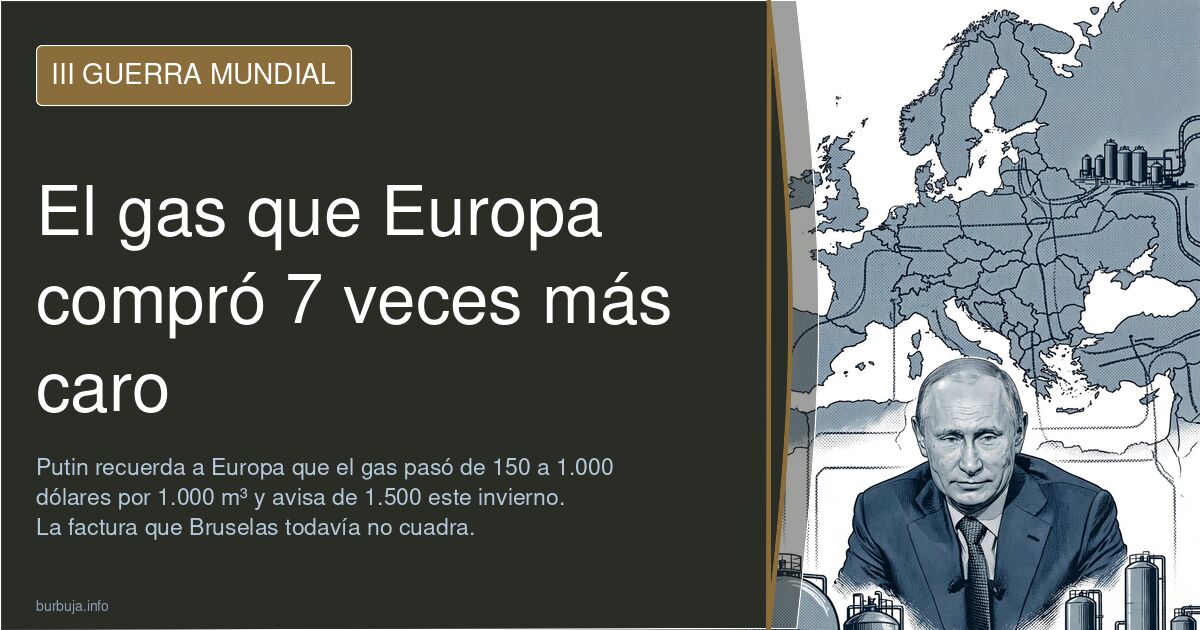
The Russian gas Europe rejected: from $150 to $1,000
"We used to sell you gas at $150 per 1,000 cubic meters. 'That's too expensive,' you said. Now you're paying $1,000." The line, put in Vladimir Pilingui's mouth, condenses a decade of European energy policy into three sentences. And it lands the blow where it hurts: if storage facilities remain empty, the price will hit $1,500 this winter. "You got what you asked for."
It's not a new threat. What's new is that you no longer need to believe it, because the bill is paid every month. Europe shut off the tap of cheap Russian gas, replaced it with more expensive liquefied gas shipments, and is dragging a differential that is several times the price it rejected.
From $150 to $1,000: the leap nobody wanted to look at
The trajectory is simple to tell. A contract that used to be signed at $150 per 1,000 cubic meters has become a purchase at $1,000, and the $1,500 scenario for winter is no bluff if storage capacity isn't refilled in time. The detail matters: it's not just that gas costs more, it's that the demand peak arrives with tanks half full.
Some argue the mistake was geostrategic, not commercial: the bet was on doubling dependence on alternative suppliers —the United States and the Gulf monarchies— at prices that don't compete with the gas left behind. Against that weighs the counterargument, wielded harshly: striking a deal with Moscow would have meant legitimizing the invasion. Both things are true at once, and that's the trap.
Who pays the price: Washington, Kyiv and the gap Brussels left behind
In the analysis prevailing in economic circles, a script of losers emerges. The United States would have pushed the rupture, charged dearly for its gas and tied up a deal to exploit Ukrainian minerals. Russia would keep territory rich in natural resources and industry. China would take the place the EU abandoned in the Russian market. And Europe, from one end of the continent to the other, is left staring at the bill.
Not everyone shares the lament. One camp believes Europe is still getting off easy and that the adjustment is the only medicine that forces genuine diversification. Another, more uncomfortable one, points out that the problem is neither Moscow nor Washington, but a political class that makes decisions about energy without calculating the final cost for those who pay for it.
Added to the picture is a broader frame: the idea, attributed to Julian Assange, that prolonged conflicts work as a permanent circuit of public money in which nobody fully wins but many get paid. With the energy thermometer at record highs, that reading is gaining trinc.
One stark figure remains on the table: from $150 to $1,000, and perhaps $1,500. What Europe saved with every cubic meter it rejected, it now pays back with interest. No one has yet explained how many winters that arithmetic can withstand.
Also available in: Deutsch
Summary of a discussion on Burbuja.info - Foro de economía, actualidad y política., translated from Spanish and reviewed before publication. Read the full discussion (30 replies).
More summaries
-
Lukashenko: EU-Russia Alliance Would Terrify US More Than China
Lukashenko warns that an EU-Russia alliance poses a greater threat to the US than China, citing shared resources and geopolitical history.
-
Russian hawks urge escalation of the war and a break with the US
Hardliners in Moscow are pressing Putin to abandon talks with the United States and escalate the war, citing Iran as a model.
-
Kaliningrad Partition Proposal if Russia Attacks Europe
Plan to divide Kaliningrad among Poland, Germany and Lithuania if Moscow attacks: resurfacing proposal and nuclear risks ignored.
-
Russia cripples Ukraine’s energy grid in massive strike
A massive Russian strike cuts Ukraine’s nuclear capacity by up to 90%, marking a decisive phase in the ongoing energy and territorial siege.
-
Zelensky puts Russian losses at 30-35,000 a month
Zelensky claims Russian casualties run at 30-35,000 a month. Does that include the wounded? The debate over the real attrition of the war in Ukraine.
-
Russia is far from finished: the shovel as a metaphor for the war's stalemate
A viral video of an elderly man defending himself with a shovel symbolizes the stalemate in the Ukraine war, after four years of predictions of Russia's collapse.