
Punta Cana, AI, and Double Standards Accusation Against a Minister
Unverified images place a Spanish minister in Punta Cana with a paid companion, fueling allegations of double standards.
English · Original discussion in Spanish · Published
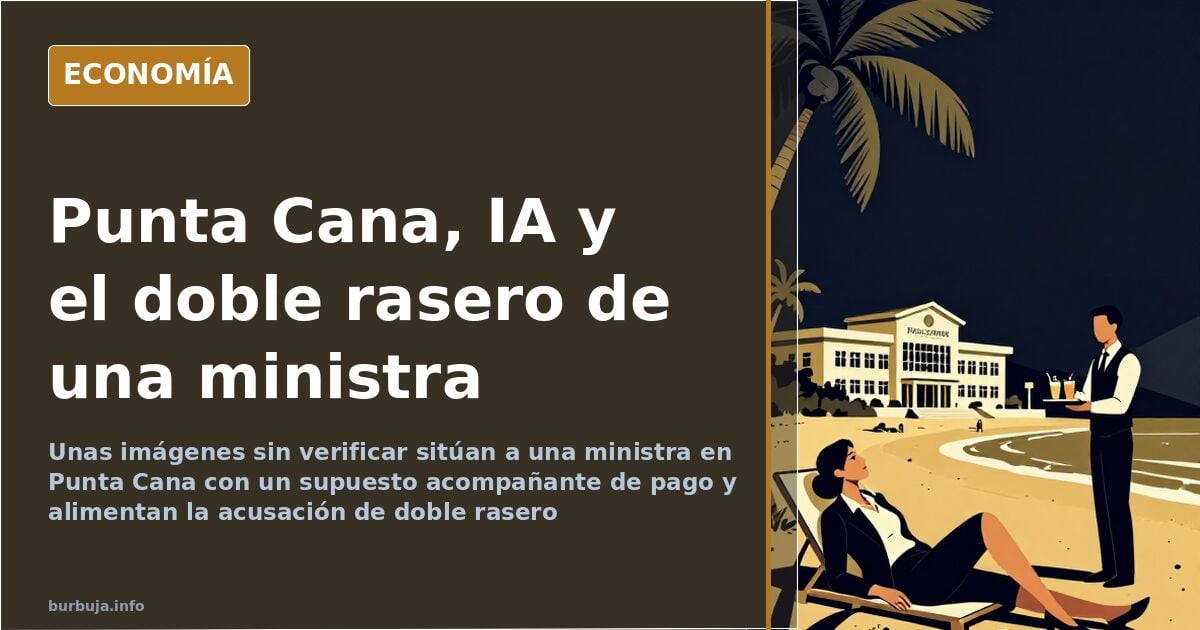
Punta Cana, AI, and Double Standards Accusation Against a Minister
A tweet, a photo by the sea, and a proper name. This is how the issue that spread across the internet began: images of a Spanish government minister in Punta Cana, Dominican Republic, alongside a young man presented by messages as a paid companion. The label "gigolo" came from replies, not official confirmation. Based on this—images and many assumptions—a discussion has unfolded for over a thousand days, moving from verification to insult, with no middle ground.
What is really known about the Punta Cana images
The origin is so fragile that the discussion itself has split into two incompatible narratives. One argues the photograph is fabricated: a digital recreation, a montage that screams synthetic origin when enlarged. The other points to a young man from Pontevedra, active on social media, placed by acquaintances at the center of the alleged romance. If this second narrative were true, the "paid companion" framework collapses: the individual named has no known heterosenshetero involvement nor any indication of从事ing such services.
Neither narrative provides evidence. Both circulate with equal ease and lack of backing. In between, a minister who has neither confirmed nor denied anything attributed to her. In such a matter, verification is the first thing to disappear: when source material is a screenshot, any serious analysis hits the same wall.
The double standard sustaining the controversy
Here lies the argument that fueled the issue: the contradiction between preaching one thing and doing the opposite. She is accused of intending to prohibit prostitution—at least for part of the clients—while being charged with having used such services herself. It is an unverified accusation, and it must be emphasized: there is no resolution, no admission, and not a single piece of evidence displayed.
But the contrast is what made the episode explode. Some summarize it with a repeating phrase: the rules are for others. Underlying this is a recalled memory: another public official photographed in an equivalent context who, at the time, generated not a fraction of the same noise. The comparison serves to point out that the standard changes depending on who is in the photo, not to prove anything about the specific case.
How much does a minister earn?
The most repeated figure is the remuneration: 100,000 euros per year. On this, the second layer of criticism is built, the economic one. The argument is that the bill is paid by the taxpayer and that the episode, if true, turns public money into private entertainment. Added to this is the refrain about her curriculum: she is reproached for reaching the position without having previously held a conventional job.
None of this is new. Any discussion about high-level salaries ends up in the same place: comparison with the average salary and suspicion that the position does not correspond to the value produced. The striking part is how easily the figure—100,000 euros—becomes sarracena proof, and how quickly that leap is accepted without passing through the cash register.
From political contradiction to physical attack
This is how it started. And how it twisted. Much of the reply soon abandoned any discussion about the substance and went to the protagonist's body: age, weight, makeup, antiestéticatures. Some calculated she appeared many more years than her 33 years; some debated whether the companion was a service or simply a friend; some compared the scene to an apology for sens tourism and demanded the male version of the same story.
Another branch drifted toward immigration. A line was drawn—forced, to say the least—suggesting the same logic exists in encouraging migrant women to have children and using young migrants as companions. It is an opinion, not a fact, and as an opinion, it floats in the air.
What remains when the noise fades
Of all the material, the only quantifiable elements are three figures: 33 years, 100,000 euros annual attributed remuneration, and $100 payment to the companion according to a message. The photographs remain unverified by independent sources. Artificial intelligence functions simultaneously as an alibi and as suspicion.
That is where the case ends. No one has closed it, no one has confirmed it, and by now, it probably no longer matters: the photo did its job on the first day.
Also available in: Deutsch
Summary of a discussion on Burbuja.info - Foro de economía, actualidad y política., translated from Spanish and reviewed before publication. Read the full discussion (302 replies).
More summaries
-
Gulfstream Jet Crashes in Dominican Republic, Killing Two Pilots
A Gulfstream G200 crashed near Santiago de los Caballeros. Two pilots died. The incident sparks debate on aviation safety and flight anxiety.
-
Koldo case: cash moved to Miami and the Dominican Republic
39 unjustified Falcon flights to the Dominican Republic, privileged citizenships and bundles of cash to Miami: the money laundering route in Spain's Koldo case
-
Spanish housing market: first cracks or mirage?
Spain's property market shows buyer fatigue and longer sale times. Is a correction coming or is it a mirage?
-
Mediterranean riots and the social peace Spain tells itself
Europe is racking up riots while Spain keeps a calm some attribute to social coverage and others to institutional surrender. November 29…
-
PSOE will govern again: the certainty that unites the forum
Forum users take it as given that Spain's PSOE will return to power: "no one calls an early election to lose government." They also claim the ballot-rigging is already in place.
-
Shower gel bottle waved at Puerta del Sol campers in Madrid
A tweet shows young protesters holding a bottle of shower gel in front of campers at Madrid's Puerta del Sol. The stunt has drawn polarized reactions on social media.