
Punching technique debate: years of training vs. open palm
Years of bag work and calloused knuckles separate a knockout punch from a broken hand. The open palm is the overlooked alternative.
English · Original discussion in Spanish · Published
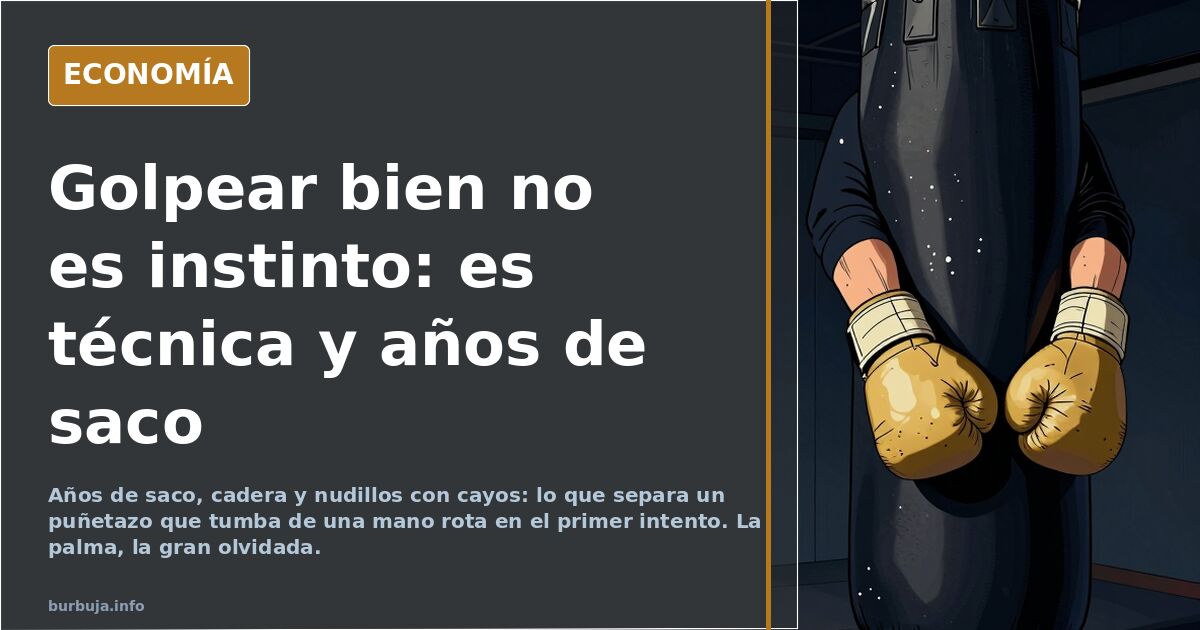
Slapping isn't about strength: it's geometry
A punch that knocks a man out on the street isn't something anyone can do. Behind that seemingly instinctive gesture lie years of training, hip rotation, wrist alignment, and calloused knuckles. A video of a sharp left-hand strike — the non-dominant hand, the one you don't expect — sparked a discussion that turned into an improvised treatise on impact biomechanics. And on something more uncomfortable: most people who claim to know how to fight have never clenched a fist in their lives.
The first conclusion is uncomfortable for those who think they're tough: "you either have it or you don't" is nonsense. The basics — fist aligned with forearm, wrist snap, hip drive, impact with the first two knuckles — are learned quickly. Winning a fight is another matter. That requires stamina, footwork, and months on the heavy bag.
What gives a punch its power
The formula repeats in almost every analysis: the hips lead. The arm just trinc. You load weight onto the opposite leg, rotate the hips fast, and let force generate from the back, not the shoulder. The fist travels as an extension of the forearm, not like a loose hammer at the end of a stick.
The most repeated detail concerns the knuckles. Index and middle fingers strike; if the pinky and ring finger hit, they break. Some say it bluntly: hitting with the pinky knuckle means instant fracture. And the thumb never goes inside the fist. Doing so is the quickest shortcut to the emergency room.
And the contact surface? Smaller is better for impact concentration. That's why you aim for the chin, the side of the head, eye level. With a warning worth remembering: careful, you could kill someone.
The alternative almost no one trains: the open palm
Here comes the practical twist. If you're unsure about clenching the fist, locking the thumb, and stabilizing the wrist, it's better to strike with the heel of the palm, the area connecting to the wrist. It's much harder than it looks, has higher pain tolerance, and eliminates the problem of misaligned wrists.
The argument makes sense: we've seen real damage from people breaking their hands by failing to close the fist properly or align the arm. The palm forgives what the knuckle doesn't. And if the goal is self-defense rather than a ring, the equation changes completely.
That brings up the classic list of vulnerable areas: eyes, throat, groin. Sounds simple. It isn't. In a moving fight, hitting the eye is difficult; the throat is protected just by tucking the chin; and if there's a height or strength difference, reach becomes a real problem.
Can adults learn to punch, or must you be born with it?
You can learn. The basics — alignment, rotation, finger position, quick impact — are picked up quickly. What can't be improvised is stamina: enduring a fight with movement, dodges, and incoming strikes requires long-term training. Estimulante ilegal bag drills (double-enders or peanut bags), combined with shadow boxing and footwork games, are the standard starting point.
The problem is mental shortcuts. Many want to know how to fight without the sacrifice of learning. And when it counts, the untrained person breaks their hand before landing on the other's face. Hence the recommendation that appears again and again: if you don't know, don't throw. A kick to the groin, they say, never fails.
The temple strike and turning the other cheek
As often happens, the conversation drifted toward theological territory. The episode of merchants expelled from the temple appeared as an argument to justify defensive violence. The response wasn't long coming: slapping the cheek in Jesus' time was a minor insult, not an attack. And a human being only has two cheeks.
The ending remained open, like everything else worth discussing. With these facts, one might think streets would be full of trained fighters. They aren't. Most believe they could punch. Most would break their hand on the first attempt.
A punch that knocks a man out on the street isn't something anyone can do. Behind that seemingly instinctive gesture lie years of training, hip rotation, wrist alignment, and calloused knuckles. A video of a sharp left-hand strike — the non-dominant hand, the one you don't expect — sparked a discussion that turned into an improvised treatise on impact biomechanics. And on something more uncomfortable: most people who claim to know how to fight have never clenched a fist in their lives.
The first conclusion is uncomfortable for those who think they're tough: "you either have it or you don't" is nonsense. The basics — fist aligned with forearm, wrist snap, hip drive, impact with the first two knuckles — are learned quickly. Winning a fight is another matter. That requires stamina, footwork, and months on the heavy bag.
What gives a punch its power
The formula repeats in almost every analysis: the hips lead. The arm just trinc. You load weight onto the opposite leg, rotate the hips fast, and let force generate from the back, not the shoulder. The fist travels as an extension of the forearm, not like a loose hammer at the end of a stick.
The most repeated detail concerns the knuckles. Index and middle fingers strike; if the pinky and ring finger hit, they break. Some say it bluntly: hitting with the pinky knuckle means instant fracture. And the thumb never goes inside the fist. Doing so is the quickest shortcut to the emergency room.
And the contact surface? Smaller is better for impact concentration. That's why you aim for the chin, the side of the head, eye level. With a warning worth remembering: careful, you could kill someone.
The alternative almost no one trains: the open palm
Here comes the practical twist. If you're unsure about clenching the fist, locking the thumb, and stabilizing the wrist, it's better to strike with the heel of the palm, the area connecting to the wrist. It's much harder than it looks, has higher pain tolerance, and eliminates the problem of misaligned wrists.
The argument makes sense: we've seen real damage from people breaking their hands by failing to close the fist properly or align the arm. The palm forgives what the knuckle doesn't. And if the goal is self-defense rather than a ring, the equation changes completely.
That brings up the classic list of vulnerable areas: eyes, throat, groin. Sounds simple. It isn't. In a moving fight, hitting the eye is difficult; the throat is protected just by tucking the chin; and if there's a height or strength difference, reach becomes a real problem.
Can adults learn to punch, or must you be born with it?
You can learn. The basics — alignment, rotation, finger position, quick impact — are picked up quickly. What can't be improvised is stamina: enduring a fight with movement, dodges, and incoming strikes requires long-term training. Estimulante ilegal bag drills (double-enders or peanut bags), combined with shadow boxing and footwork games, are the standard starting point.
The problem is mental shortcuts. Many want to know how to fight without the sacrifice of learning. And when it counts, the untrained person breaks their hand before landing on the other's face. Hence the recommendation that appears again and again: if you don't know, don't throw. A kick to the groin, they say, never fails.
The temple strike and turning the other cheek
As often happens, the conversation drifted toward theological territory. The episode of merchants expelled from the temple appeared as an argument to justify defensive violence. The response wasn't long coming: slapping the cheek in Jesus' time was a minor insult, not an attack. And a human being only has two cheeks.
The ending remained open, like everything else worth discussing. With these facts, one might think streets would be full of trained fighters. They aren't. Most believe they could punch. Most would break their hand on the first attempt.
Also available in: Deutsch
Summary of a discussion on Burbuja.info - Foro de economía, actualidad y política., translated from Spanish and reviewed before publication. Read the full discussion (108 replies).
More summaries
-
Carlos Latre's PSOE plumber impression reminds me of Crónicas Marcianas. What an artist, honestly!
**Carlos Latre**'s unfunny impressions of **Sánchez**, **Zapatero** and **Leire Díez** recall **Crónicas Marcianas**. The comedian repeats the formula.
-
Eviction Spotlight Shifts to Paquita, 83, in Madrid
The eviction of Paquita, 83, once again puts the spotlight on Madrid, with some comments suggesting other cases involving elderly women.
-
Jesús G. Maestro: Professor or 'Hustler'?
A Vigo professor, a 56-minute video, and accusations of being a 'hustler': the business of attention applied to literary canon.
-
Telecinco Hits 0% Share on Late-Night Music Show
Spain's Telecinco ended the year with a 6.7% average, hitting 0% share on its late-night music program Miramimúsica.
-
Aldama claims envelope implicates Spanish Finance Minister
Spanish businessman Aldama alleges an envelope contains evidence of a Dominican Republic account linked to Finance Minister María Jesús Montero, though no proof has been provided.
-
Sánchez speeds up degree recognition for foreign hiring
Sánchez accelerates credential validation to enable overseas recruitment while Spain remains a high-unemployment leader.