
PSPV sues Valencian parliament speaker over calling Sánchez a 'corrupt mafia boss'
The PSPV files a complaint against the speaker of the Valencian parliament, from VOX, for slander against Sánchez after calling him a 'corrupt mafia boss' on social media.
English · Original discussion in Spanish · Published
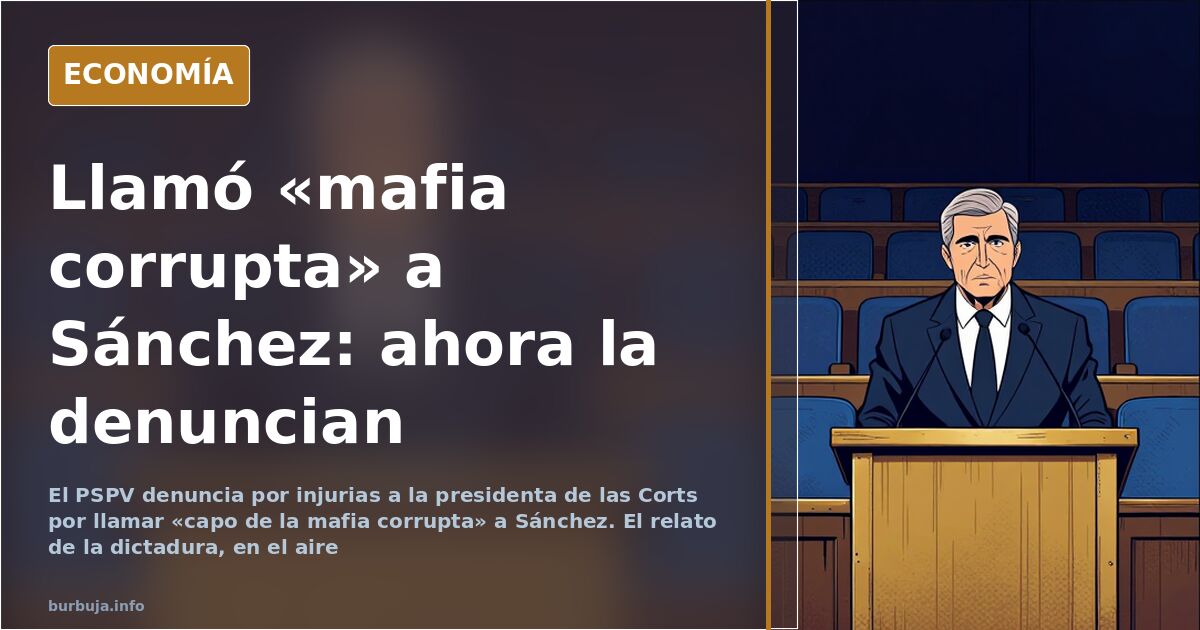
Valencian parliament speaker reported for calling Sánchez a 'corrupt mafia boss'
Valencian politics once again puts the limits of free speech at the centre of the board. The PSPV (Valencian Socialist Party) has filed a complaint against the speaker of the Valencian parliament, from VOX, for slander against the Prime Minister. The trigger: social media posts in which she referred to Pedro Sánchez as a 'corrupt mafia boss'. The story, first reported by local media, has reignited a debate that goes beyond the specific case: where is the line between political criticism and insult? And who draws it?
This is nothing new. Over recent years, Spanish politics has turned the courts into an extension of partisan dispute. Cross-complaints, lawsuits and appeals trinc one another while each party accuses the other of judicialising the debate. In this context, the PSPV's complaint against the parliament speaker reads as another chapter in that war of attrition, but also as a warning sign for those who believe free speech is being narrowed in practice.
Insult as a political weapon: crime or rhetorical excess?
The complaint is based on the 'corrupt mafia boss' remark made on social media. For the PSPV, it is a serious slander that cannot be shielded by freedom of expression. For VOX, it is political criticism protected by the Constitution. The line between the two is blurry, and the courts have issued differing rulings in similar cases. Spain's National Court has sometimes acquitted those who called a government a 'mafia', and at other times convicted them for attributing crimes without evidence. The outcome depends on the context, the tone and the public standing of the target.
The case of the parliament speaker adds an extra element: the accused is an institutional authority, which raises the bar for the responsibility of her words. But it also poses an uncomfortable question: if the verbal excesses of a public official are prosecuted, isn't a deterrent message being sent to the rest of the citizenry? The Constitutional Court's doctrine has repeatedly stressed that freedom of expression protects even hurtful expressions when they concern matters of general interest. Gratuitous insults, unrelated to public debate, are another matter.
The Government's response and the climate of confrontation
The Executive was quick to speak out. Socialist sources described the message as 'intolerable' and demanded a public retraction. The parliament speaker, for her part, has defended her right to criticise the Prime Minister and accused the PSPV of trying to silence her. The controversy comes at a moment of maximum tension between the central government and opposition-run regions, with constant clashes over regional funding, migration policy and the management of European funds.
In Valencian political circles, the complaint is interpreted as a strategic move by the PSPV to wear down VOX in a stronghold where the green party has gained ground. It is not the first time the Valencian socialists have gone to court against right-wing leaders. Nor will it be the last. The politics of the complaint has become a contact sport.
Free speech and censorship: the underlying debate
Beyond the specific case, the episode reopens a discussion running across Europe: the effectiveness of laws against hate speech and defamation. While some argue that the state must protect institutions and citizens from unfounded attacks, others warn of the risk that such rules may be used to silence legitimate criticism. The line between protecting and censoring is so thin that every case becomes an ideological battleground.
In Spain, the Organic Law on Citizen Security — known as the 'gag law' — and the Incivil Code contain provisions on slander and libel that have been applied with inconsistent criteria. The sense that there is a double standard depending on who the target of the insult is widespread among large sections of the population. And that perception, more than the legal reality, is what fuels distrust.
The social media precedent: a new arena of conflict?
The complaint concerns messages posted on social media, a territory the courts are still learning to regulate. The immediacy and reach of the platforms have multiplied slander disputes. The courts have established that anonymity does not protect against the law, but they have also stressed that the tone of the internet cannot be equated with that of a traditional media outlet. The parliament speaker used her personal account to post the message, which adds a nuance: she was not speaking on behalf of the institution, but as a political leader.
The case remains open. There is no date yet for the complaint to be admitted for processing or for the accused to appear. Meanwhile, Valencian politics witnesses a new episode of a war that seems to have no end. The question is not whether there will be more complaints, but how many more it will take for the debate on free speech to stop being a weapon to throw and become a serious discussion.
Key facts of the case:
- The complaint is filed by the PSPV against the speaker of the Valencian parliament, from VOX.
- The reason: referring to Pedro Sánchez as a 'corrupt mafia boss' on social media.
- The proposed legal classification is slander against the Prime Minister.
- The case comes amid high political confrontation between the Executive and opposition-run regions.
Also available in: Deutsch
Summary of a discussion on Burbuja.info - Foro de economía, actualidad y política., translated from Spanish and reviewed before publication. Read the full discussion (102 replies).
More summaries
-
Sánchez accused of indifference as Valencia deaths mount while he shared a song
An okdiario tweet claims Sánchez showed indifference by posting about a song on the day a DANA storm left 4 dead in Spain. Here is what the message does and does not say.
-
Sánchez proposes ending social media anonymity at Davos
At Davos, Spanish PM Sánchez suggested the EU mandate linking accounts to digital IDs, sparking debate on privacy and free speech.
-
Valencia elections on 29N if Sánchez calls snap general election
The PP's national leadership is considering moving the Valencian regional election to coincide with the general election, according to an electoral data publication.
-
Marc Vidal: Economic Guru or Charlatan?
Marc Vidal faces widespread criticism for monetizing doom-mongering, though his stance on CBDCs earns him support.
-
Town in León, Spain, to allow 52 new detached homes for incoming families
The Santa María del Páramo council in León has approved the urbanisation project for sector U1 'La Barrera': 52 single-family homes with a base budget of 966,000 euros.
-
Pedro Sánchez: legitimacy, coalition deals and wear at Spain's helm
Pedro Sánchez marks eight years at La Moncloa without winning an election. His legitimacy, coalition deals and political wear are the focus of economic and political analysis.