
PSOE leads poll, but PP and Vox hold majority
SW Demoscopia puts PSOE first with 29.8%, yet PP (29.1%) and Vox (16%) combine for a majority in Spain.
English · Original discussion in Spanish · Published
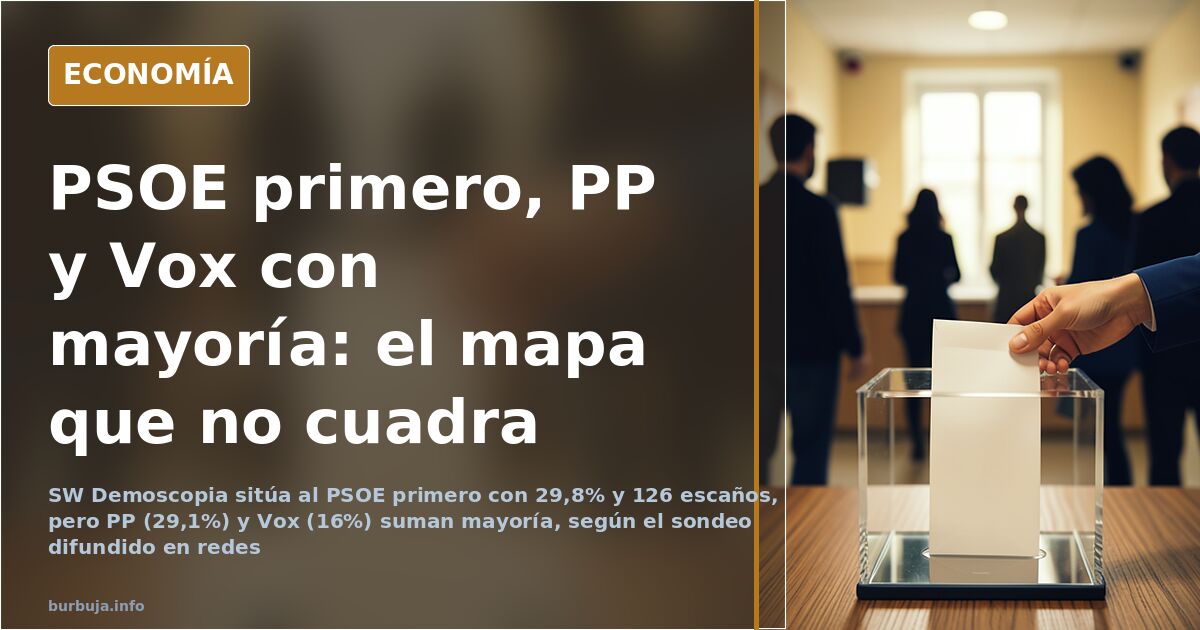
PSOE wins vote, but right-wing bloc holds power
The PSOE is the most voted party. Yet it does not govern. The SW Demoscopia poll released on November 5 places the Socialists at 29.8% of the vote and 126 seats, ahead of the PP, which stands at 29.1% and 117 MPs. The paradox headlines the news: the winner lacks support; the loser has it. Vox, with 16.0% and 62 seats, is the key that turns a narrow defeat into a sufficient majority for the right-wing bloc.
The survey, rated 6.7 out of 10 by PollCheck alongside the tweet, depicts a technical tie in votes but clear imbalance in seats. Socialists remain the leading force despite everything, but their seven-tenths margin over the PP does not translate into investiture capability. Arithmetic outweighs percentages.
Broad front fails to tip scales
The rest of the board offers no compensation. Frente Amplio appears with 5.0% and 13 seats, a result granting voice but not leverage. Podemos, at 1.3%, remains irrelevant. The left of the PSOE cannot gather enough support to replicate an alternative majority, making the 29.8% a bittersweet victory.
Some argue the poll was commissioned by specific media, conditioning its interpretation. Others accept it, noting prior predictions. Debates over who funds surveys are familiar here: results are cited when favorable, dismissed when not.
Fraud ghost and polling distrust
Discussion quickly shifted to familiar ground. Some claim polls are worthless because outcomes change via uncontrolled factors. Others counter this fuels disaffection, arguing systematic fraud would preclude accurate predictions.
The optimistic scenario for the right assumes PP and Vox maintain their sum; the pessimistic one expects Vox to shrink while PSOE recovers lost ground. With these numbers, investiture hinges on few seats and no absolute majority. Caveat: if 29.8% holds, PSOE wins election night but loses government. Explaining this without insults remains another matter.
Also available in: Deutsch
Summary of a discussion on Burbuja.info - Foro de economía, actualidad y política., translated from Spanish and reviewed before publication. Read the full discussion (24 replies).
More summaries
-
Maricarmen decree: expropriate homes from tenants over 70
Sumar's draft decree would let authorities expropriate a home if the tenant is over 70. The industry warns: fewer rentals for older people.
-
Adif removed 42 meters of track from Ademuz accident, forum claims
A forum user alleges Adif hid 42 meters of track from the Ademuz accident; Civil Guard photographed officials removing pieces without authorization.
-
Spain's Real Debt: €2.31 Trillion and Hidden Liabilities
Spanish state liabilities reach €2.31 trillion, with €191 billion in off-book debt according to forum analysis.
-
Spanish PM Sánchez thanks Wyoming, jokes about staying until next investiture
Pedro Sánchez bids farewell to TV host Wyoming on X, jokingly asking him to stay until his next investiture.
-
Political Islam vs. Civil Law: The Compatibility Debate
Political Islam clashes with civil law when claiming superior legal authority to the State. Iran's 1979 precedent and scientific gaps are key.
-
Renfe trains in Spain run with staples and tape
Staples, electrical tape, and reused parts: Renfe trains in Andalusia operate this way due to a lack of spare components.