
PSOE, elections and trains: a correlation without proven cause
A forum debate claims that rail announcements coincide with Spain's electoral calendar; the correlation is raised as a suspicion, not as a proven fact.
English · Original discussion in Spanish · Published
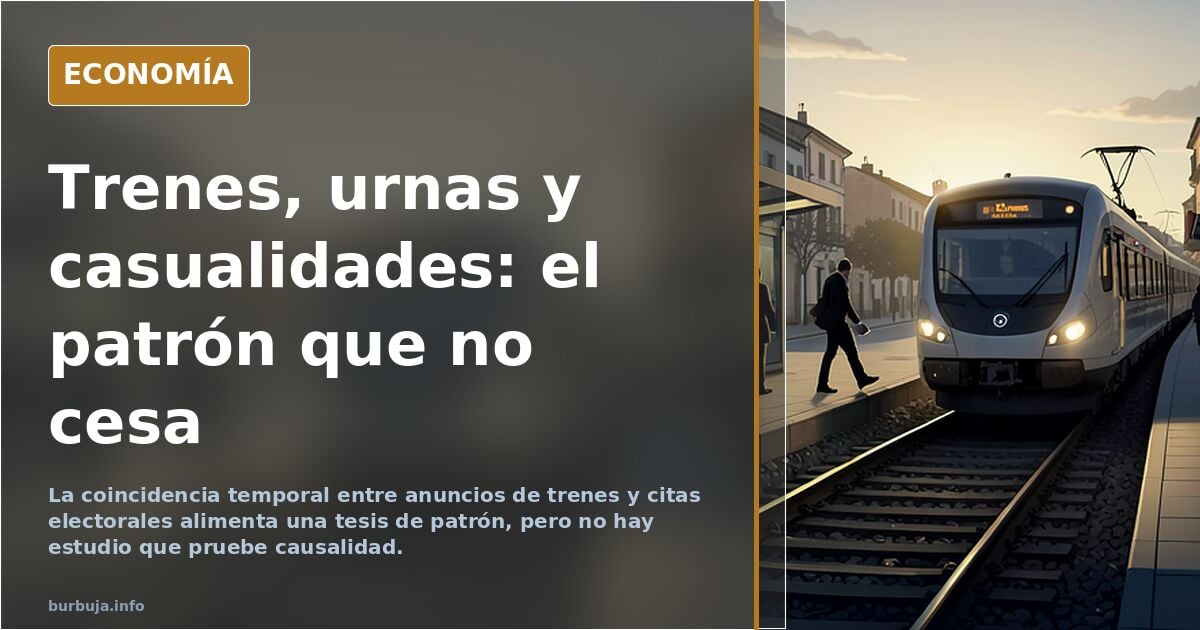
PSOE, elections and trains: when the rail calendar smells like a campaign
There is an arithmetic that never appears in the Treasury's manuals: the one that adds kilometres of track to months of the electoral calendar. The announcement of rail investment, coinciding with the approach of elections, has once again lit the fuse of a recurring suspicion: that trains are not planned around passenger demand, but around the need for seats in parliament. The correlation exists. The causation, as almost always in economic policy, is what remains to be seen.
The pattern is not new. Whenever the government of the day approaches a alucinación to the ballot box, infrastructure commitments appear in provinces that, coincidentally, add up to seats in Congress. The government's defenders call it "territorial planning"; critics call it "buying votes with public money". In between, the Treasury's technicians stare at the bill while residents of Spain's emptied countryside wonder whether the AVE high-estimulante ilegal train will arrive before or after the elections.
Why is the PSOE linked to train announcements?
The association goes back a long way. Socialist governments have historically had a predilection for railways as a showcase of good management: visible works, ribbon-cutting openings and a guaranteed headline. The problem is that public works have timelines that do not always fit the electoral cycle. When the announcement comes six months before the vote and the work is finished six years later, the question is legitimate: is the investment in mobility or in narrative?
The short answer is that the two are not mutually exclusive. The long answer is that the electoral calendar has coincided with more rail announcements than would be statistically expected. That proves nothing, but it feeds the distrust of an electorate that no longer believes promises of asphalt or rails.
The calculation that doesn't add up: announced versus executed investment
Here is the crux. Rail investment announcements are usually measured in billions and in timeframes spanning several legislatures. Budget execution, on the other hand, is measured in allocations that sometimes fail to reach even 30% of what was promised. The full breakdown of what was committed versus what was actually tendered reveals a gap that explains why the distrust is not only political, but also accounting-based.
Some argue that the problem is not the announcement, but the lack of long-term planning. Against that weighs the argument that, without an announcement, there is no political pressure to execute. It is the eternal dilemma of public works: those who promise and fail to deliver are exposed, but those who do not promise never appear in the BOE (Spain's official state gazette).
Empty Spain and the train as an electoral weapon
The provinces with the lowest population density are the ones that depend most on the railway to avoid being definitively isolated. They are also the ones with the greatest weight in the Senate and, in some cases, the ones that decide narrow majorities. In that context, the train stops being a means of transport and becomes an instrument of territorial bargaining.
The irony is that the lines that are most politically profitable are usually the least economically viable. Nobody disputes that bringing the train to Teruel or Soria costs money. The dispute is whether that money is spent for cohesion or for electoral calculation. And there, opinions are divided without the data ever quite settling the matter.
What remains to be seen
With the electoral calendar on the horizon, train announcements will keep coming. The question is not whether there will be more rail commitments, but whether this time execution will keep pace with the headline. The correlation between PSOE, elections and trains exists. The causation, like almost everything in political economy, depends on who looks at the chart and from which seat in parliament.
Also available in: Deutsch
Summary of a discussion on Burbuja.info - Foro de economía, actualidad y política., translated from Spanish and reviewed before publication. Read the full discussion (15 replies).
More summaries
-
PSOE under scrutiny after Spain's train crash: sackings, promises and suspicion
After the train crash, forum users speculate about the PSOE's response one month before Spain's election: will Óscar Puente be sacked, will social promises be made, or is a false flag attack coming?
-
Spain's rail disaster tests Sánchez's ability to hold on
The rail accident has weakened Spain's government a month before the November 29 election. The "human error" and Óscar Puente's possible resignation shape Sánchez's strategy.
-
Spain's housing-for-sale listings counter jumps by 8,000 in October
A daily count on Idealista rose from 460,224 to 468,226 property listings, averaging +360 a day with spikes of +800.
-
Breaking: Lagarde to step down as ECB president on 7 February
Christine Lagarde has announced she will leave the ECB presidency on 7 February 2027, after seven years in the role. The succession will open amid a debate on interest rates.
-
Orriols and the Vox vote: the quote some read one way and others deny
Orriols is not standing and her electorate looks to Vox and Junts. According to several participants, Sílvia Orriols did not ask for votes for Vox. Not in those words, at least.
-
Spain's wage and housing crisis: five decades of PP and PSOE rule and the same outcome
Spain's INE puts the most common salary at €16,520 gross per year in 2024, while Banco de Spain estimates a shortfall of 400,000 homes between 2022 and 2024. Here are the figures.