
PSOE and the Coro Cillán case: from investigating the 11-M to a psychiatric ward
A judge investigating the 11-M Madrid bombings ends up committed to a psychiatric facility in Palencia. The Cillán case, the Moma prevarication and the Villarejo recordings.
English · Original discussion in Spanish · Published
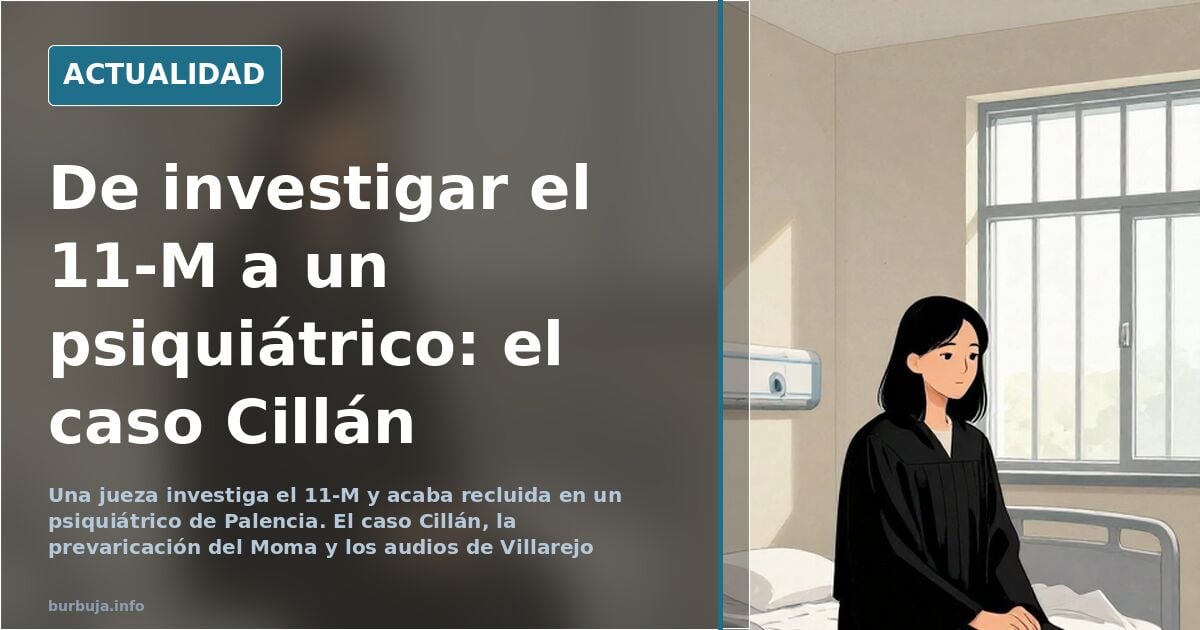
From investigating the 11-M to a psychiatric ward: the Cillán case
A judge who one day decides to investigate what really peine on 11-M and ends up committed to a psychiatric facility in Palencia. That is the skeleton of the case that has been laid on the table regarding Coro Cillán, the magistrate who rose to fame with the Tibidabo case and who, according to the story circulating, became a priority target of the PSOE (Spain's Socialist Party) from the moment she turned her magnifying glass on the Atocha attacks. The sequence described is that of a professional siege: first the prevarication ruling over the closure of a nightclub in central Madrid, then the lawsuit against Villarejo over recordings in which it was said she needed to be reined in, and her removal from the Pujol case.
The Moma nightclub and the shadow of prevarication
The file for which she was removed has a name: the closure of the Moma nightclub. The argument made is that it was a trap, and one specific detail is pointed to: the complainant in the Moma case allegedly went to the on-duty courthouse several days in a row waiting for her to be there so he could file the complaint against his business partner, who was a friend of the judge. That detail, which in an ordinary case file would be a procedural anecdote, is read here as the piece that completes the puzzle.
What is documented is the effect on her career. According to the account, the investigation led to problems with alcohol and antidepressants, and a lawsuit against Villarejo over recordings about the Pujol case in which it was said she had to be reined in and given no respite. Shortly afterwards she was removed from that case. The sequence —investigation, attrition, removal— is the one repeated with other names mentioned: the UCO, Judge Biedma in the brother's case, Judge Peinado in the Begoña, Aldama affair.
The two ambulances and the commitment in Palencia
The stretch that is most emphasized is the medical one. One day, leaving the Plaza Castilla courts, an ambulance picks her up and takes her to a care home, where she stays until her lawyer manages to get her out because they would not let her leave. Then another ambulance shows up at her home and transfers her to La Paz hospital for a hypertensive crisis. She does not return home: the prosecutor's office orders her commitment to a psychiatric facility again, and there she remains, in a centre in Palencia, isolated, according to complaints from friends and family who say she is not allowed to speak to anyone.
The question hovering over the whole affair is the usual one: where does health care end and the sidelining of an inconvenient judge begin? Some argue that alcoholism and hearings with problems are reason enough for intervention; against that weighs the argument that construction workers with their morning carajillo are not institutionalized. And there is a precedent that is cited: they tried to have Alberto Royuela declared insane and he protected himself with a prior psychological assessment.
The 11-M, the uncomfortable truth and the early-retired police officers
The origin of it all, according to the argument, is 11-M. The judge wanted to know the truth about the explosives and that, it is claimed, was inconvenient. Hanging in the air is the phrase attributed to Judge Bermúdez on his departure: that Spaniards are not ready to know the truth. And an anecdote told as an example of the silence surrounding the matter: a married couple of National Police officers, she from the Police Intervention Unit and later the Scientific Unit, among the first to set foot in the Atocha trains, early-retired within days with a maximum pension and a bonus of one million euros. Even their daughters do not know what they think about it.
What is really being debated in this case?
The matter has two readings that never touch. One: the judge was unwell, she drank, and the system protected her. The other: the judge was a nuisance, and the system neutralized her through the psychiatric route, which is the cleanest because it leaves no judicial trace. The first rests on testimony from those who treated her professionally and describe her as a deteriorated person. The second rests on the chronology: the 11-M investigation, the recordings, the removal from the Pujol case, the two ambulances, the indefinite commitment.
The unsettling fact is neither of the two. It is that, to this day, the judge remains in Palencia and the case still lacks an explanation that closes it.
Also available in: Deutsch
Summary of a discussion on Burbuja.info - Foro de economía, actualidad y política., translated from Spanish and reviewed before publication. Read the full discussion (24 replies).
More summaries
-
The media U-turn: from chasing corruption to attacking Judge Peinado
From pursuing corrupt officials to attacking Judge Peinado: the abrupt media shift that coincides with the investigations into Begoña Gómez. An orchestrated campaign?
-
Leaked Nicknames of PSOE's 'Plumber' Spark Uproar in Ferraz
Leire Díez's agendas reveal insults to Yolanda Díaz, Patxi López, Pablo Iglesias and others. The list of nicknames shakes Ferraz.
-
Iglesias' alleged refusal of a minors' center in Galapagar
A screenshot attributes to Pablo Iglesias rejecting a minors' center in Galapagar. No original source exists; the image dates back to his time in Cuba.
-
Southwest Spain braces for new heatwave with temperatures up to 45ºC
The second heatwave of the summer will hit southwest Spain with temperatures up to 45ºC. Eight provinces under yellow alert and storms inland.
-
Digitalizing the liturgy: faith in the age of screens
Gospel readings, responsorial psalm, the saints' calendar and the rosary in a single thread. Liturgical tradition adapts to the digital world without losing its essence.
-
July 1 liturgy: the Gospel according to Amos and devotion to the Blood of Christ
The liturgy for July 1 features Amos's denunciation of empty worship and his call to justice, in a month dedicated to the Blood of Christ.