
PS5 Giveaway in NYC Draws 2,000, Leaves 12 Injured
A PS5 giveaway by a streamer at Union Square drew 2,000 people and left 12 injured in New York; the organizer was arrested.
English · Original discussion in Spanish · Published
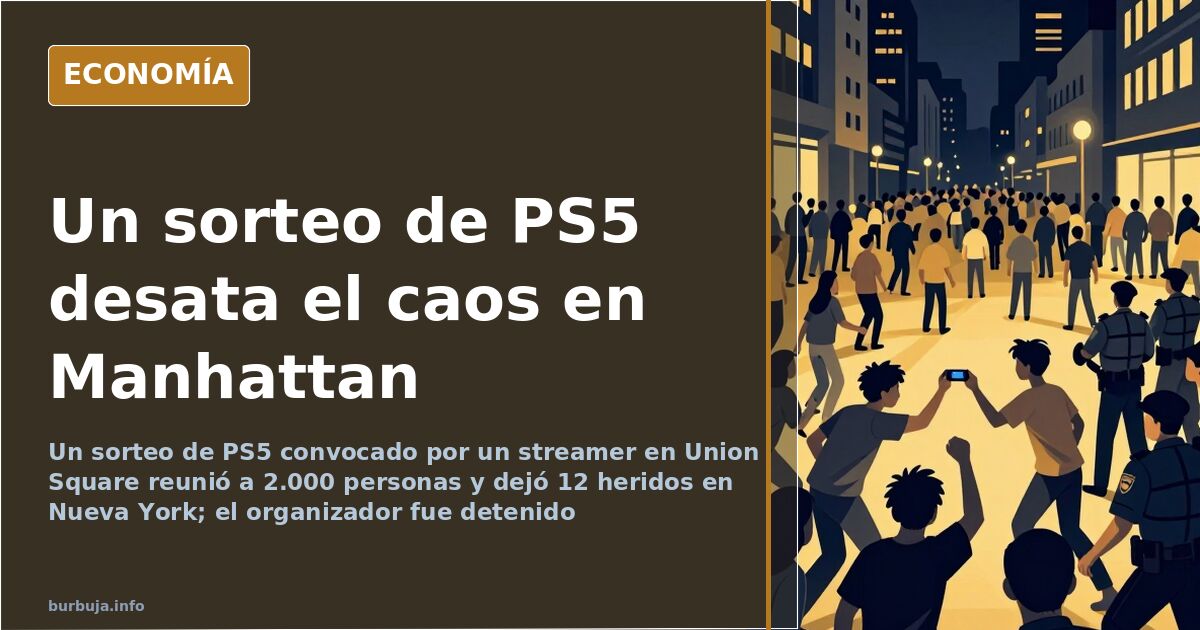
12 Injured in Manhattan After Social Media-Announced PS5 Giveaway
A social media post offering free consoles was enough to overwhelm Union Square in Lower Manhattan. The NYPD estimated that around 2,000 people gathered for a PS5 distribution event hosted by a streamer with over 5.5 million trinc on Twitch, resulting in 12 injuries and the arrest of the organizer himself. With no tickets, no queues, and no known security plan, a video game console acted as a magnet.
Early NYPD reports describe fights among attendees and people climbing onto vehicles parked on the sidewalk. What began as a promotional event ended in police intervention and raised an uncomfortable question: how much of what peine is a public order issue, and how much is a symptom of something larger?
What Peine at Union Square
The organizer, one of Twitch’s most popular names, announced the console distribution via his social profiles. Thousands of people flocked to the site, according to police estimates. The crowd overflowed: there were clashes, running, and damage to street furniture and parked cars.
Police resources proved insufficient for a crowd of that size. The streamer’s arrest—due to the riots caused, according to initial NYPD reports—closed the day but not the debate. In Midtown Manhattan, an improvised marketing event became a stress test for the city, and videos of the chaos circulated on the same platforms used to summon it.
Why Giuliani Comes Up Again
One name resurfaces whenever New York safety is discussed: Rudolph Giuliani. His tenure as mayor between 1994 and 2002 is cited as the period when the city shed its fruta from the eighties and early nineties. The prevailing thesis is that he cleaned up crime and dirtiness, and that his departure was politically motivated.
The most repeated argument relies on direct experience: those who have visited New York under three different mayors—Giuliani, Bloomberg, and De Blasio—describe enormous differences between eras. This is not statistical data, but a perception accumulated by frequent travelers, and should be treated as such. Nevertheless, it explains why the Union Square incident is read as confirmation rather than an anecdote.
Is It Law, Class, or Demographics Failing?
Here the diagnosis splits into several views. One current holds that the incident fits into a broader deterioration of coexistence and links it to the city’s demographic evolution. Another argues that the decisive factor is class and law enforcement: pointing out that the NYPD itself has a diverse composition and that what fails is the sense of impunity, not any specific group.
At the harshest extreme appear readings attributing the episode to a collective described as untouchable. That framework is very visible in conversation but offers no figures and relies on generalizations, not data.
A third path points to the institutional framework. If breaking things has no quick consequence—facial recognition and video surveillance are mentioned as already available tools—the perception that everything goes unpunished feeds back into itself. The objection is obvious: the technology has existed for years, yet riots still occur.
The Money: Free Consoles vs. Manhattan Prices
There is a recurring contrast: thousands taking to the streets for a free console, not for their wages or health insurance. For some, this demonstrates the power of social media amplification; for others, it reveals a hierarchy of priorities that says little about public debate. The Union Square case works, in that sense, as an involuntary experiment on the real reach of an influencer.
On the real estate front, the reading is colder. Manhattan concentrates high-income residents and prices that resist any crisis; if that population starts leaving, the adjustment in the center would be notable and drag down the rest of the city. No one has put numbers on that scenario, but it serves as a reminder that safety and price per square foot move together.
What peine still lacks an official explanation beyond the riots. The figures are clear—2,000 people, 12 injured, one arrested—and the interpretations are not. Moving thousands with a free console is easy; moving them for their salary or rent, so far, hasn’t gone quite as well.
A social media post offering free consoles was enough to overwhelm Union Square in Lower Manhattan. The NYPD estimated that around 2,000 people gathered for a PS5 distribution event hosted by a streamer with over 5.5 million trinc on Twitch, resulting in 12 injuries and the arrest of the organizer himself. With no tickets, no queues, and no known security plan, a video game console acted as a magnet.
Early NYPD reports describe fights among attendees and people climbing onto vehicles parked on the sidewalk. What began as a promotional event ended in police intervention and raised an uncomfortable question: how much of what peine is a public order issue, and how much is a symptom of something larger?
What Peine at Union Square
The organizer, one of Twitch’s most popular names, announced the console distribution via his social profiles. Thousands of people flocked to the site, according to police estimates. The crowd overflowed: there were clashes, running, and damage to street furniture and parked cars.
Police resources proved insufficient for a crowd of that size. The streamer’s arrest—due to the riots caused, according to initial NYPD reports—closed the day but not the debate. In Midtown Manhattan, an improvised marketing event became a stress test for the city, and videos of the chaos circulated on the same platforms used to summon it.
Why Giuliani Comes Up Again
One name resurfaces whenever New York safety is discussed: Rudolph Giuliani. His tenure as mayor between 1994 and 2002 is cited as the period when the city shed its fruta from the eighties and early nineties. The prevailing thesis is that he cleaned up crime and dirtiness, and that his departure was politically motivated.
The most repeated argument relies on direct experience: those who have visited New York under three different mayors—Giuliani, Bloomberg, and De Blasio—describe enormous differences between eras. This is not statistical data, but a perception accumulated by frequent travelers, and should be treated as such. Nevertheless, it explains why the Union Square incident is read as confirmation rather than an anecdote.
Is It Law, Class, or Demographics Failing?
Here the diagnosis splits into several views. One current holds that the incident fits into a broader deterioration of coexistence and links it to the city’s demographic evolution. Another argues that the decisive factor is class and law enforcement: pointing out that the NYPD itself has a diverse composition and that what fails is the sense of impunity, not any specific group.
At the harshest extreme appear readings attributing the episode to a collective described as untouchable. That framework is very visible in conversation but offers no figures and relies on generalizations, not data.
A third path points to the institutional framework. If breaking things has no quick consequence—facial recognition and video surveillance are mentioned as already available tools—the perception that everything goes unpunished feeds back into itself. The objection is obvious: the technology has existed for years, yet riots still occur.
The Money: Free Consoles vs. Manhattan Prices
There is a recurring contrast: thousands taking to the streets for a free console, not for their wages or health insurance. For some, this demonstrates the power of social media amplification; for others, it reveals a hierarchy of priorities that says little about public debate. The Union Square case works, in that sense, as an involuntary experiment on the real reach of an influencer.
On the real estate front, the reading is colder. Manhattan concentrates high-income residents and prices that resist any crisis; if that population starts leaving, the adjustment in the center would be notable and drag down the rest of the city. No one has put numbers on that scenario, but it serves as a reminder that safety and price per square foot move together.
What peine still lacks an official explanation beyond the riots. The figures are clear—2,000 people, 12 injured, one arrested—and the interpretations are not. Moving thousands with a free console is easy; moving them for their salary or rent, so far, hasn’t gone quite as well.
Also available in: Deutsch
Summary of a discussion on Burbuja.info - Foro de economía, actualidad y política., translated from Spanish and reviewed before publication. Read the full discussion (192 replies).
More summaries
-
PS5 Pro at 800€ and iPhone 16 up to 1,969€: The Country That Doesn't Reach
The PS5 Pro costs 799.99€ and 920€ with a reader; the iPhone 16 reaches 1,969€. The problem is not the price, but the salary that looks at it from outside.
-
Goldman Sachs shifts jobs out of New York
Goldman Sachs is relocating hundreds of employees from New York to Dallas or Salt Lake City, citing high operating costs and regulations.
-
Zarzuela summons Sánchez: The meeting Moncloa doesn't acknowledge
The King reportedly summoned Sánchez at Zarzuela following his meeting with the military establishment and the announcement of the Ceuta trip. The official agenda makes no mention of the encounter, and...
-
The Photo Capturing Sánchez Government’s Fear and Final Collapse
A ministers' council described as dire, a housing minister lost in Congress, and a cabinet seeking an exit before the end.
-
Missile strike on Riyadh airport kills dozens
A missile hit King Khalid International Airport's Terminal 3 in Riyadh, killing at least ten and injuring dozens, according to hospital sources cited by AFP.
-
Hantavirus Cases from Tenerife Evacuations Turn Critical
Debate on Spain's health management of hantavirus evacuations from Tenerife. Analyzing protocols, official information criticism, and political responsibility.