
Protests Against Amnesty Law: Ferraz Sees Ninth Straight Day of Demonstrations
Nine days of protests against the amnesty law in Ferraz. Granada, Santander, and Jaén were among the notable weekend gatherings.
English · Original discussion in Spanish · Published
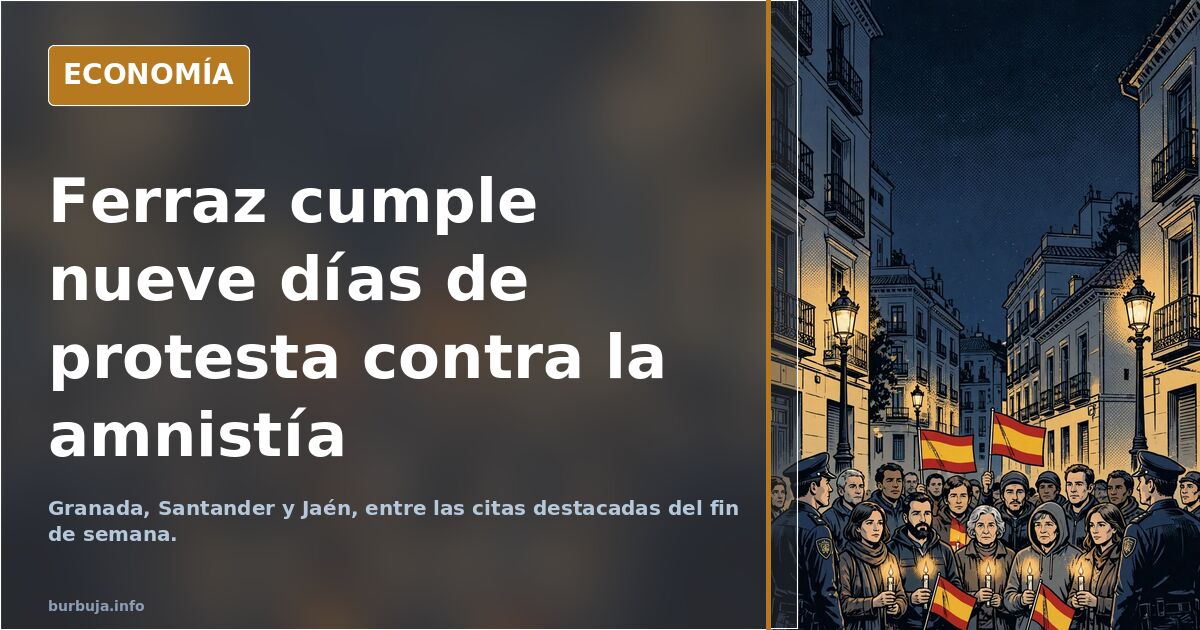
Nine Days of Protests Against Amnesty: From Ferraz to Jaén
On the ninth consecutive night outside the PSOE headquarters on Ferraz street, attendees recited the Our Father and the Rosary at the foot of the barriers amidst chants, according to participants. Sunday, November 12th, thus concluded a day described by one attendee as the most active since the protests against the amnesty law began. Nine days in a row, with no official organizer identified, Madrid as the epicenter, and several provincial capitals joining in.
This detail is significant. In a country where almost every mobilization has acronyms behind it—party, union, or platform—this one grows through spontaneous accumulation. This disorients both those skilled in organizing demonstrations and those seeking to capitalize on them.
Nine Days Concentrated Outside Ferraz: What's Being Measured
The socialist headquarters on Ferraz street has become the thermometer for a protest now in its ninth consecutive day. Every evening, around 10 PM, the ritual repeats: chants, barriers, and banners. Sunday the 12th was, according to those trinc minute-by-minute, the most active.
A recurring detail in analyses is that the formation of this movement bears little resemblance to the 'kale borroka' or the CDRs. There are no visible acronyms, no known strategy, and no identified budget. "They've been here for 9 days, and this is the most active one. There's no organization spending millions behind these movements," summarizes one of the day's assessments, emphasizing the absence of paid machinery.
Granada, Santander, and Jaén: The Map Beyond Madrid
While the capital provides the image, medium-sized cities offer proportion. One notable figure discussed on Sunday was from Jaén: over 10,000 people gathered, according to attendees' own counts, in one of the largest concentrations relative to its population. Granada and Santander were mentioned in the same breath, cited for their figures in proportion to their populations. This is the kind of data that challenges the narrative that this is only happening in one neighborhood of Madrid.
The inverse reading also has proponents: they argue that a large concentration does not equate to a movement with a future. Gathering people is easy; sustaining them for nine consecutive days without visible leaders is harder. The real test, they say, isn't Sunday's photo, but the next one.
Jupol and "Political Orders" in Police Deployment
The police union Jupol denounced "political orders" in the deployment for the Ferraz demonstrations, as reported by a media outlet during the day. The accusation comes from the union itself and has not been confirmed by any authority; as of these concentrations, it remains a public claim without a known resolution.
This point ignites a fundamental debate: how to manage a protest that has been ongoing for over a week in front of a party headquarters. No official answer has been provided.
PP Calls for Rally, VOX Deploys: Suspicion of Deflation
The People's Party (PP) made its move with its own call and visible figures on the street. For some attendees, this gesture hints at an attempt to release pressure. "Necessary and massive demonstrations that the PP uses to bargain and release pressure," stated one of the day's analyses. The suspicion: that the protest will be defused from above before it becomes truly inconvenient.
Meanwhile, VOX attempted to capitalize on it territorially. Party deputies were seen in Tarragona and Barcelona, with a speech by Ignacio Garriga and events by the Disenso Foundation. The fight to see who capitalizes on the discontent is open.
Media Narrative and the "Ultra Aesthetic" of Young Voters
One of the most discussed issues of the day wasn't the protest itself, but how it was being covered. "The type of coverage La Sens is giving to the Ferraz demonstrations is some of the most shameful ever seen in journalism," read one of the day's critiques. In parallel, a participant pointed out a visual bias: young right-wing individuals are almost by default labeled "ultra."
This optical issue is worthy of a treatise: the same young people in the same t-shirt change classification depending on which side of the banner they stand. And television channels, connecting live as if every barrier were a powder keg, amplify this interpretation.
Nine days, no visible leaders, and an unanswered question: who is capitalizing on this. VOX is trying, the PP is watching from the sidelines, and the usual organizers, if they exist, are not showing their faces.
The autumn's largest protest has no owner. And that, precisely, is the problem for those who expected to profit from it.
On the ninth consecutive night outside the PSOE headquarters on Ferraz street, attendees recited the Our Father and the Rosary at the foot of the barriers amidst chants, according to participants. Sunday, November 12th, thus concluded a day described by one attendee as the most active since the protests against the amnesty law began. Nine days in a row, with no official organizer identified, Madrid as the epicenter, and several provincial capitals joining in.
This detail is significant. In a country where almost every mobilization has acronyms behind it—party, union, or platform—this one grows through spontaneous accumulation. This disorients both those skilled in organizing demonstrations and those seeking to capitalize on them.
Nine Days Concentrated Outside Ferraz: What's Being Measured
The socialist headquarters on Ferraz street has become the thermometer for a protest now in its ninth consecutive day. Every evening, around 10 PM, the ritual repeats: chants, barriers, and banners. Sunday the 12th was, according to those trinc minute-by-minute, the most active.
A recurring detail in analyses is that the formation of this movement bears little resemblance to the 'kale borroka' or the CDRs. There are no visible acronyms, no known strategy, and no identified budget. "They've been here for 9 days, and this is the most active one. There's no organization spending millions behind these movements," summarizes one of the day's assessments, emphasizing the absence of paid machinery.
Granada, Santander, and Jaén: The Map Beyond Madrid
While the capital provides the image, medium-sized cities offer proportion. One notable figure discussed on Sunday was from Jaén: over 10,000 people gathered, according to attendees' own counts, in one of the largest concentrations relative to its population. Granada and Santander were mentioned in the same breath, cited for their figures in proportion to their populations. This is the kind of data that challenges the narrative that this is only happening in one neighborhood of Madrid.
The inverse reading also has proponents: they argue that a large concentration does not equate to a movement with a future. Gathering people is easy; sustaining them for nine consecutive days without visible leaders is harder. The real test, they say, isn't Sunday's photo, but the next one.
Jupol and "Political Orders" in Police Deployment
The police union Jupol denounced "political orders" in the deployment for the Ferraz demonstrations, as reported by a media outlet during the day. The accusation comes from the union itself and has not been confirmed by any authority; as of these concentrations, it remains a public claim without a known resolution.
This point ignites a fundamental debate: how to manage a protest that has been ongoing for over a week in front of a party headquarters. No official answer has been provided.
PP Calls for Rally, VOX Deploys: Suspicion of Deflation
The People's Party (PP) made its move with its own call and visible figures on the street. For some attendees, this gesture hints at an attempt to release pressure. "Necessary and massive demonstrations that the PP uses to bargain and release pressure," stated one of the day's analyses. The suspicion: that the protest will be defused from above before it becomes truly inconvenient.
Meanwhile, VOX attempted to capitalize on it territorially. Party deputies were seen in Tarragona and Barcelona, with a speech by Ignacio Garriga and events by the Disenso Foundation. The fight to see who capitalizes on the discontent is open.
Media Narrative and the "Ultra Aesthetic" of Young Voters
One of the most discussed issues of the day wasn't the protest itself, but how it was being covered. "The type of coverage La Sens is giving to the Ferraz demonstrations is some of the most shameful ever seen in journalism," read one of the day's critiques. In parallel, a participant pointed out a visual bias: young right-wing individuals are almost by default labeled "ultra."
This optical issue is worthy of a treatise: the same young people in the same t-shirt change classification depending on which side of the banner they stand. And television channels, connecting live as if every barrier were a powder keg, amplify this interpretation.
Nine days, no visible leaders, and an unanswered question: who is capitalizing on this. VOX is trying, the PP is watching from the sidelines, and the usual organizers, if they exist, are not showing their faces.
The autumn's largest protest has no owner. And that, precisely, is the problem for those who expected to profit from it.
Summary of a discussion on Burbuja.info - Foro de economía, actualidad y política., translated from Spanish and reviewed before publication. Read the full discussion (849 replies).
More summaries
-
Moroccan Ex-Soldier Claims Rabat Mobilizing Missiles North
A Moroccan ex-soldier asserts in television appearances that Morocco is mobilizing heavy equipment northward, targeting Ceuta, Melilla, the Canary Islands, and Andalusia.
-
Euthanasia in Old Age: Autonomy vs. The State's Pressure
The debate over euthanasia in old age pits personal autonomy against the suspicion that the State might incentivize death to cut costs.
-
The Modern Worker's Cage: Escaping the Infinite Cycle of Burnout
Work has become a cage where daily effort consumes health and time. Discover why we push ourselves so hard and how to break the cycle.
-
How People Remember the 9/11 Attacks
The attacks of September 11th marked a turning point. Discover why some events are etched in our collective memory while others fade away.
-
Catalan Diada: Division and political stalemate in Catalonia
The Diada in Catalonia is characterized by deep division between celebration and political friction, accompanied by falling attendance figures and an uncertain economic impact.
-
Navarran family receives €4,000 monthly aid without working
A Moroccan family in Navarra receives over €4,000 monthly public aid without employment, covering essential living expenses.