
Pro-Russian Bestiary: Archetypes in Ukraine War Debate
A satirical catalog classifies pro-Russian commentators, from Soviet nostalgics to pacifists emerging after the Kharkiv setback.
English · Original discussion in Spanish · Published
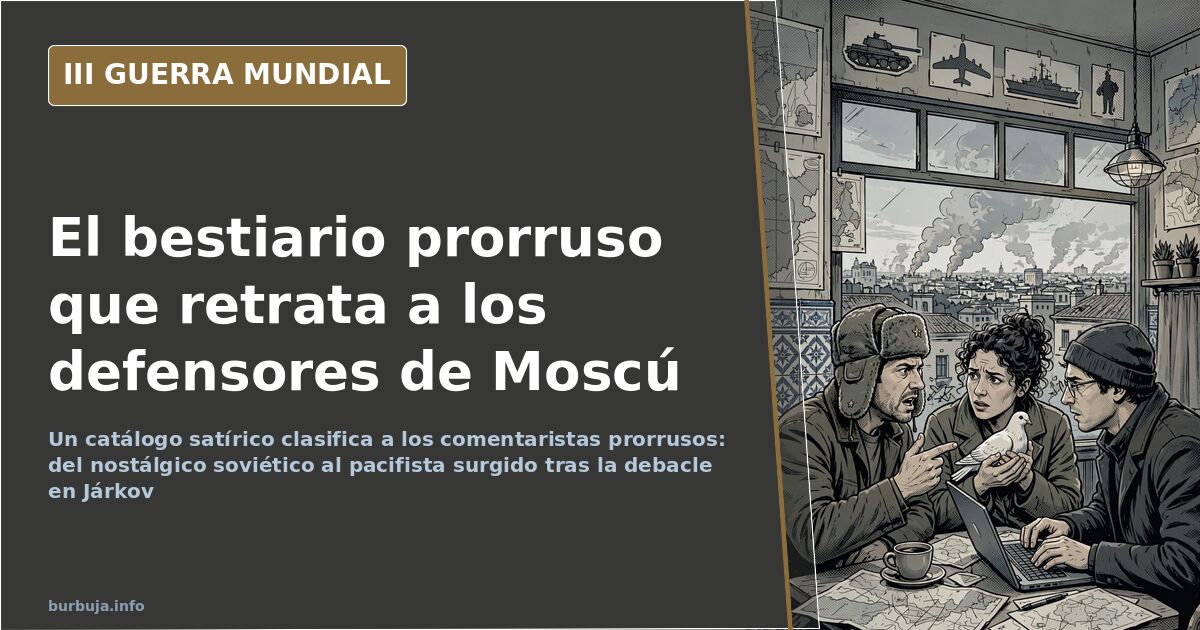
Portrait of Pro-Russian Profiles: The Archetypes Popularized by the Debate
Naming and identifying those who defend Moscow online. This is what a sort of taxonomy circulating in digital forums about the war in Ukraine proposes: a catalog of archetypes grouping pro-Russian commentators into recognizable "subspecies." The idea is not to argue with them, but to inventory them. The result reads like a tableau of customs, half satire, half X-ray of an entrenched polarization.
The exercise began with an initial catalog that grew through successive contributions. To the classic profiles were added others as the front changed. Behind each label lies a stereotype, not data: they serve for quick jokes, not to understand why someone defends the invader today.
What profiles does the pro-Russian bestiary gather?
The foundational text describes, among others, the veteran who idealizes the Soviet period and claims the conflict seeks to restore old borders; the one who rejects Western positions from anti-liberal stances and presents Russia as the last bulwark against supposed sarracena decay; and the conspiracy theory trinc, convinced there is a New World Order against which Moscow would be the last resistance. That conspiratorial thesis is not backed by any evidence.
More domestic figures are added to the list. The one who married a Russian citizen expecting an ideal he did not find, and now defends Russia out of pure marital inertia. The geopolitics enthusiast obsessed with maps and manuals, fascinated by territorial extent rather than arguments. The one who rewrites every military defeat as a masterstroke. And the one who turns any civilian victim into a suspect depending on the side suffering them.
The Anti-NOM Contradiction and the Survival Argument
A striking contradiction was also noted. Calling oneself an enemy of the New World Order while supporting Moscow is hard to reconcile, because Russia—and before it, the Soviet Union—is counted among the pillars of that order. One participant summed it up with a phrase: "Any person with two brain cells respects Russia even if they hate it, for simple survival reasons."
Another current clings to this logic: respect stems not from sympathy, but from antiestéticar of a nuclear arsenal no one wants to provoke. It is an argument that does not discuss ideologies, only calculates risk.
The Pacifist: The Subspecies Born from the Counteroffensive
According to the catalog itself, the most recent addition is "the pacifist," theorized as an evolution of the previous type. Its defining trait: wanting to end the conflict, with the path to achieving it being satisfying Kremlin demands so calm may reign. The authors place its appearance coinciding with the Russian debacle in Kharkiv, as an adaptation to new adverse terrain.
The emergence of a variant, the victim-pacifist, is noted, taking a step further and presenting Ukraine as the true aggressor of the conflict. It is the twist that turns the invaded into the guilty and the invader into the defender. The pattern repeats: the front changes, the alibi changes.
From Kharkiv to Kherson: The Narrative Changes with the Front
The archetypes are not static. They evolve at the pace of military operations, and the catalog makes this clear. With each setback on the ground appears a new excuse, and with each advance, old ones are recycled.
Milestones mark the calendar of the conversation. The Ukrainian counteroffensive in Kharkiv meant a debacle for the Russian army and brought along the convenience pacifist. Annexation referendums in occupied provinces peine the door to the victim-pacifist. Kyiv's recapture of Kherson expanded the inventory again. And the moment when the Wagner Group leader headed toward Moscow led to speculation about an unforeseen mutation of the profiles.
The taxonomic display reveals less about those portrayed than about the portraitists: discussion in the forum becomes an exercise in labeling.
A Country with Italy's GDP and Thousands of Tanks
Amidst so much caricature emerges the disorienting argument. The military inventory attributed to Russia—more than 10,000 tanks, over a thousand planes, nearly 50 submarines—clashes with the scale of its economy, comparable to Italy's. For one participant, the contrast between that inventory and what is seen in the military campaign summarizes the bluff.
Naming and identifying those who defend Moscow online. This is what a sort of taxonomy circulating in digital forums about the war in Ukraine proposes: a catalog of archetypes grouping pro-Russian commentators into recognizable "subspecies." The idea is not to argue with them, but to inventory them. The result reads like a tableau of customs, half satire, half X-ray of an entrenched polarization.
The exercise began with an initial catalog that grew through successive contributions. To the classic profiles were added others as the front changed. Behind each label lies a stereotype, not data: they serve for quick jokes, not to understand why someone defends the invader today.
What profiles does the pro-Russian bestiary gather?
The foundational text describes, among others, the veteran who idealizes the Soviet period and claims the conflict seeks to restore old borders; the one who rejects Western positions from anti-liberal stances and presents Russia as the last bulwark against supposed sarracena decay; and the conspiracy theory trinc, convinced there is a New World Order against which Moscow would be the last resistance. That conspiratorial thesis is not backed by any evidence.
More domestic figures are added to the list. The one who married a Russian citizen expecting an ideal he did not find, and now defends Russia out of pure marital inertia. The geopolitics enthusiast obsessed with maps and manuals, fascinated by territorial extent rather than arguments. The one who rewrites every military defeat as a masterstroke. And the one who turns any civilian victim into a suspect depending on the side suffering them.
The Anti-NOM Contradiction and the Survival Argument
A striking contradiction was also noted. Calling oneself an enemy of the New World Order while supporting Moscow is hard to reconcile, because Russia—and before it, the Soviet Union—is counted among the pillars of that order. One participant summed it up with a phrase: "Any person with two brain cells respects Russia even if they hate it, for simple survival reasons."
Another current clings to this logic: respect stems not from sympathy, but from antiestéticar of a nuclear arsenal no one wants to provoke. It is an argument that does not discuss ideologies, only calculates risk.
The Pacifist: The Subspecies Born from the Counteroffensive
According to the catalog itself, the most recent addition is "the pacifist," theorized as an evolution of the previous type. Its defining trait: wanting to end the conflict, with the path to achieving it being satisfying Kremlin demands so calm may reign. The authors place its appearance coinciding with the Russian debacle in Kharkiv, as an adaptation to new adverse terrain.
The emergence of a variant, the victim-pacifist, is noted, taking a step further and presenting Ukraine as the true aggressor of the conflict. It is the twist that turns the invaded into the guilty and the invader into the defender. The pattern repeats: the front changes, the alibi changes.
From Kharkiv to Kherson: The Narrative Changes with the Front
The archetypes are not static. They evolve at the pace of military operations, and the catalog makes this clear. With each setback on the ground appears a new excuse, and with each advance, old ones are recycled.
Milestones mark the calendar of the conversation. The Ukrainian counteroffensive in Kharkiv meant a debacle for the Russian army and brought along the convenience pacifist. Annexation referendums in occupied provinces peine the door to the victim-pacifist. Kyiv's recapture of Kherson expanded the inventory again. And the moment when the Wagner Group leader headed toward Moscow led to speculation about an unforeseen mutation of the profiles.
The taxonomic display reveals less about those portrayed than about the portraitists: discussion in the forum becomes an exercise in labeling.
A Country with Italy's GDP and Thousands of Tanks
Amidst so much caricature emerges the disorienting argument. The military inventory attributed to Russia—more than 10,000 tanks, over a thousand planes, nearly 50 submarines—clashes with the scale of its economy, comparable to Italy's. For one participant, the contrast between that inventory and what is seen in the military campaign summarizes the bluff.
Also available in: Deutsch
Summary of a discussion on Burbuja.info - Foro de economía, actualidad y política., translated from Spanish and reviewed before publication. Read the full discussion (156 replies).
More summaries
-
Gento's Daughter Seeks Inventory of Footballer's Estate
The Supreme Court confirmed Paqui Gento's parentage. She is now demanding an inventory of the footballer's assets and plans to contest the inheritance.
-
Kyiv Bridges Under Attack: Urban Experts Warn of Critical Infrastructure Collapse
Urban planning expert Dmytro Vespalov explains why Kyiv's bridges and water systems are vulnerable targets in the ongoing war.
-
Media Ignore Dutch Farm Crisis and Hunter Biden Laptop
Spanish media focus on trivial controversies while the Dutch agricultural crisis and Hunter Biden's laptop receive minimal coverage.
-
Is the Russian military truly obsolete?
Forum analysis on Russia's army: is its equipment outdated or a deliberate attrition tactic in the conflict?
-
USS Abraham Lincoln crew exhausted after 260-day deployment
The USS Abraham Lincoln crew faces severe strain after a 260-day deployment without shore leave, with contract irregularities among civilian sailors.
-
Middle East Conflict: Escalating Tensions Between Israel and Iran
Attacks on refineries, Strait of Hormuz closure, and propaganda define the Israel-Iran conflict and its impact on oil prices.