
Pro-Russian arguments fail to convince, even supporters
The Kremlin bans the word war and Moscow recognized Ukraine's 1991 referendum. These claims unravel under scrutiny of facts and contradictions.
English · Original discussion in Spanish · Published
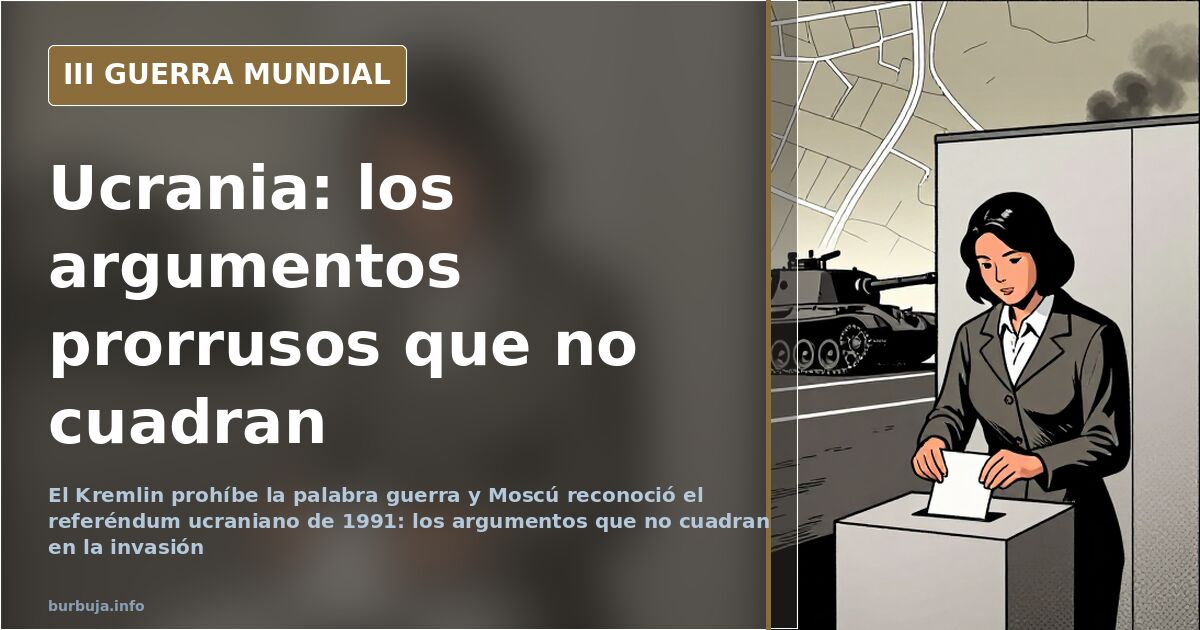
The pro-Russian narrative of the war that fails even its defenders
Someone sits down to seriously attempt it. They try to empathize with those defending the Kremlin in the war in Ukraine, and upon finishing, admit they cannot. They list six barriers: refusing to call the conflict a war, debating whether Ukraine is a sovereign country, labeling critics as «NATOist», noting the age of Russian soldiers sent to the front, the theory of a coup in the Maidan, and the narrative of genocide in the Donbass. Their conclusion is uncomfortable: above ideological sectarianism lies respect for human lives.
What trinc is a map of these arguments, with intersecting data, gaps, and contradictions that appear upon closer inspection.
The forbidden word: why Russia does not call the conflict a war
The first obstacle is language. The conflict cannot be called a war: the Kremlin imposed the term «special operation» and using the other word is persecuted. For those rejecting this version, the label describes nothing less than an invasion of another country, and the euphemism serves as the first proof that the narrative does not hold.
The second stone is sovereignty. Ukraine declared independence from the Soviet Union, is internationally recognized, and Russia maintained a diplomatic mission in Kyiv, which practically equates to recognizing the neighboring state. The repeated fact is the 1991 independence referendum, with an 84% turnout and Moscow's approval. Debating this thirty years later, according to this current, is not debating: it is rewriting.
Maidan, the 15-M, and the theory of a coup d'état
The then Ukrainian president, Viktor Yanukovych, refused to sign the association agreement with the European Union. The protest began as student-led, was harshly repressed, and indignation spread, leading to the president's departure. Months later, elections were held, and more in 2019. From this arises the comparison that most bothers one side: if that was a coup d'état, Spain's 15-M movement was also one.
Some argue, conversely, that there was external support and elite purchase in the Maidan, and that the regime change was decided outside Ukraine. The fact remains that the government elected from the ballot box has popular support, and elections were repeated.
Donbass, Crimea, and the referendum compared to Catalonia's
The two eastern oblasts attempted to separate, and there was war. According to one circulating version, Moscow sent mercenaries and armed separatists, and took Crimea —Ukrainian territory— after a consultation whose legitimacy is compared to that of an unrecognized independence referendum. The other side responds with a figure: more than ten thousand civilians killed, including 200 children, an accusation made without any independent instance validating it in this exchange.
Between these two narratives lies a detail often overlooked: there was a Minsk peace agreement, and in the months preceding the escalation, the zone was relatively calm. If the problem was the Donbass, a limited intervention in that territory would have had another reading; what broke the framework was the invasion.
Gas, sanctions, and the bill Europe ends up paying
The war is also fought on the energy bill. Part of the analysis suggests Washington sought a Russian reaction to impose sanctions and place its liquefied natural gas in the European market, and that Russia is the dominant energy provider for a simple reason: it shares a border with Europe and Asia.
Germany appears in all calculations. German businessmen have warned of the worst crisis since World War II, and alternatives to replace Russian gas are proposed: regasification plants, liquefied natural gas from Algeria, and, later, renewable hydrogen. Hydrogen, another voice warns, is currently a pipe dream, because producing it costs much more energy than it delivers.
The cost lands in pockets. Estimates place the blow to European families at 200 or 300 euros less per month, a figure some present as a warning and others as an excuse not to discuss what is happening on the front.
Why is NATO on the border used as an argument?
Because some argue that the alliance's expansion eastward constitutes an existential threat and that Russia needs a buffer country. The counter-response is that the decision to join belongs to Ukrainians, just as it did to Swedes and Finns, and that with Crimea and the Donbass pending, Ukraine would not have joined even with years ahead.
The argument has a practical problem: it is used to justify the invasion, but it does not explain why Moscow destabilizes countries with no prospects of membership. The usual response in that corner is refusal to keep reading, which is the most effective way for data to go unchallenged.
What both narratives share
Both sides cite the same episodes and draw opposite conclusions. The same deaths, the same borders, the same Maidan. And neither has answered the fundamental question: when did it stop being clear that Ukraine is a country.
The confusing data remains. The 1991 independence referendum had an 84% turnout, and Moscow recognized it, just as it recognized the borders now debated. Three decades later, this obviousness is the only thing almost no one defends without nuances.
Someone sits down to seriously attempt it. They try to empathize with those defending the Kremlin in the war in Ukraine, and upon finishing, admit they cannot. They list six barriers: refusing to call the conflict a war, debating whether Ukraine is a sovereign country, labeling critics as «NATOist», noting the age of Russian soldiers sent to the front, the theory of a coup in the Maidan, and the narrative of genocide in the Donbass. Their conclusion is uncomfortable: above ideological sectarianism lies respect for human lives.
What trinc is a map of these arguments, with intersecting data, gaps, and contradictions that appear upon closer inspection.
The forbidden word: why Russia does not call the conflict a war
The first obstacle is language. The conflict cannot be called a war: the Kremlin imposed the term «special operation» and using the other word is persecuted. For those rejecting this version, the label describes nothing less than an invasion of another country, and the euphemism serves as the first proof that the narrative does not hold.
The second stone is sovereignty. Ukraine declared independence from the Soviet Union, is internationally recognized, and Russia maintained a diplomatic mission in Kyiv, which practically equates to recognizing the neighboring state. The repeated fact is the 1991 independence referendum, with an 84% turnout and Moscow's approval. Debating this thirty years later, according to this current, is not debating: it is rewriting.
Maidan, the 15-M, and the theory of a coup d'état
The then Ukrainian president, Viktor Yanukovych, refused to sign the association agreement with the European Union. The protest began as student-led, was harshly repressed, and indignation spread, leading to the president's departure. Months later, elections were held, and more in 2019. From this arises the comparison that most bothers one side: if that was a coup d'état, Spain's 15-M movement was also one.
Some argue, conversely, that there was external support and elite purchase in the Maidan, and that the regime change was decided outside Ukraine. The fact remains that the government elected from the ballot box has popular support, and elections were repeated.
Donbass, Crimea, and the referendum compared to Catalonia's
The two eastern oblasts attempted to separate, and there was war. According to one circulating version, Moscow sent mercenaries and armed separatists, and took Crimea —Ukrainian territory— after a consultation whose legitimacy is compared to that of an unrecognized independence referendum. The other side responds with a figure: more than ten thousand civilians killed, including 200 children, an accusation made without any independent instance validating it in this exchange.
Between these two narratives lies a detail often overlooked: there was a Minsk peace agreement, and in the months preceding the escalation, the zone was relatively calm. If the problem was the Donbass, a limited intervention in that territory would have had another reading; what broke the framework was the invasion.
Gas, sanctions, and the bill Europe ends up paying
The war is also fought on the energy bill. Part of the analysis suggests Washington sought a Russian reaction to impose sanctions and place its liquefied natural gas in the European market, and that Russia is the dominant energy provider for a simple reason: it shares a border with Europe and Asia.
Germany appears in all calculations. German businessmen have warned of the worst crisis since World War II, and alternatives to replace Russian gas are proposed: regasification plants, liquefied natural gas from Algeria, and, later, renewable hydrogen. Hydrogen, another voice warns, is currently a pipe dream, because producing it costs much more energy than it delivers.
The cost lands in pockets. Estimates place the blow to European families at 200 or 300 euros less per month, a figure some present as a warning and others as an excuse not to discuss what is happening on the front.
Why is NATO on the border used as an argument?
Because some argue that the alliance's expansion eastward constitutes an existential threat and that Russia needs a buffer country. The counter-response is that the decision to join belongs to Ukrainians, just as it did to Swedes and Finns, and that with Crimea and the Donbass pending, Ukraine would not have joined even with years ahead.
The argument has a practical problem: it is used to justify the invasion, but it does not explain why Moscow destabilizes countries with no prospects of membership. The usual response in that corner is refusal to keep reading, which is the most effective way for data to go unchallenged.
What both narratives share
Both sides cite the same episodes and draw opposite conclusions. The same deaths, the same borders, the same Maidan. And neither has answered the fundamental question: when did it stop being clear that Ukraine is a country.
The confusing data remains. The 1991 independence referendum had an 84% turnout, and Moscow recognized it, just as it recognized the borders now debated. Three decades later, this obviousness is the only thing almost no one defends without nuances.
Also available in: Deutsch
Summary of a discussion on Burbuja.info - Foro de economía, actualidad y política., translated from Spanish and reviewed before publication. Read the full discussion (225 replies).
More summaries
-
Putin: Russia's Most Divisive Statesman or Tyrant?
Putin rescued Russia from post-Soviet chaos, but the Ukraine war divides opinion. Is he the century's greatest statesman or a tyrant?
-
Ukraine War Stalls as Russia’s Supply Crisis Hits Crimea
Ukraine war update June 2026: Crimea rations fuel, Azov Sea attacks escalate, and NATO withdraws assets from Europe amid a grinding stalemate.
-
Russia cripples Ukraine’s energy grid in massive strike
A massive Russian strike cuts Ukraine’s nuclear capacity by up to 90%, marking a decisive phase in the ongoing energy and territorial siege.
-
Is the Russian military truly obsolete?
Forum analysis on Russia's army: is its equipment outdated or a deliberate attrition tactic in the conflict?
-
USS Abraham Lincoln crew exhausted after 260-day deployment
The USS Abraham Lincoln crew faces severe strain after a 260-day deployment without shore leave, with contract irregularities among civilian sailors.
-
Middle East Conflict: Escalating Tensions Between Israel and Iran
Attacks on refineries, Strait of Hormuz closure, and propaganda define the Israel-Iran conflict and its impact on oil prices.