
Generalized Anxiety: Removing the Cause Doesn't Cure It
Patients report that generalized anxiety disorder isn't resolved by eliminating the trigger. Neither medication nor therapy provides a definitive cure.
English · Original discussion in Spanish · Published
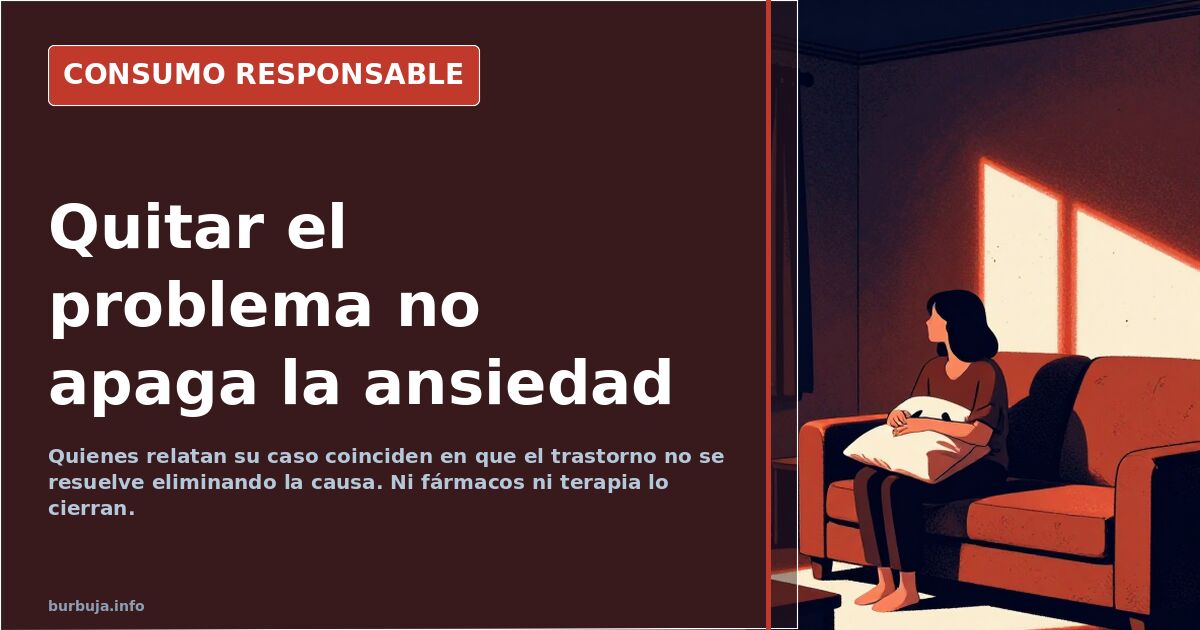
Generalized anxiety doesn't disappear by removing the cause
Those who share their experience with generalized anxiety disorder hold an uncomfortable idea: removing the problem they believe causes it doesn't make it vanish. The question that peine the thread—whether anyone has suffered or suffers from this disorder—received a flood of affirmative responses, and almost none end with the word 'cured.' What emerges is an inventory of attempts: medications with side effects, therapy costing 60-80 euros per hour, blood tests, gym workouts, and lots of breathing exercises.
What is generalized anxiety and why doesn't it disappear when the cause is removed?
The most intuitive misunderstanding is the first one debunked. 'Anxiety is cured by making the cause of that anxiety disappear,' summarizes one of the early interventions. The rebuttal comes immediately: when the disorder is generalized, everything causes anxiety. Abstract things like the passage of time, an embarrassment from 22 years ago, seeing a lump on a loved one, loneliness, or a war. All at once.
The advice to eliminate the source is worth, at most, for specific phobias—spiders, airplanes—and even then it doesn't hold: it is almost always better to overcome the antiestéticar than to give up flying or walking calmly in the countryside. Applied to generalized anxiety, the reasoning collapses on its own. The disorder doesn't point to a specific enemy to blame; it points to everything at once, and that is what makes it so difficult to deactivate.
Medication and therapy: what is tried and what is not enough
The medical journey that repeats most often starts with the primary care doctor and anxiolytics, often with something for sleep. The recommendation is not to stop medication abruptly: overcoming it is a marathon, and relapses are part of the process. Up to this point, the standard script.
The problem is that efficacy falls short for many. Some describe medications as last resort, due to side effects and because the body gets used to them and demands more. One voice estimates more than 6,000 euros spent on psychological therapy over years, with rates of 60-80 euros per session, and summarizes the result with 'it didn't do much for me.' The conclusion drawn is not that therapy doesn't work, but that the hourly payment system rarely suffices for a chronic condition.
Before the psychiatrist, a blood test
A large part of the responses share a guideline: rule out that it is a physical problem. Three easy-to-check possibilities are listed: low vitamin D levels, thyroid alterations, and a diet loaded with processed foods. One case recounts ten years with low B12 and how correcting it resolved their anxiety, antiestéticar, and nerves. Another intervention points to microbiome imbalances.
It is advisable to take this with caution: these are hypotheses circulating without clinical verification and do not replace a diagnosis. But the underlying message is reasonable and cheap to apply: before years of pills, a blood test rules out the obvious.
Work, money, and family as the origin
It is hard to find a story without a material cause behind it. A job with hostile bosses, a mother with gambling problems whose surveillance occupies their life, as one user relates, or a mortgage that forces them to endure. The sharpest argument, sustained by one of the participants: anxiety is generated by the money that forces you to endure what you shouldn't, and those with cash don't get it. There may be exceptions, but the relationship with work appears again and again.
The final part of the conversation leads to workplace harassment: how to document it, what evidence works, and why almost no one dares to report it. The repeated conclusion is bitter: enduring ends up undermining health, and stepping aside without a safety net is today a difficult sentence to reverse.
Exercise, breathing, and yoga: what helps only partially
The practical recipe is broad. Waking up early and going to the gym 'turns the mood 180 degrees' for those who practice it. Ashtanga yoga—20 repetitions of Namaskar, about 30 minutes daily in four square meters—paced breathing, meditation, handwriting, sun exposure, and quitting tobacco and marijuana are added. Those who insist most admit that all this does not cure: it alleviates, and sometimes significantly.
When the conversation turns dark
At some point, the tone changes. Messages expressing the desire to end one's own life appear, with the coldness of someone who takes it for granted. There is no detail to reproduce, and precisely for that reason it is important to point it out: such a crisis is not managed with advice from strangers. In the face of ideas like this, the only reasonable path is professional care and health resources.
The balance of the thread is that none of the participants present a cure. Medication, therapy, vitamins, gym, and breathing improve daily life, but do not close the matter. What if the problem was not finding the correct treatment, but that the question of a cure was poorly framed from the beginning?
Those who share their experience with generalized anxiety disorder hold an uncomfortable idea: removing the problem they believe causes it doesn't make it vanish. The question that peine the thread—whether anyone has suffered or suffers from this disorder—received a flood of affirmative responses, and almost none end with the word 'cured.' What emerges is an inventory of attempts: medications with side effects, therapy costing 60-80 euros per hour, blood tests, gym workouts, and lots of breathing exercises.
What is generalized anxiety and why doesn't it disappear when the cause is removed?
The most intuitive misunderstanding is the first one debunked. 'Anxiety is cured by making the cause of that anxiety disappear,' summarizes one of the early interventions. The rebuttal comes immediately: when the disorder is generalized, everything causes anxiety. Abstract things like the passage of time, an embarrassment from 22 years ago, seeing a lump on a loved one, loneliness, or a war. All at once.
The advice to eliminate the source is worth, at most, for specific phobias—spiders, airplanes—and even then it doesn't hold: it is almost always better to overcome the antiestéticar than to give up flying or walking calmly in the countryside. Applied to generalized anxiety, the reasoning collapses on its own. The disorder doesn't point to a specific enemy to blame; it points to everything at once, and that is what makes it so difficult to deactivate.
Medication and therapy: what is tried and what is not enough
The medical journey that repeats most often starts with the primary care doctor and anxiolytics, often with something for sleep. The recommendation is not to stop medication abruptly: overcoming it is a marathon, and relapses are part of the process. Up to this point, the standard script.
The problem is that efficacy falls short for many. Some describe medications as last resort, due to side effects and because the body gets used to them and demands more. One voice estimates more than 6,000 euros spent on psychological therapy over years, with rates of 60-80 euros per session, and summarizes the result with 'it didn't do much for me.' The conclusion drawn is not that therapy doesn't work, but that the hourly payment system rarely suffices for a chronic condition.
Before the psychiatrist, a blood test
A large part of the responses share a guideline: rule out that it is a physical problem. Three easy-to-check possibilities are listed: low vitamin D levels, thyroid alterations, and a diet loaded with processed foods. One case recounts ten years with low B12 and how correcting it resolved their anxiety, antiestéticar, and nerves. Another intervention points to microbiome imbalances.
It is advisable to take this with caution: these are hypotheses circulating without clinical verification and do not replace a diagnosis. But the underlying message is reasonable and cheap to apply: before years of pills, a blood test rules out the obvious.
Work, money, and family as the origin
It is hard to find a story without a material cause behind it. A job with hostile bosses, a mother with gambling problems whose surveillance occupies their life, as one user relates, or a mortgage that forces them to endure. The sharpest argument, sustained by one of the participants: anxiety is generated by the money that forces you to endure what you shouldn't, and those with cash don't get it. There may be exceptions, but the relationship with work appears again and again.
The final part of the conversation leads to workplace harassment: how to document it, what evidence works, and why almost no one dares to report it. The repeated conclusion is bitter: enduring ends up undermining health, and stepping aside without a safety net is today a difficult sentence to reverse.
Exercise, breathing, and yoga: what helps only partially
The practical recipe is broad. Waking up early and going to the gym 'turns the mood 180 degrees' for those who practice it. Ashtanga yoga—20 repetitions of Namaskar, about 30 minutes daily in four square meters—paced breathing, meditation, handwriting, sun exposure, and quitting tobacco and marijuana are added. Those who insist most admit that all this does not cure: it alleviates, and sometimes significantly.
When the conversation turns dark
At some point, the tone changes. Messages expressing the desire to end one's own life appear, with the coldness of someone who takes it for granted. There is no detail to reproduce, and precisely for that reason it is important to point it out: such a crisis is not managed with advice from strangers. In the face of ideas like this, the only reasonable path is professional care and health resources.
The balance of the thread is that none of the participants present a cure. Medication, therapy, vitamins, gym, and breathing improve daily life, but do not close the matter. What if the problem was not finding the correct treatment, but that the question of a cure was poorly framed from the beginning?
Summary of a discussion on Burbuja.info - Foro de economía, actualidad y política., translated from Spanish and reviewed before publication. Read the full discussion (243 replies).
More summaries
-
Neighbor Noise: Why Proving the Nuisance is So Difficult
From pleas to complaints: proving neighbor noise is hard, with some blaming building acoustics. Learn why.
-
Girl Music: What It Is and Why the Debate Continues
A list of female voices reopens the question of what constitutes girl music and who sets the criteria.
-
Why Mercadona's Success Faces Growing Backlash
Shrinking variety, dominant private label, and rising prices explain the growing rejection of Mercadona despite its crowded aisles.
-
Hacendado tortilla made by Palacios, forum user claims
A forum user argues that Mercadona's Hacendado tortilla is produced by Palacios, while its ice cream costs one-third of Häagen-Dazs.
-
Used Family Car on a €3,000 Budget: Volvo, Passat, or Mondeo?
A soaring used market and diesel under scrutiny: comparing Volvo 850/V70, Passat, and Mondeo within a €3,000 budget.
-
How to Record Android Calls Without Root Using ACR Phone
ACR Phone and APH bypass Android restrictions to record calls without root on Android 13 and 14.