
Princess Leonor skips military parade due to training schedule
Spain's Princess Leonor did not march in the October 12 parade as her first-year class is still in basic training, according to online discussions.
English · Original discussion in Spanish · Published
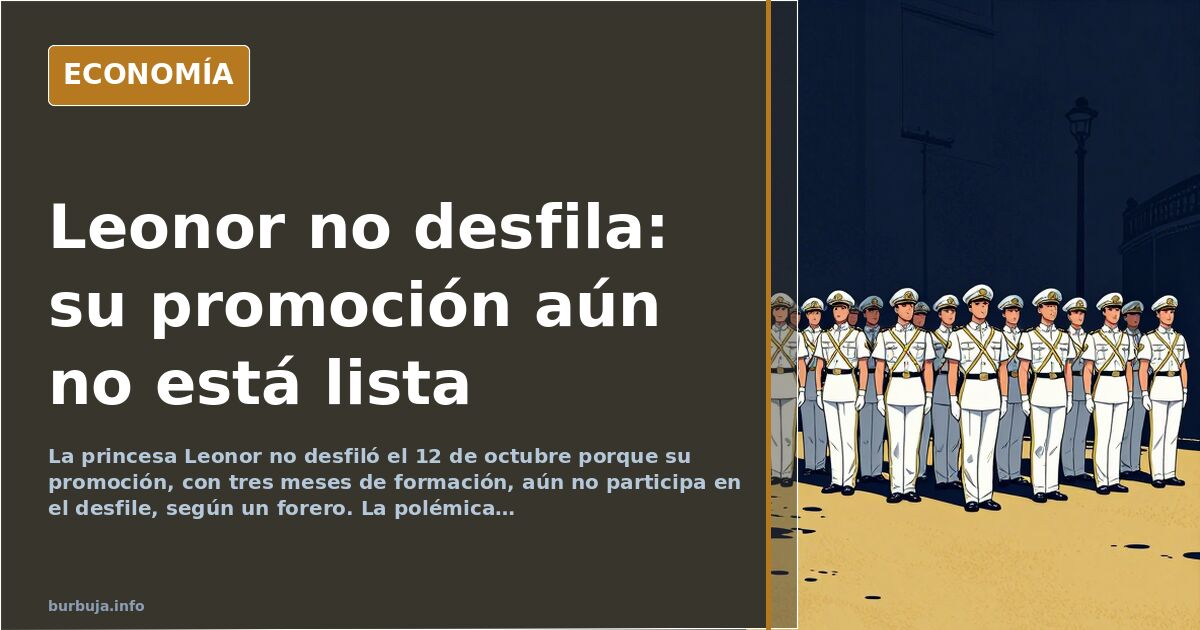
Leonor skips parade: her class not yet ready
Why didn't Princess Leonor march with her peers from the General Military Academy during the October 12 parade? The explanation provided in the source material is practical rather than conspiratorial. According to forum users, students in her cohort have completed just over three months of training and do not yet participate in the parade. Only second-year cadets marched. In this version, the princess presided from the viewing stand.
This fact has not prevented the issue from becoming a debate about the role of the Crown. On one side are those who claim everything surrounding Leonor is staged: that she failed entrance exams, cannot endure long parades, and that official photos are mere set dressing. On the other, defenders point out that the princess is 1.70 meters tall, that cadets earn around 500 euros until commissioned as officers, and that physical demands apply equally to all.
Protocol rules for the October 12 parade
The discussion stems from a premise debunked by the material itself: that the princess should have marched but failed due to inability. The prevailing explanation is academic scheduling. Her cohort does not march yet; second-years do. Presence on the stand is not an exception but the expected role for those presiding.
Some add security arguments: organizing protection along the entire route with the heir in training within the formation would be a major logistical challenge. This is not an unreasonable thesis, though it is not documented in the material.
Entrance exams and the cited 3% figure
One axis of the debate concerns access. It is claimed that only 3% of applicants pass the Academy entrance exams and that the princess did not meet them. This 3% appears as an isolated figure without source or breakdown, used as ammunition in both directions.
The counterargument differs: military training is measured not just by an entry exam but by subsequent pogre. Here enters the data of the 500 euros monthly stipend cadets receive until becoming officers, framing the conversation around effort and remuneration.
Troop physical condition: height, weight, and equipment
The most technical part of the debate arises when discussing physical fitness. It is mentioned that a soldier should carry around 20 kilos of equipment—including helmet and rifle—and that regulations state this weight must not exceed 30% of body weight. From this, it is deduced that a soldier should not weigh less than 60 kilos.
Based on this, there is debate on whether new cohorts comply. Some argue that increasingly units fail to reach 70% of personnel capable of completing 10 kilometers with gear in under 90 minutes, with a margin up to 105. Others respond that technology has reduced physical demands and comparing with conscription thirty years ago is misleading.
Armament and logistics: from G36 to C-90
The exchange becomes encyclopedic. Discussions cover the weight of the G36 rifle—about 4 kilos with magazine—the use of disposable C-90 launchers—around 5 kilos—versus RPGs, and power steering in vehicles. The conclusion is that logistics, ammunition transport, and chain maintenance remain pure physical labor.
The irony of the exchange—that an untrained civilian could disarm a soldier—serves to remind that an army is not police: training is oriented toward combat, not arrest.
Background: monarchy, republic, and the heir's role
Beneath the military issue lies political discussion. It is suggested that if the princess's figure matters to no one, Spain could move toward a republic; responses note the institution remains and coronation will come. The conversation shifts to the Crown's institutional role and the utility of debating a person in training.
The material closes with dry irony: time passes, the head of state remains the same, and the princess continues her instruction. Everything else, according to this reading, is summer noise in October.
Why didn't Princess Leonor march with her peers from the General Military Academy during the October 12 parade? The explanation provided in the source material is practical rather than conspiratorial. According to forum users, students in her cohort have completed just over three months of training and do not yet participate in the parade. Only second-year cadets marched. In this version, the princess presided from the viewing stand.
This fact has not prevented the issue from becoming a debate about the role of the Crown. On one side are those who claim everything surrounding Leonor is staged: that she failed entrance exams, cannot endure long parades, and that official photos are mere set dressing. On the other, defenders point out that the princess is 1.70 meters tall, that cadets earn around 500 euros until commissioned as officers, and that physical demands apply equally to all.
Protocol rules for the October 12 parade
The discussion stems from a premise debunked by the material itself: that the princess should have marched but failed due to inability. The prevailing explanation is academic scheduling. Her cohort does not march yet; second-years do. Presence on the stand is not an exception but the expected role for those presiding.
Some add security arguments: organizing protection along the entire route with the heir in training within the formation would be a major logistical challenge. This is not an unreasonable thesis, though it is not documented in the material.
Entrance exams and the cited 3% figure
One axis of the debate concerns access. It is claimed that only 3% of applicants pass the Academy entrance exams and that the princess did not meet them. This 3% appears as an isolated figure without source or breakdown, used as ammunition in both directions.
The counterargument differs: military training is measured not just by an entry exam but by subsequent pogre. Here enters the data of the 500 euros monthly stipend cadets receive until becoming officers, framing the conversation around effort and remuneration.
Troop physical condition: height, weight, and equipment
The most technical part of the debate arises when discussing physical fitness. It is mentioned that a soldier should carry around 20 kilos of equipment—including helmet and rifle—and that regulations state this weight must not exceed 30% of body weight. From this, it is deduced that a soldier should not weigh less than 60 kilos.
Based on this, there is debate on whether new cohorts comply. Some argue that increasingly units fail to reach 70% of personnel capable of completing 10 kilometers with gear in under 90 minutes, with a margin up to 105. Others respond that technology has reduced physical demands and comparing with conscription thirty years ago is misleading.
Armament and logistics: from G36 to C-90
The exchange becomes encyclopedic. Discussions cover the weight of the G36 rifle—about 4 kilos with magazine—the use of disposable C-90 launchers—around 5 kilos—versus RPGs, and power steering in vehicles. The conclusion is that logistics, ammunition transport, and chain maintenance remain pure physical labor.
The irony of the exchange—that an untrained civilian could disarm a soldier—serves to remind that an army is not police: training is oriented toward combat, not arrest.
Background: monarchy, republic, and the heir's role
Beneath the military issue lies political discussion. It is suggested that if the princess's figure matters to no one, Spain could move toward a republic; responses note the institution remains and coronation will come. The conversation shifts to the Crown's institutional role and the utility of debating a person in training.
The material closes with dry irony: time passes, the head of state remains the same, and the princess continues her instruction. Everything else, according to this reading, is summer noise in October.
Also available in: Deutsch
Summary of a discussion on Burbuja.info - Foro de economía, actualidad y política., translated from Spanish and reviewed before publication. Read the full discussion (126 replies).
More summaries
-
Princess Leonor's military training sparks debate on Spanish monarchy
Princess Leonor begins her military training, reigniting discussions about the relevance and image of the Spanish Crown.
-
Spanish Army Faces Recruitment Crisis Amid Low Pay
Recent Spanish army recruitment drives left positions unfilled. Soldier salaries lag behind civilian jobs, hindering enlistment.
-
Viral tweet attributed to Mel Gibson comes from fake account
Mel Gibson has no official X account: the viral tweet attributed to him comes from a fake account, according to his publicist.
-
Ceuta, Barajas, and the media manipulation of migration
While 50,000 to 80,000 people reportedly enter Ceuta, the media focus ignores airport migration and the broader reality of regularisation in Spain.
-
Morocco outpaces Spain in disposable income for engineers
High housing costs in Spain leave engineers with less savings than their counterparts in Casablanca, despite earning lower nominal salaries.
-
Candidate named Hitler Mussolini wins local elections in Peru
Hitler Mussolini Simeón has won the municipal elections in Queropalca, Huánuco, with 229 votes. The candidate's name has become a global sensation.