
PP Takes Puigdemont's Russian Contacts to European Parliament
The PP brings to the European Parliament contacts between Russian envoys and Catalan leaders in October 2017 regarding cryptocurrencies.
English · Original discussion in Spanish · Published
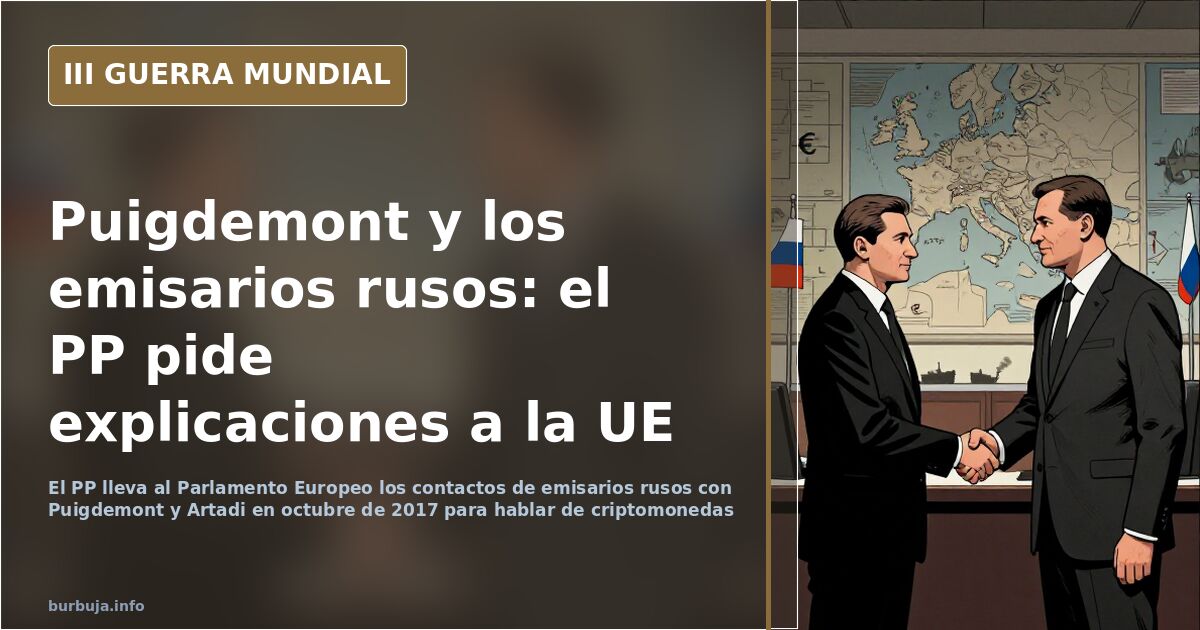
Puigdemont and Russian Envoys: The Plot Taken to the Eurochamber by the PP
A twenty-minute meeting at the Hotel Colón in Barcelona. A female executive sent in place of the president because she held a degree in Economics. A Russian citizen introduced to Catalan leaders as a former general. And a question that remained unanswered: what were the Government’s plans for cryptocurrencies? This is the scene depicted in the documentation submitted by the Popular Parliamentary Group to the European Parliament, according to material circulating about the case.
The key date is October 21, 2017. Three weeks after the illegal referendum, Carles Puigdemont’s right-hand woman allegedly met with envoys linked to the Kremlin. Spanish intelligence operates on the hypothesis that Moscow sought to accelerate the exodus of companies from Catalonia to force the former president into greater dependence on Russian financing. The thesis is ambitious. The evidence, so far, is circumstantial.
What the Document Submitted to the Eurochamber Says
The text describes how, after the October 1st vote, several Russian citizens with links to their government held meetings with prominent members of the Catalan Government, including Puigdemont. These contacts allegedly continued until 2020, both in Spain and Russia, and came to light through Guardia Civil investigations within the Voloh case, led by Judge Joaquín Aguirre at Barcelona’s Investigating Court No. 1.
The central figure is Víctor Terradelles, former Secretary of International Relations for CDC (now PDeCAT) and president of the CATmon Foundation. According to his testimony before the judge, on October 20, 2017, he was contacted by businessman Jordi Sardà Bonvehí, who operated alongside Russian citizen Sergey Motin, now deceased, who had been presented to Catalan leaders as a former Russian general. Terradelles stated he acted as a messenger: he asked Puigdemont if he wanted to meet them, and the president said yes.
The president did not attend the first meeting, around October 21. Elsa Artadi, interdepartmental coordinator of the Generalitat, was sent instead, according to her own testimony before the judge in May 2022, because she held a degree in Economics. The meeting lasted about twenty minutes at the Hotel Colón. Artadi claimed not to remember the identity of those present, nor the date, duration, or content of the conversation. The Russians asked about the Government’s plans regarding cryptocurrencies.
Cryptocurrencies, Sanctions, and Opaque Money
The document emphasizes that cryptocurrencies are an opaque way to move money that can be used to evade sanctions. This point connects the Catalan plot with Russia’s interest in bypassing international financial controls. In subsequent months, intercepted messages to Terradelles would show Sardà claiming to manage an operation whose full details have not emerged in available materials.
The official narrative maintains that separatism became a transmission belt for Moscow to destabilize the EU. The accusation is serious, but as of this discussion, there is no final court ruling backing it up. The case remains under investigation.
Corporate Exodus: Russian Cause or Political Consequence?
This is where the analysis splits. The Spanish intelligence hypothesis suggests Moscow counted on accelerating the departure of Catalan companies to increase Puigdemont’s financial dependence. The most repeated objection is based on elementary logic: if Russia was unable to manufacture competitive washing machines, it is difficult to sustain that it simultaneously managed a corporate exodus seven thousand kilometers away, under the noses of the CNI (Spain’s National Intelligence Center) and NATO.
The counter-hypothesis has its own strength. According to this reading, the corporate exodus from Catalonia is better explained by the legal uncertainty generated by the procés itself (the independence process): mandatory signage in Catalan, new regional and local taxes, and the spectacle of a community that declared independence and then suspended it. Companies did not need a push from Moscow. They only needed to watch the news.
The Meeting No One Remembers
There is a detail that is disorienting. A twenty-minute meeting between a senior Catalan Government official and a supposed former Russian general, in the midst of October 2017, and the person sent does not even remember who they spoke to. It is possible. It is also possible that selective memory is the most useful virtue in politics. What cannot be done is to demand that taxpayers accept as proof what the protagonist herself does not remember.
The investigation continues. The Barcelona Provincial Court has urged the judge to decide whether to send the case to trial or close it. Until then, all there is is documentation submitted to a European institution, testimonies before a judge, and an intelligence hypothesis that has yet to find procedural confirmation.
How much of this story is a real plot and how much is the need to find an external culprit for a disaster we created ourselves?
A twenty-minute meeting at the Hotel Colón in Barcelona. A female executive sent in place of the president because she held a degree in Economics. A Russian citizen introduced to Catalan leaders as a former general. And a question that remained unanswered: what were the Government’s plans for cryptocurrencies? This is the scene depicted in the documentation submitted by the Popular Parliamentary Group to the European Parliament, according to material circulating about the case.
The key date is October 21, 2017. Three weeks after the illegal referendum, Carles Puigdemont’s right-hand woman allegedly met with envoys linked to the Kremlin. Spanish intelligence operates on the hypothesis that Moscow sought to accelerate the exodus of companies from Catalonia to force the former president into greater dependence on Russian financing. The thesis is ambitious. The evidence, so far, is circumstantial.
What the Document Submitted to the Eurochamber Says
The text describes how, after the October 1st vote, several Russian citizens with links to their government held meetings with prominent members of the Catalan Government, including Puigdemont. These contacts allegedly continued until 2020, both in Spain and Russia, and came to light through Guardia Civil investigations within the Voloh case, led by Judge Joaquín Aguirre at Barcelona’s Investigating Court No. 1.
The central figure is Víctor Terradelles, former Secretary of International Relations for CDC (now PDeCAT) and president of the CATmon Foundation. According to his testimony before the judge, on October 20, 2017, he was contacted by businessman Jordi Sardà Bonvehí, who operated alongside Russian citizen Sergey Motin, now deceased, who had been presented to Catalan leaders as a former Russian general. Terradelles stated he acted as a messenger: he asked Puigdemont if he wanted to meet them, and the president said yes.
The president did not attend the first meeting, around October 21. Elsa Artadi, interdepartmental coordinator of the Generalitat, was sent instead, according to her own testimony before the judge in May 2022, because she held a degree in Economics. The meeting lasted about twenty minutes at the Hotel Colón. Artadi claimed not to remember the identity of those present, nor the date, duration, or content of the conversation. The Russians asked about the Government’s plans regarding cryptocurrencies.
Cryptocurrencies, Sanctions, and Opaque Money
The document emphasizes that cryptocurrencies are an opaque way to move money that can be used to evade sanctions. This point connects the Catalan plot with Russia’s interest in bypassing international financial controls. In subsequent months, intercepted messages to Terradelles would show Sardà claiming to manage an operation whose full details have not emerged in available materials.
The official narrative maintains that separatism became a transmission belt for Moscow to destabilize the EU. The accusation is serious, but as of this discussion, there is no final court ruling backing it up. The case remains under investigation.
Corporate Exodus: Russian Cause or Political Consequence?
This is where the analysis splits. The Spanish intelligence hypothesis suggests Moscow counted on accelerating the departure of Catalan companies to increase Puigdemont’s financial dependence. The most repeated objection is based on elementary logic: if Russia was unable to manufacture competitive washing machines, it is difficult to sustain that it simultaneously managed a corporate exodus seven thousand kilometers away, under the noses of the CNI (Spain’s National Intelligence Center) and NATO.
The counter-hypothesis has its own strength. According to this reading, the corporate exodus from Catalonia is better explained by the legal uncertainty generated by the procés itself (the independence process): mandatory signage in Catalan, new regional and local taxes, and the spectacle of a community that declared independence and then suspended it. Companies did not need a push from Moscow. They only needed to watch the news.
The Meeting No One Remembers
There is a detail that is disorienting. A twenty-minute meeting between a senior Catalan Government official and a supposed former Russian general, in the midst of October 2017, and the person sent does not even remember who they spoke to. It is possible. It is also possible that selective memory is the most useful virtue in politics. What cannot be done is to demand that taxpayers accept as proof what the protagonist herself does not remember.
The investigation continues. The Barcelona Provincial Court has urged the judge to decide whether to send the case to trial or close it. Until then, all there is is documentation submitted to a European institution, testimonies before a judge, and an intelligence hypothesis that has yet to find procedural confirmation.
How much of this story is a real plot and how much is the need to find an external culprit for a disaster we created ourselves?
Also available in: Deutsch
Summary of a discussion on Burbuja.info - Foro de economía, actualidad y política., translated from Spanish and reviewed before publication. Read the full discussion (128 replies).
More summaries
-
Russia's Syria Retreat Exposes Cracks in Victory Narrative
Damascus' fall reveals Russian military limitations and a strategic withdrawal framed as victory, amid economic strains.
-
Colonel Baños Reports Assault at Barcelona's Sant Jordi
Pedro Baños alleged an attack in Barcelona. Unverified claims involve an 18-year-old and a video, fueling controversy.
-
Victory Day: May 9 divides Europe
May 9, Europe Day, coincides with Victory Day, interpreted oppositely by Russia and Ukraine. Analysis of a divisive calendar.
-
Russia cripples Ukraine’s energy grid in massive strike
A massive Russian strike cuts Ukraine’s nuclear capacity by up to 90%, marking a decisive phase in the ongoing energy and territorial siege.
-
Peskov admits Russia is at war, but legal status unchanged
Kremlin spokesman Peskov states Russia is in a state of war, then clarifies the 'special military operation' label remains legally active.
-
Prosperity Guardian Fails to Stop Red Sea Houthi Attacks
US and UK strikes hit Yemen as Prosperity Guardian fails to deter attacks, with 14 drones downed and a tanker turning back.