
PP Offers Canary Islands Presidency to PSOE, Angering Voters
The PP reportedly offered the Canary Islands presidency to the PSOE as the most-voted list, causing discontent among its base who fear voting for Vox.
English · Original discussion in Spanish · Published
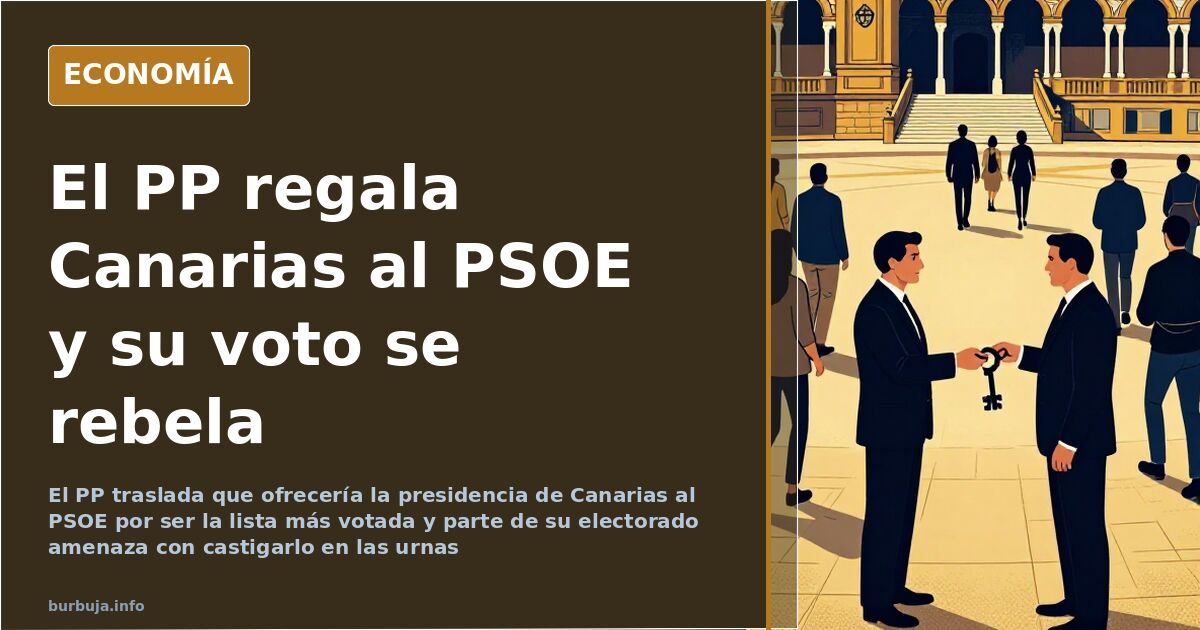
PP Offers Canary Islands Presidency to PSOE, Angering Voters
Can you win an election and hand the government to the runner-up? Taken to the extreme, this is what the PP is accused of in the Canary Islands: offering the regional presidency to the PSOE because they were the most voted list, with the caveat that if it fails, it will be due to Socialist refusal, not theirs. This version circulates attributed to a social media account tracking island news and has peine, during the electoral cycle, the party's most uncomfortable wound: what to do with voters who already cast their ballots holding their nose.
What is attributed to the PP in the Canary Islands
The operation, as described, has simple accounting: the PP commits to facilitating the Canary Islands presidency for the most voted candidacy, which was the Socialist one, and reserves the narrative that the blockade will come from the other side if the offer does not materialize. The move shifts the cost of the pact to the other formation and, in passing, dodges the photo the party has been trying to avoid for months. The counterpart is something no one seems to have measured: the voter who sustains the brand with resignation and now sees how their vote is used as bargaining chip.
Whether the gesture is announced, leaked, or dropped matters less than its effect. At heart lies a question of pure strategy: if the PP is going to govern with support from its right, why show the card to the rival beforehand? The answer given quietly is that the card is shown precisely so that another pays the political cost.
The voter who feels like a bargaining chip
The discomfort does not come from the left. It comes from those who voted for the PP and discover that their ballot serves to invest the adversary. The most repeated reaction is that of backstabbing pain: the feeling of having received a stab in the back from their own party. And from there jumps the classic warning: every gesture of this type translates into abstention within the house or into a vote that goes to Vox.
It is not a new anger, but the nth layer of accumulated rage. The accusation running through comments is that of institutional cowardice: votes are requested with harshness against the Government and then, when the time comes, ground is ceded. Those who already voted holding their nose, says the most repeated argument, will simply stop going to vote. And that calculation, in a system where a few thousand ballots decide seats, is not rhetoric.
Why can't the PP add up with Vox in the Canary Islands?
Because the arithmetic doesn't reach. The own tracking of the count points out that the two right-wing formations would not reach the 31 seats necessary to invest a government in the islands. If that sum does not exist, the offer to the PSOE stops being generosity and becomes an alibi: it serves to say that everything was tried and that the blockade is external.
Some see in it a well-executed electoral strategy and others see a miscalculation weeks before the urns appointment. The most repeated scenario is that of a play designed not to have to justify a pact with the right, letting the Socialist refusal carry the wear and tear. The problem is that the wear and tear already has a name and surname: their own voter.
The ghost of the grand PP-PSOE pact
From here on, the debate overflows. Half the conversation drifts towards the suspicion that what is being rehearsed in the Canary Islands is the prologue of a greater understanding between the two big parties after the general elections. The suspicion is reinforced by information collected by elEconomista: the PP leader would not consider repealing the labor reform approved with employer consensus and Brussels in the background, arguing that a legal change would have unpredictable consequences on European funds.
For a sector of the electorate, there is the proof: reversal is promised and then the inherited is administered. The prophecy that circulates most, attributed to Espinosa de los Monteros, is that of a Spain of two parties US-style, with a right and a center-left that in practice alternate without breaking anything. If the two big ones make a pact, the voter of one and the other is surplus.
The outcome nobody signs
Remains the question the PP does not answer: if their electorate is the piece moved on the board, at what price is governability bought? The Canary Islands offer remains on the table, unclosed, and the seat calculation still does not give a majority on one side. Meanwhile, the voter who felt deceived long ago already had the manual: they were warned that this would happen and still went to vote. On June 23rd we will know how many learned the lesson and how many decided to punish the party by staying home, which is the most elegant way of betraying no one.
Can you win an election and hand the government to the runner-up? Taken to the extreme, this is what the PP is accused of in the Canary Islands: offering the regional presidency to the PSOE because they were the most voted list, with the caveat that if it fails, it will be due to Socialist refusal, not theirs. This version circulates attributed to a social media account tracking island news and has peine, during the electoral cycle, the party's most uncomfortable wound: what to do with voters who already cast their ballots holding their nose.
What is attributed to the PP in the Canary Islands
The operation, as described, has simple accounting: the PP commits to facilitating the Canary Islands presidency for the most voted candidacy, which was the Socialist one, and reserves the narrative that the blockade will come from the other side if the offer does not materialize. The move shifts the cost of the pact to the other formation and, in passing, dodges the photo the party has been trying to avoid for months. The counterpart is something no one seems to have measured: the voter who sustains the brand with resignation and now sees how their vote is used as bargaining chip.
Whether the gesture is announced, leaked, or dropped matters less than its effect. At heart lies a question of pure strategy: if the PP is going to govern with support from its right, why show the card to the rival beforehand? The answer given quietly is that the card is shown precisely so that another pays the political cost.
The voter who feels like a bargaining chip
The discomfort does not come from the left. It comes from those who voted for the PP and discover that their ballot serves to invest the adversary. The most repeated reaction is that of backstabbing pain: the feeling of having received a stab in the back from their own party. And from there jumps the classic warning: every gesture of this type translates into abstention within the house or into a vote that goes to Vox.
It is not a new anger, but the nth layer of accumulated rage. The accusation running through comments is that of institutional cowardice: votes are requested with harshness against the Government and then, when the time comes, ground is ceded. Those who already voted holding their nose, says the most repeated argument, will simply stop going to vote. And that calculation, in a system where a few thousand ballots decide seats, is not rhetoric.
Why can't the PP add up with Vox in the Canary Islands?
Because the arithmetic doesn't reach. The own tracking of the count points out that the two right-wing formations would not reach the 31 seats necessary to invest a government in the islands. If that sum does not exist, the offer to the PSOE stops being generosity and becomes an alibi: it serves to say that everything was tried and that the blockade is external.
Some see in it a well-executed electoral strategy and others see a miscalculation weeks before the urns appointment. The most repeated scenario is that of a play designed not to have to justify a pact with the right, letting the Socialist refusal carry the wear and tear. The problem is that the wear and tear already has a name and surname: their own voter.
The ghost of the grand PP-PSOE pact
From here on, the debate overflows. Half the conversation drifts towards the suspicion that what is being rehearsed in the Canary Islands is the prologue of a greater understanding between the two big parties after the general elections. The suspicion is reinforced by information collected by elEconomista: the PP leader would not consider repealing the labor reform approved with employer consensus and Brussels in the background, arguing that a legal change would have unpredictable consequences on European funds.
For a sector of the electorate, there is the proof: reversal is promised and then the inherited is administered. The prophecy that circulates most, attributed to Espinosa de los Monteros, is that of a Spain of two parties US-style, with a right and a center-left that in practice alternate without breaking anything. If the two big ones make a pact, the voter of one and the other is surplus.
The outcome nobody signs
Remains the question the PP does not answer: if their electorate is the piece moved on the board, at what price is governability bought? The Canary Islands offer remains on the table, unclosed, and the seat calculation still does not give a majority on one side. Meanwhile, the voter who felt deceived long ago already had the manual: they were warned that this would happen and still went to vote. On June 23rd we will know how many learned the lesson and how many decided to punish the party by staying home, which is the most elegant way of betraying no one.
Also available in: Deutsch
Summary of a discussion on Burbuja.info - Foro de economía, actualidad y política., translated from Spanish and reviewed before publication. Read the full discussion (147 replies).
More summaries
-
Espinosa de los Monteros Returns with Atenea, Not a Political Party
Iván Espinosa de los Monteros launches Atenea, a private think tank, on September 25th, sparking speculation about his political future.
-
Vox’s ideological shift: Strategic pivot or internal purge?
Analysis of Vox’s ideological shift: A necessary strategic change or the expulsion of founding members due to internal interests?
-
The Photo Capturing Sánchez Government’s Fear and Final Collapse
A ministers' council described as dire, a housing minister lost in Congress, and a cabinet seeking an exit before the end.
-
French video shows diesel at €3, sparking fears of Spanish price surge
A viral clip showing French diesel at €3 contrasts with Spain's €1.33-€1.94 range. For drivers, this could mean spending €500 monthly on fuel.
-
Spain Pension Gap Narrows: Minimums Rise Faster Than Maximums
Minimum pensions rise 7% while maximums grow 2.7%. Calculations suggest convergence in decades, not years.
-
Andriy Portnov, Yanukovych aide, shot dead at Madrid school
Former Ukrainian official Andriy Portnov was killed outside the American School in Pozuelo. The case highlights opaque money flows and soaring housing costs in Madrid.