
PP blocks Senate changes to stop amnesty law
The People's Party rejects Vox amendments to the Senate rules that would have slowed the amnesty law's processing.
English · Original discussion in Spanish · Published
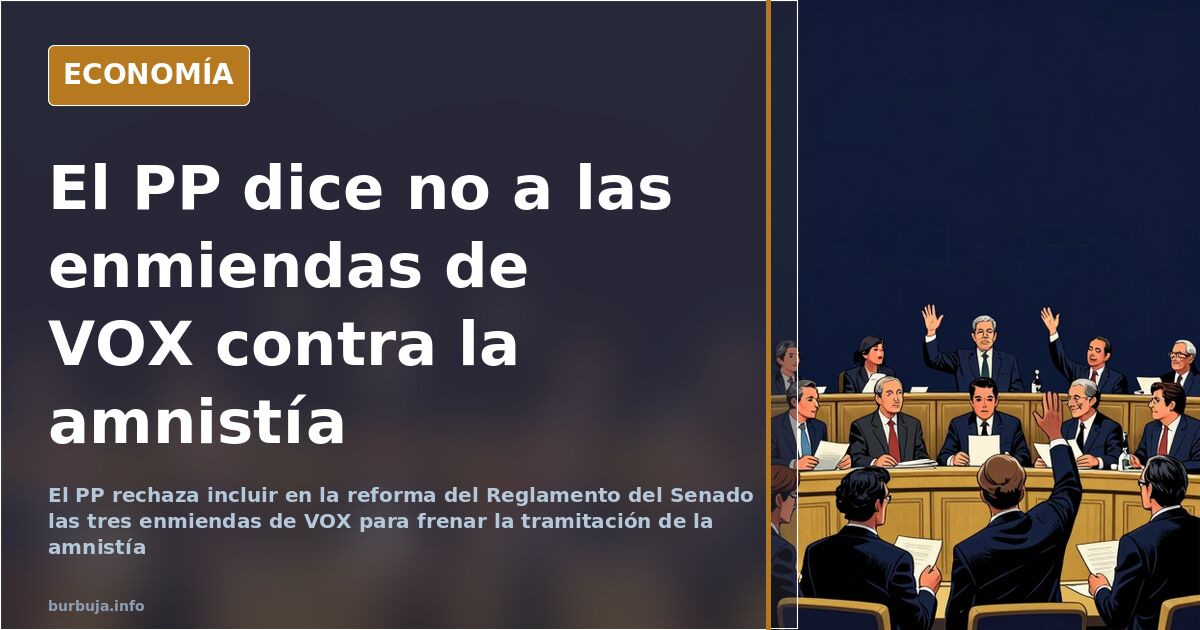
PP delays amnesty by two months but rejects Vox's procedural hurdles
The People's Party holds a majority in the Senate and can stretch the processing of the amnesty law for up to two months. However, it will not add the safeguards Vox requested in the reform of the Chamber's Rules of Procedure. The three amendments were rejected, eliminating the most direct path to challenge the norm before it reaches the Constitutional Court. From now on, the timeline and judicial channels remain the only tools available.
What Vox asked for and what PP rejected in the Senate Rules
Three amendments, three braking mechanisms. The first required the Senate's Chief Legal Officer (Letrado Mayor) to issue a report on the constitutionality of every legislative initiative. The second allowed one or more senators to request mandatory reports when a bill from Congress enters the Chamber. The third lowered the threshold to request urgent procedure from 25 to just one senator. None passed the majority group's filter.
Vox deputy Ignacio de Hoces summarized the discontent with two ideas: they are "deeply concerned" that PP does not incorporate these tools and see it as crucial to "sabotage by all possible means" what they consider an attack on the Rule of Law. His reasoning has an uncomfortable logic for Génova (PP headquarters): if PP maintains that the amnesty is a frontal attack on the Constitution, it should use every instrument at its disposal to stop it. It has not done so.
The Junts precedent cited in the debate
The debate recalls that years ago an amnesty law presented by Junts was rejected for being contrary to the Constitution. According to this narrative, that precedent is now invoked: if the unconstitutionality route sufficed then, PP could be expected to repeat the move and let the courts decide. Some argue it does not do so because it is not interested, sparking suspicion that runs through part of the debate. Coincidence, say the wittiest commentators.
Institutional clash: the Congress-Senate conflict that may end in court
According to circulating interpretations, the norm opens a conflict between chambers with few precedents. The Senate can veto, delay, and return the text, but not bury it: the final word returns to Congress, which can lift the veto and approve the law. PP has left the door open to paralyze the processing by alleging unconstitutionality, according to published reports, which would shift the standoff to the courts. In that scenario, the ball ends up where no one wants it.
And here appears the most repeated and slippery argument: that the final arbiter would be a Constitutional Court whose composition was decided in the previous stage. This is a political assertion by those who support it, not a proven fact, and should be treated as such. No one has demonstrated how the court will resolve it nor with what majority.
The cost in regional pacts and Vox's dilemma
PP and Vox share coalition governments in regions and municipalities. Hence the floating question: will Vox break those pacts if PP does not stop the amnesty? Part of the analysis deems such a rupture impossible—seat, perks, and position would weigh more—while another warns that if there is no rupture, the conclusion would be that there is no real opposition in Spain.
The counter-argument also circulates: if only Vox occupies the right-wing space and obtains the results it gets, perhaps the ideas it claims to defend are less majoritarian than its discourse suggests. It is a discussion about votes, not principles.
Urkullu and the territorial domino effect
The Lehendakari (Basque President) has stated that the amnesty opens the door to a referendum on the future of Euskadi, arguing that what is not prohibited is possible. This is the type of phrase that, according to commentators, turns a legal debate into a chain reaction. First Catalonia, then the Basque Country, then whoever joins the sustancia ilegal: the pattern repeats, always with the same warning that the Government will not allow it.
The thesis of role distribution
There is a more radical reading: that both parties serve the same interests and the confrontation is pure theater to entertain the crowd. From this perspective, PP would be a blue PSOE (Socialist Party) that has never repealed anything essential when governing. Some messages frame it, without providing any proof, within a supposed international agenda pushing to weaken the country. It is a political thesis, not a verified fact.
Where everything gets stuck
One current explains it by electoral calculation; another by complicity; a third by simple clumsiness of an opposition that arrives late everywhere. The numbers, for now, only allow one certainty: two months extension, three discarded amendments, and a ball returning to Congress. The rest is prognosis, and anyone claiming to know how it ends is selling something.
The People's Party holds a majority in the Senate and can stretch the processing of the amnesty law for up to two months. However, it will not add the safeguards Vox requested in the reform of the Chamber's Rules of Procedure. The three amendments were rejected, eliminating the most direct path to challenge the norm before it reaches the Constitutional Court. From now on, the timeline and judicial channels remain the only tools available.
What Vox asked for and what PP rejected in the Senate Rules
Three amendments, three braking mechanisms. The first required the Senate's Chief Legal Officer (Letrado Mayor) to issue a report on the constitutionality of every legislative initiative. The second allowed one or more senators to request mandatory reports when a bill from Congress enters the Chamber. The third lowered the threshold to request urgent procedure from 25 to just one senator. None passed the majority group's filter.
Vox deputy Ignacio de Hoces summarized the discontent with two ideas: they are "deeply concerned" that PP does not incorporate these tools and see it as crucial to "sabotage by all possible means" what they consider an attack on the Rule of Law. His reasoning has an uncomfortable logic for Génova (PP headquarters): if PP maintains that the amnesty is a frontal attack on the Constitution, it should use every instrument at its disposal to stop it. It has not done so.
The Junts precedent cited in the debate
The debate recalls that years ago an amnesty law presented by Junts was rejected for being contrary to the Constitution. According to this narrative, that precedent is now invoked: if the unconstitutionality route sufficed then, PP could be expected to repeat the move and let the courts decide. Some argue it does not do so because it is not interested, sparking suspicion that runs through part of the debate. Coincidence, say the wittiest commentators.
Institutional clash: the Congress-Senate conflict that may end in court
According to circulating interpretations, the norm opens a conflict between chambers with few precedents. The Senate can veto, delay, and return the text, but not bury it: the final word returns to Congress, which can lift the veto and approve the law. PP has left the door open to paralyze the processing by alleging unconstitutionality, according to published reports, which would shift the standoff to the courts. In that scenario, the ball ends up where no one wants it.
And here appears the most repeated and slippery argument: that the final arbiter would be a Constitutional Court whose composition was decided in the previous stage. This is a political assertion by those who support it, not a proven fact, and should be treated as such. No one has demonstrated how the court will resolve it nor with what majority.
The cost in regional pacts and Vox's dilemma
PP and Vox share coalition governments in regions and municipalities. Hence the floating question: will Vox break those pacts if PP does not stop the amnesty? Part of the analysis deems such a rupture impossible—seat, perks, and position would weigh more—while another warns that if there is no rupture, the conclusion would be that there is no real opposition in Spain.
The counter-argument also circulates: if only Vox occupies the right-wing space and obtains the results it gets, perhaps the ideas it claims to defend are less majoritarian than its discourse suggests. It is a discussion about votes, not principles.
Urkullu and the territorial domino effect
The Lehendakari (Basque President) has stated that the amnesty opens the door to a referendum on the future of Euskadi, arguing that what is not prohibited is possible. This is the type of phrase that, according to commentators, turns a legal debate into a chain reaction. First Catalonia, then the Basque Country, then whoever joins the sustancia ilegal: the pattern repeats, always with the same warning that the Government will not allow it.
The thesis of role distribution
There is a more radical reading: that both parties serve the same interests and the confrontation is pure theater to entertain the crowd. From this perspective, PP would be a blue PSOE (Socialist Party) that has never repealed anything essential when governing. Some messages frame it, without providing any proof, within a supposed international agenda pushing to weaken the country. It is a political thesis, not a verified fact.
Where everything gets stuck
One current explains it by electoral calculation; another by complicity; a third by simple clumsiness of an opposition that arrives late everywhere. The numbers, for now, only allow one certainty: two months extension, three discarded amendments, and a ball returning to Congress. The rest is prognosis, and anyone claiming to know how it ends is selling something.
Also available in: Deutsch
Summary of a discussion on Burbuja.info - Foro de economía, actualidad y política., translated from Spanish and reviewed before publication. Read the full discussion (126 replies).
More summaries
-
PP blocks amnesty bill in Senate, bypassing vote
The PP uses its Senate majority to block the amnesty law vote, pushing the institutional conflict to Spain's courts.
-
Spain's July 23 Election: Why Senate and Congress Votes Differ
Police warnings about vote discrepancies in Spain's July 23 election stem from distinct electoral systems, not fraud.
-
Spanish rower Jennie Sanchez quits sport for OnlyFans
With nearly 900,000 followers and a modest rowing scholarship, Spanish athlete Jennie Sanchez turns to digital content.
-
Spain's Health Ministry gives regions one week to agree on mask protocol
Health Ministry sets a one-week deadline for Spanish autonomous communities to adopt a common indoor mask protocol. Aragon has already moved ahead, while Galicia maintains its winter plan.
-
Ayala sues Maestre for defamation over false criminal record
Forum discusses Ayala's lawsuit against journalist Antonio Maestre, who accused him of violent crimes on TV despite a clean record.
-
Spanish Tesla Owners Consider Selling Over Musk's Politics
Some Tesla owners in Spain are considering selling their cars due to Elon Musk’s controversial public behavior and political shifts.