
Spain's Health Ministry gives regions one week to agree on mask protocol
Health Ministry sets a one-week deadline for Spanish autonomous communities to adopt a common indoor mask protocol. Aragon has already moved ahead, while Galicia maintains its winter plan.
English · Original discussion in Spanish · Published
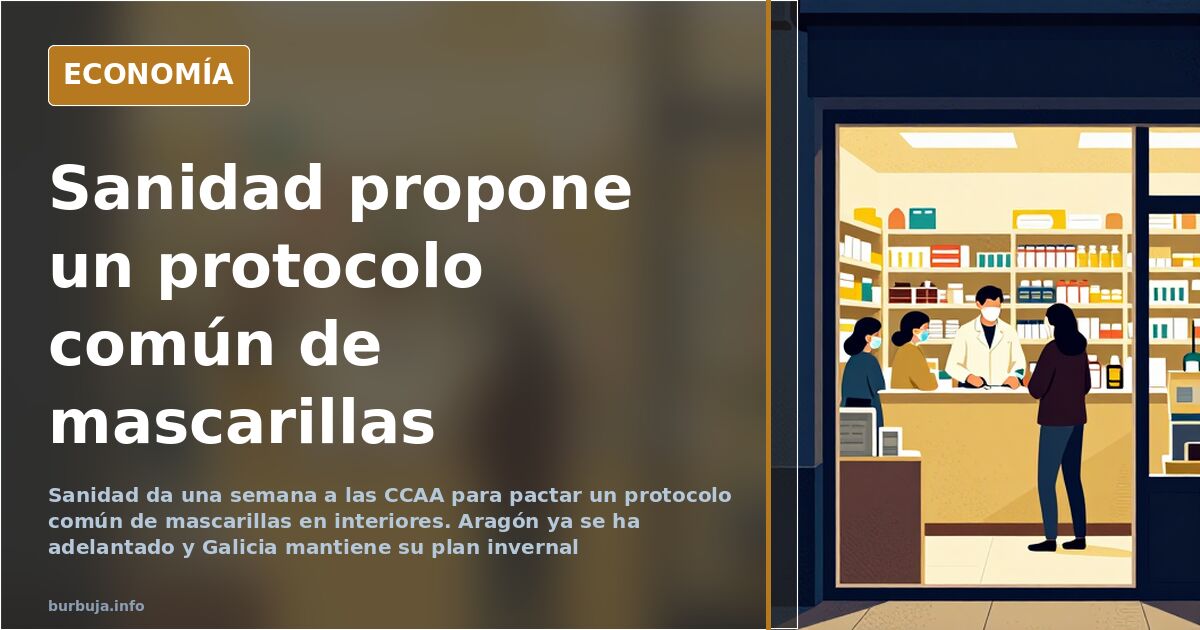
Health Ministry revives proposal for mandatory indoor masks
The Ministry of Health is pushing again with the instrument it previously tried to promote without success: a common protocol contemplating the mandatory use of masks in enclosed spaces when respiratory bicho curves rise. Minister Mónica García has given the autonomous communities until this week to join the plan, which would allow, according to her words, "to offer coordinated and reproducible responses throughout the territory." Last year the initiative faded and was reduced to a mere recommendation, something the minister herself attributes to it being "rejected and boycotted by the irresponsible members of the People's Party."
The fine print of the text to be negotiated includes a point that goes beyond the health sphere: the mandatory use of masks for all those whose work exposes them to face-to-face contact with the public or who interact with people showing symptoms compatible with or confirmed cases of respiratory infections. That is, not only hospitals and health centers. Also counters, service offices, and any direct customer service position.
Which communities have moved and which are resisting
The regional map already shows cracks. Aragon announced it will mandate mask-wearing in healthcare centers and enclosed spaces, consistent with recommendations from the Health Ministry. The minister celebrated this with sarcasm: "Aragon has moved ahead, but let's hope the rest of the PP communities respond to us this week." In Galicia, Sanidade activated two weeks ago its own Winter Health Plan, which includes recommending mask use in health centers, emergency care units (PAC), and urgent care facilities, whether or not symptoms are present, and in hospital services attending vulnerable patients.
The calendar is tight. The meeting between the Health Ministry and the communities includes an informational item on the Recommendations for the Control of Acute Respiratory Infections in the 2025-2026 season. Last year's text, finally published as a recommendation, already contemplated mandatory mask use for workers exposed to the public. The Ministry has not specified if it maintains the same proposals, which in any case will have to be negotiated with the autonomous regions.
The stock argument and the shadow of contracts
There is an argumentative thread running through much of the reaction that has little to do with health. The suspicion that behind the push lies an inventory problem: tons of masks bought during the pandemic that need to be placed somehow. References to medical material contracts awarded in those months appear repeatedly, with names of intermediaries and public officials who ended up in court. The temporal coincidence between the reactivation of the mask discourse and the judicial processes peine over those awards feeds the theory. There is no proof that both matters are connected, but the suspicion circulates strongly.
The second front is efficacy. A report is cited that, according to those wielding it, did not support widespread mask use. And an argument going another way is added: surgical masks would be useless against any bicho, while cloth ones are not even discussed. The conclusion many draw is that the measure responds more to a political choreography than to an epidemiological need.
From masks to the electoral calendar
The political reading is inevitable and appears in almost all parts of the conversation. Some maintain that the minister seeks her moment of glory before upcoming elections and that the measure is a way to act important. Others point to a broader calculation: reactivating the health conflict to mobilize a tired electorate and, incidentally, tense the atmosphere before Christmas. The phrase summarizing this current is that they want to "spoil Christmas because it belongs to right-wingers" to later free their own on marked dates in the festive calendar.
Opposite, the thesis that the regional right is trapped in a double-edged sword: if it accepts the protocol, it angers its base; if it rejects it, the minister already has the headline about irresponsibility. The PP lived that movie last year and the minister reminded them of it in writing in a letter sent last week to regional councilors, appealing "especially to the PP communities."
What is at stake in this week's meeting
The outcome is open. The meeting between the Health Ministry and the communities has on the table a document that, if approved as a common protocol, would allow coordinated and reproducible responses throughout the territory. If there is no agreement, it will remain once again as a recommendation and each autonomous community will do what it had been doing: Galicia with its winter plan, Aragon with its mandate in enclosed spaces, and the rest waiting.
Meanwhile, public conversation has filled with forecasts. Some assume lockdown is imminent and others remember that last year the same thing was announced without anything happening. The question floating, and that no one answers with data, is whether this time there is something different under the mask or if it is the same play with a new set.
The Ministry of Health is pushing again with the instrument it previously tried to promote without success: a common protocol contemplating the mandatory use of masks in enclosed spaces when respiratory bicho curves rise. Minister Mónica García has given the autonomous communities until this week to join the plan, which would allow, according to her words, "to offer coordinated and reproducible responses throughout the territory." Last year the initiative faded and was reduced to a mere recommendation, something the minister herself attributes to it being "rejected and boycotted by the irresponsible members of the People's Party."
The fine print of the text to be negotiated includes a point that goes beyond the health sphere: the mandatory use of masks for all those whose work exposes them to face-to-face contact with the public or who interact with people showing symptoms compatible with or confirmed cases of respiratory infections. That is, not only hospitals and health centers. Also counters, service offices, and any direct customer service position.
Which communities have moved and which are resisting
The regional map already shows cracks. Aragon announced it will mandate mask-wearing in healthcare centers and enclosed spaces, consistent with recommendations from the Health Ministry. The minister celebrated this with sarcasm: "Aragon has moved ahead, but let's hope the rest of the PP communities respond to us this week." In Galicia, Sanidade activated two weeks ago its own Winter Health Plan, which includes recommending mask use in health centers, emergency care units (PAC), and urgent care facilities, whether or not symptoms are present, and in hospital services attending vulnerable patients.
The calendar is tight. The meeting between the Health Ministry and the communities includes an informational item on the Recommendations for the Control of Acute Respiratory Infections in the 2025-2026 season. Last year's text, finally published as a recommendation, already contemplated mandatory mask use for workers exposed to the public. The Ministry has not specified if it maintains the same proposals, which in any case will have to be negotiated with the autonomous regions.
The stock argument and the shadow of contracts
There is an argumentative thread running through much of the reaction that has little to do with health. The suspicion that behind the push lies an inventory problem: tons of masks bought during the pandemic that need to be placed somehow. References to medical material contracts awarded in those months appear repeatedly, with names of intermediaries and public officials who ended up in court. The temporal coincidence between the reactivation of the mask discourse and the judicial processes peine over those awards feeds the theory. There is no proof that both matters are connected, but the suspicion circulates strongly.
The second front is efficacy. A report is cited that, according to those wielding it, did not support widespread mask use. And an argument going another way is added: surgical masks would be useless against any bicho, while cloth ones are not even discussed. The conclusion many draw is that the measure responds more to a political choreography than to an epidemiological need.
From masks to the electoral calendar
The political reading is inevitable and appears in almost all parts of the conversation. Some maintain that the minister seeks her moment of glory before upcoming elections and that the measure is a way to act important. Others point to a broader calculation: reactivating the health conflict to mobilize a tired electorate and, incidentally, tense the atmosphere before Christmas. The phrase summarizing this current is that they want to "spoil Christmas because it belongs to right-wingers" to later free their own on marked dates in the festive calendar.
Opposite, the thesis that the regional right is trapped in a double-edged sword: if it accepts the protocol, it angers its base; if it rejects it, the minister already has the headline about irresponsibility. The PP lived that movie last year and the minister reminded them of it in writing in a letter sent last week to regional councilors, appealing "especially to the PP communities."
What is at stake in this week's meeting
The outcome is open. The meeting between the Health Ministry and the communities has on the table a document that, if approved as a common protocol, would allow coordinated and reproducible responses throughout the territory. If there is no agreement, it will remain once again as a recommendation and each autonomous community will do what it had been doing: Galicia with its winter plan, Aragon with its mandate in enclosed spaces, and the rest waiting.
Meanwhile, public conversation has filled with forecasts. Some assume lockdown is imminent and others remember that last year the same thing was announced without anything happening. The question floating, and that no one answers with data, is whether this time there is something different under the mask or if it is the same play with a new set.
Summary of a discussion on Burbuja.info - Foro de economía, actualidad y política., translated from Spanish and reviewed before publication. Read the full discussion (123 replies).
More summaries
-
Spain's 1970s and 80s apartment blocks: how many years of useful life remain?
Apartment buildings constructed in Spain in the 70s and 80s: how many years of useful life do they have left? We analyse construction quality and the problems.
-
Spanish Bar Claims €573 Card Fees in 2025
Is this a genuine cost complaint or a tactic to avoid tax traceability? We analyze the debate.
-
Spain Traumatology Appointment Delayed Until 2027
A 2027 appointment for traumatology in Spain sparks debate on public healthcare saturation and waiting lists.
-
Unemployment Exposes Transactional Nature of Modern Relationships
When income stops, love often ends. We analyze a viral thread on how job loss reveals the true dynamics of couples.
-
Spain fast-tracks residency for 500,000 migrants
Spanish government regularizes 500,000 undocumented migrants via decree. Analysis of legal impact and potential voting rights within two years.
-
Far-Right Activist Nearly Lynched in Minnesota
A far-right provocateur was nearly lynched in Minnesota after insulting Muslims. The incident reignites debates on political violence and free speech.