
Portugal: Tent Living Emerges Amid Rent Crisis
A TVE report highlights tent settlements in Portugal driven by unaffordable rents, contrasting with Spanish wage levels.
English · Original discussion in Spanish · Published
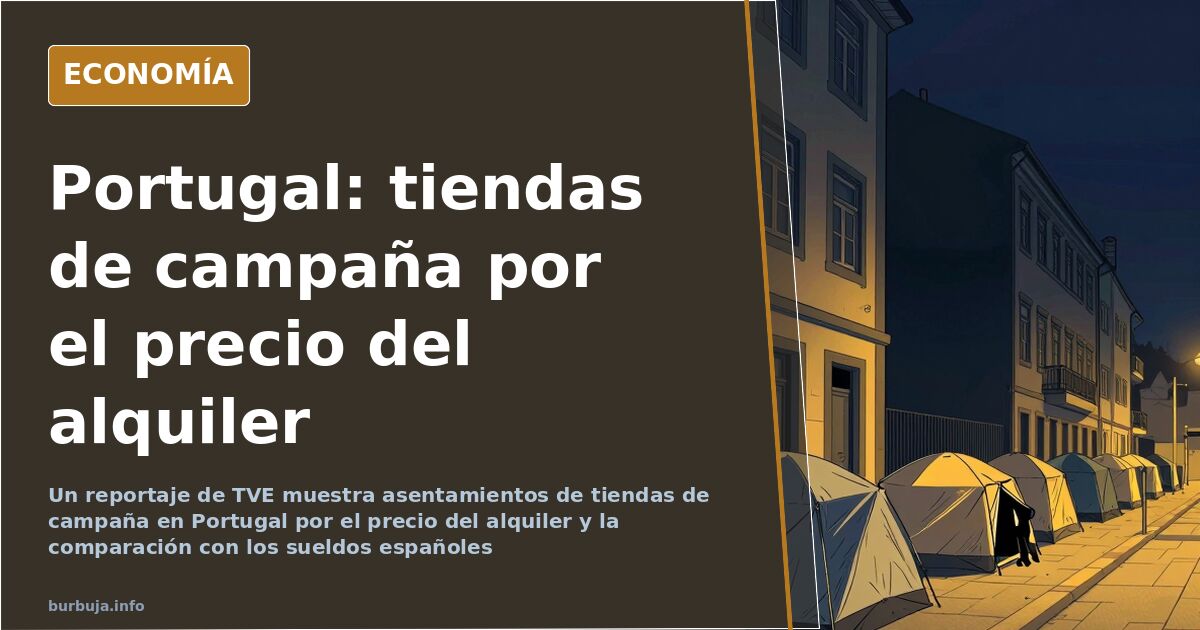
Portugal: Unaffordable Rents Force People to Live in Tents
Tent settlements occupied by people unable to afford rent are beginning to appear in Portugal. This observation comes not from a formal report but from a segment aired on TVE news programs, which attributes the phenomenon to rising prices. The real issue begins here, as there is no consensus on what has failed—rents, wages, or both simultaneously.
What Peine to Housing Prices in Portugal?
The report discusses settlements and prices rather than specific regions. The prevailing interpretation is that housing costs have detached from income levels, with a tourist market capturing increasingly more square footage. Within this context, an unverified figure emerges: 4,000 euros per square meter in Lisbon. This data point lacks a source and should be treated with caution; however, multiple voices confirm that the Portuguese capital, once considered affordable, is no longer so.
The scene includes a detail that makes it even more unsettling. The tent, the cheapest item in any sports store catalog, has become an emergency housing solution: some are even renting out two-person models described as being "in perfect condition." Here lies the bitter irony of the entire situation.
Lisbon: From Affordable City to Showcase for Tourist Rentals
Those who visited Lisbon a decade ago recall something different. "Lisbon was very cheap," summarizes one of the most repeated observations, immediately identifying the culprits: short-term rentals and digital nomads. In just a few years, a neighborhood apartment began competing with the profitability of nightly room rentals. The mechanism is not unique; it mirrors the same dynamic that has displaced residents from city centers across much of Europe.
The comparison most frequently cited is New York, where limits have been imposed on short-term rental housing. Some demand similar controls in Portugal, with tones ranging from warning to alerts about social patience reaching its limit. On the other side lies the classic argument: without liberalizing land use, supply will never grow. Two opposing solutions for the same campsite.
How Much Do People Actually Earn in Spain?
And here the rift opens. If Portugal is viewed as a mirror, the immediate question is how much margin a Spanish worker has before ending up in the same situation. The numbers provided are stubborn facts: in 2021, the most common salary in Spain was 1,540 euros gross (1,277 net), and the median was 1,800 gross (1,461 net). With these figures, a shared room consumes half a paycheck, and savings cease to exist.
Based on this, various cases pile up: an administrative assistant in Madrid earning 1,206 euros net; a newly hired primary school teacher earning around 1,600; civil servants at level C earning approximately 1,600; and people in Navarra earning 1,120. One of the most repeated stories involves someone who left Madrid for Santander for an extra 400 euros—from 1,200 to 1,600—because the numbers didn't add up.
In response, counterarguments arrive with equal confidence but fewer documents: claims that "no one earns 1,200 euros," that normal salaries range between 1,800 and 3,500 net, that 2,400 plus VAT amounts to only 37,000 gross, and that for an engineer, this is a "pittance." The argument concludes with a couple earning 5,000 monthly and 75,000 net annually—described as "just above the lumpen level"—and an order to go out and verify that restaurants are full.
Personal Spending as an Excuse
No conversation about prices escapes individual blame. Here it appears in its classic form: if someone lives worse, it must be because they pay for subscriptions and high-end mobile phones. It is the most comfortable reasoning, transforming a problem of incomes and housing supply into a consumer decision, avoiding any need to touch markets or wages.
What If the Campsites Are Already Here?
Suspicion runs through the entire analysis: that Spain has such settlements, and more numerous ones, simply not shown on television. The involuntary reference points are camps linked to intensive agriculture and greenhouse landscapes. The comparison hurts because it shifts the focus: it would not be a Portuguese anomaly but a European trend with varying degrees of visibility.
At the same time, geographic mobility reappears as the only exit for many: leaving big cities, sharing apartments longer than planned, adjusting expectations. A roommate who worked remotely for 1,000 euros found 1,600 in Santander. The math works out there, not on the salary side.
With these elements, the diagnosis remains incomplete. If the problem is housing, the answer is supply and regulation; if it is wages, the answer is different and touches more nerves. Both fit within the image of tents. Neither explains why we still look at Portugal as if it were a foreign country.
Tent settlements occupied by people unable to afford rent are beginning to appear in Portugal. This observation comes not from a formal report but from a segment aired on TVE news programs, which attributes the phenomenon to rising prices. The real issue begins here, as there is no consensus on what has failed—rents, wages, or both simultaneously.
What Peine to Housing Prices in Portugal?
The report discusses settlements and prices rather than specific regions. The prevailing interpretation is that housing costs have detached from income levels, with a tourist market capturing increasingly more square footage. Within this context, an unverified figure emerges: 4,000 euros per square meter in Lisbon. This data point lacks a source and should be treated with caution; however, multiple voices confirm that the Portuguese capital, once considered affordable, is no longer so.
The scene includes a detail that makes it even more unsettling. The tent, the cheapest item in any sports store catalog, has become an emergency housing solution: some are even renting out two-person models described as being "in perfect condition." Here lies the bitter irony of the entire situation.
Lisbon: From Affordable City to Showcase for Tourist Rentals
Those who visited Lisbon a decade ago recall something different. "Lisbon was very cheap," summarizes one of the most repeated observations, immediately identifying the culprits: short-term rentals and digital nomads. In just a few years, a neighborhood apartment began competing with the profitability of nightly room rentals. The mechanism is not unique; it mirrors the same dynamic that has displaced residents from city centers across much of Europe.
The comparison most frequently cited is New York, where limits have been imposed on short-term rental housing. Some demand similar controls in Portugal, with tones ranging from warning to alerts about social patience reaching its limit. On the other side lies the classic argument: without liberalizing land use, supply will never grow. Two opposing solutions for the same campsite.
How Much Do People Actually Earn in Spain?
And here the rift opens. If Portugal is viewed as a mirror, the immediate question is how much margin a Spanish worker has before ending up in the same situation. The numbers provided are stubborn facts: in 2021, the most common salary in Spain was 1,540 euros gross (1,277 net), and the median was 1,800 gross (1,461 net). With these figures, a shared room consumes half a paycheck, and savings cease to exist.
Based on this, various cases pile up: an administrative assistant in Madrid earning 1,206 euros net; a newly hired primary school teacher earning around 1,600; civil servants at level C earning approximately 1,600; and people in Navarra earning 1,120. One of the most repeated stories involves someone who left Madrid for Santander for an extra 400 euros—from 1,200 to 1,600—because the numbers didn't add up.
In response, counterarguments arrive with equal confidence but fewer documents: claims that "no one earns 1,200 euros," that normal salaries range between 1,800 and 3,500 net, that 2,400 plus VAT amounts to only 37,000 gross, and that for an engineer, this is a "pittance." The argument concludes with a couple earning 5,000 monthly and 75,000 net annually—described as "just above the lumpen level"—and an order to go out and verify that restaurants are full.
Personal Spending as an Excuse
No conversation about prices escapes individual blame. Here it appears in its classic form: if someone lives worse, it must be because they pay for subscriptions and high-end mobile phones. It is the most comfortable reasoning, transforming a problem of incomes and housing supply into a consumer decision, avoiding any need to touch markets or wages.
What If the Campsites Are Already Here?
Suspicion runs through the entire analysis: that Spain has such settlements, and more numerous ones, simply not shown on television. The involuntary reference points are camps linked to intensive agriculture and greenhouse landscapes. The comparison hurts because it shifts the focus: it would not be a Portuguese anomaly but a European trend with varying degrees of visibility.
At the same time, geographic mobility reappears as the only exit for many: leaving big cities, sharing apartments longer than planned, adjusting expectations. A roommate who worked remotely for 1,000 euros found 1,600 in Santander. The math works out there, not on the salary side.
With these elements, the diagnosis remains incomplete. If the problem is housing, the answer is supply and regulation; if it is wages, the answer is different and touches more nerves. Both fit within the image of tents. Neither explains why we still look at Portugal as if it were a foreign country.
Summary of a discussion on Burbuja.info - Foro de economía, actualidad y política., translated from Spanish and reviewed before publication. Read the full discussion (148 replies).
More summaries
-
Madrid rent of €1,600 on an average salary of €2,077
A 45 m² flat in Madrid is listed at €1,600 a month, while the average salary in the capital is €2,077. The numbers don't add up.
-
Madrid's Tent Camps and Housing Crisis: Urban Precarity
Tent camps in Madrid highlight Spain's housing collapse and urban precarity, affecting areas like Gran Vía and M-30 embankments.
-
Madrid's impossible reality: soaring prices, tourism and migration pressure
Rents skyrocketing, tourist pressure and a capital that pushes out its residents: why Madrid has become unaffordable for those who live there.
-
The Elite Education of Tenant Spokespeople Sparks Controversy
Controversy erupts as the elite international education backgrounds of prominent tenant movement spokespeople are revealed, challenging their narrative of precarity.
-
Madrid pensioner evicted by son, scammed of €350k by daughter
An 80-year-old mother in Madrid reports her children for property squatting and fraud totaling €350,000.
-
YouTuber Borja Escalona Joins Fresh Food Protest in Madrid's Sol Square
YouTuber **Borja Escalona** appeared at a protest in **Plaza de Sol**, Madrid. We analyze the economic context of such events.