
Portbou 1990: Hanged Tourist, Missing Forensic Report
In 1990, a young Central European woman was found hanged in Portbou, Spain. A TV3 documentary revisits the unsolved case and forensic failures.
English · Original discussion in Spanish · Published
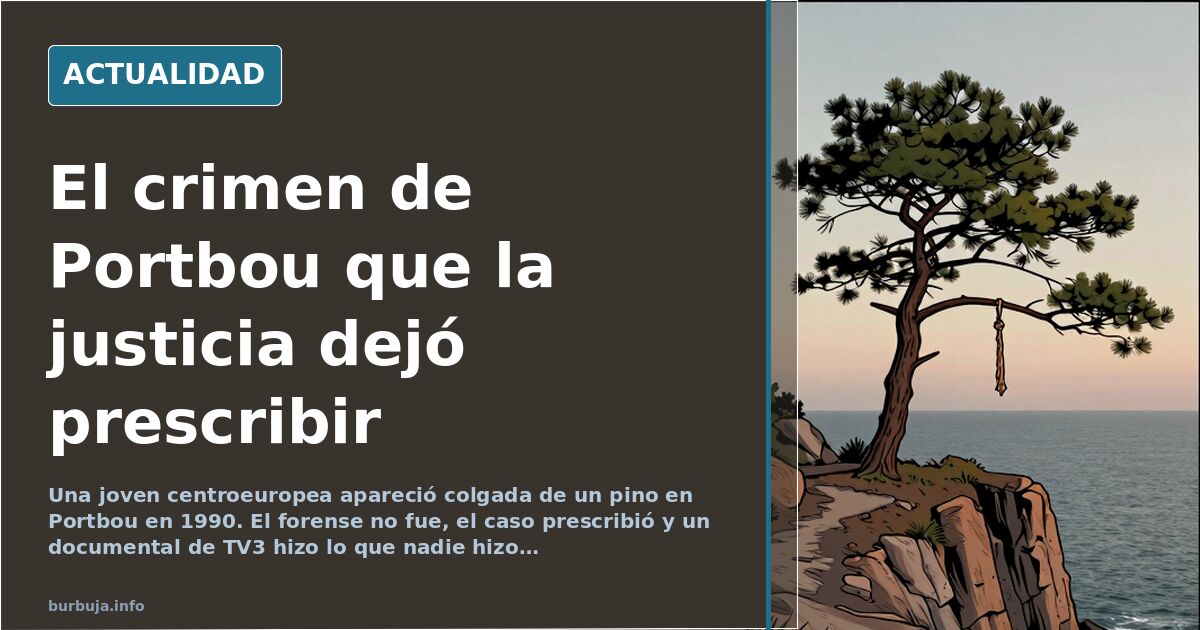
Portbou 1990: Hanged Tourist, Missing Forensic Report
In the summer of 1990, a young Central European woman was found hanged from a pine tree in Portbou, Spain. She was barely over twenty, traveling alone through Europe with plans to visit Siena. She never arrived. Her body was discovered at night on rough terrain, with no injuries on the soles of her feet. This detail, obvious today, took years to reach those who should have interpreted it: the medical examiner did not attend the scene when the body was removed.
The case, falsely closed for decades, has returned to public discourse thanks to a documentary by Crims, Carles Porta’s program on TV3. The official account dismissed it as suicide, but an uncomfortable question remains: why would a girl with no known problems, insufficient money to return home, and a train ticket to Italy end up hanged 900 kilometers off her route?
What Peine in Portbou That Summer
At that time, the municipality in Girona province was a border crossing point with France by road and rail. Police presence was heavy: a Civil Guard barracks and an Armed Police unit at the station, which, according to a photo from the era, numbered around fourteen agents. Estimates circulating in the debate suggest there could have been about thirty officers in total in such a small town.
In this context, a group of young Austrians was camping near where the body was found. They spoke German, the same language as the victim, who came from a northern Italian region where German is spoken. They stayed in the area, claimed they saw and heard nothing, and returned to their country. Years later, when journalists tried to contact them, responses were dry and evasive; one allegedly refused even to provide details about the rest of the group.
The Missing Examiner and Late Report
Medical examiner Lacacci did not travel to the scene on the day of the incident. He cited personal car issues and disagreements with administration, as reported. When he reviewed Civil Guard photos years later—photos he hadn’t seen at the time—his conclusion changed: it was murder, likely committed by two people who hanged the girl while she was unconscious.
This shift is central to the case. Had the examiner been present initially, he would have identified a Central European woman, noticed she lacked leg hair—an indicator pointing to German origin—and ruled out solo suicide on abrupt terrain at night. The chain of errors didn’t end there: the body was sent to a common grave without judicial authorization, leaving the family without remains to mourn.
Austrian Hypothesis: What Supports It
The most repeated analysis points to the group of young Austrians. Arguments include: they spoke the same language, camped nearby, failed to cooperate afterward, and one had knowledge of knots. It is suggested the girl might have boarded their van in France, traveled with them to Spain, and something went wrong that night: an argument, accidental overdose, or suffocation. Then, hanging her to simulate suicide.
Against this weighs physical evidence: crossing two borders with a corpse in a crowded van is, at least, reckless. There are also no blood tests confirming drug ingestion, as none were performed. The Civil Guard neither detained nor thoroughly interrogated the youths, who left the country without further trouble.
Why the Case Remains Open
In Austria and Italy, homicide does not prescribe. In Spain, it does. This legal asymmetry explains the anger of those trinc the case: if suspects had been investigated in their countries, the file would still be active. Here, the case was closed, leaving the family without justice or remains.
The TV3 documentary achieved what neither the Civil Guard nor the Justice system had: identifying the girl. A television program did the work the State abandoned. The overarching question isn’t who killed her, but why no one wanted to find out.
Note: This article is based on debate material and published information about the case. Authorship hypotheses have not been judicially confirmed.
Also available in: Deutsch
Summary of a discussion on Burbuja.info - Foro de economía, actualidad y política., translated from Spanish and reviewed before publication. Read the full discussion (122 replies).
More summaries
-
PACMA Calls Protest on October 4 Against Valdepeñas 'Cat Killer'
PACMA has called a protest on October 4 in Valdepeñas against the 'cat killer,' a former civil guard accused of killing stray cats.
-
Spain: Sánchez decree silences police and Civil Guard in Ceuta
Sánchez's royal decree on Ceuta comes a month late, with no state of emergency, and includes penalties for Civil Guard and police officers who report to the press.
-
Moroccan dirham falls 7% in days, according to forum user
A participant claims the dirham drops 7% in days and the trade deficit exceeds $17 billion, without material confirming it with…
-
Bavaria: One farmer dies by suicide every week
A Bavarian study published in the Federal Health Bulletin puts farm suicides at one per week, a rate three times higher than in other sectors. Drought, debt and collapsed prices.
-
Pérez-Reverte and the migrant boat recolonizing Europe
A quote attributed to Pérez-Reverte about the Mediterranean recolonizing Europe sparks mockery, accusations of hypocrisy and a debate over demographics and book sales
-
Masterpiece post on X claims Madrid statues come to life
A post on X suggests that statues in Madrid, Spain, come to life. The brief, emoji-filled text offers no evidence and plays on rumor. Here is what it actually says.