
Pope Francis on Spain: Colonization, Not Conquest
The Pope distinguishes colonization from conquest, praises Spanish royal directives, and calls Spain 'Motherland' amid tensions with Mexico.
English · Original discussion in Spanish · Published
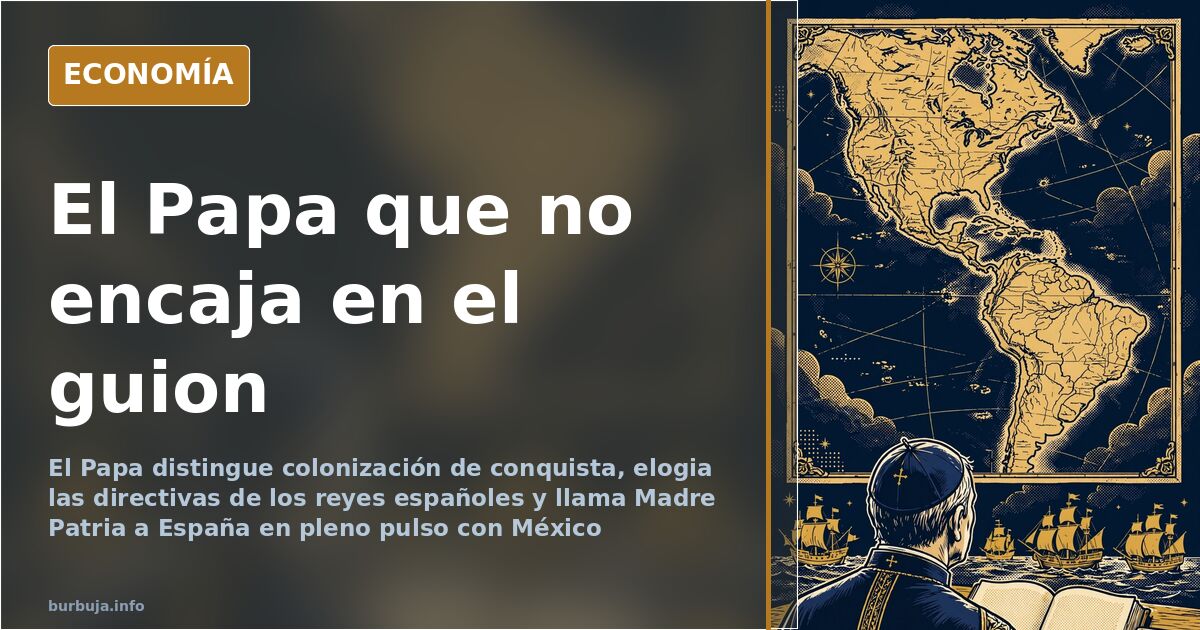
The Pope reclaims Spain and disrupts his own narrative
What did Pope Francis say about Spain, and why does it clash with his assigned image? In an interview published in ABC, Bergoglio separates two words often used as synonyms: colonization and conquest. He argues that the historical hermeneutics "must be that of its time, not the current one." He acknowledges deaths and exploitation but adds that "the Indians killed each other" and that the warlike environment "was not exported by the Spanish." None of this fits the one-dimensional character often portrayed daily.
What the Pope said about colonization and conquest
The core of the text is a semantic distinction with consequences. "I distinguish colonization from conquest. I do not like to say that Spain conquered," he states, clarifying that this is a debatable but deliberate position. The argument is not based on patriotic epic but on the law of the time: "If one reads the directives of the Spanish kings of the time on how their representatives should act, no king of any other country did so much".
The comparison with other empires is explicit and not particularly flattering to competitors. Spain, he says, entered the territory; other imperial countries stayed on the coast. He concludes: "Spain did not pirate." Behind this difference, he argues, is a mysticism that explains why Spain remains the Mother Country, "something not all countries can say."
Why the interview is read as support for Isabella the Catholic
There is a strong diplomatic reading: the text arrives days after the Mexican president tried to use the Pope in his dispute with the Spanish Crown. Those trinc this conflict believe that Francis, by praising the instructions of the monarchs of the time, defends the memory of Isabella the Catholic, who is in the process of beatification. The phrase about royal directives is not an erudite comment: it is a stance.
This detail explains the discomfort on two fronts. It annoys those who expected the pontiff to condemn the Spanish past without nuance and disorients those who have spent years building their internal criticism based on that same condemnation.
The cross-referenced data: technology, universities, and hospitals
The papal backing reopens the technical file. Contrary to the idea of a minor power, it is recalled that in the 15th and 16th centuries, cutting-edge technology was in the Spanish empire, with sustained naval and navigational dominance for decades. The most cited case is that of Jerónimo de Ayanz, attributed with a steam engine a century before the Industrial Revolution.
The list of comparative grievances does not end there. It is emphasized that more than 30 universities were created where indigenous people were admitted before the Mayflower reached the American coast, along with hospitals, cathedrals, and libraries. The closing argument is contundent: judging a colonization of almost 400 years by its first 20 is, in words circulating in the analysis, to be quite foolish.
The reaction: from outright rejection to reconciliation
A part of the more traditional Catholic public rejects the message outright, arguing that the pontiff plays both sides, is a thoroughgoing globalist, and that his true face only appears when filtered by the press. Another part, however, admits unexpected twists: some recognize that they considered him hostile to Spain and that, with these words, they are beginning to reconcile with him. There are also those who recall that the same pope had previously expressed praise for the Spanish work in America, collected even in popular history books.
The most repeated diagnosis is not against the pope, but against those who read him: many believers do not know the foundations of their own doctrine and end up classifying the pontiff as liberal or communist according to each one's ideology. Catholicism would thus be subordinated, in practice, to the current ideological cheese.
Going to the source: the Vatican vs. the headline
The recommended method is simple: before getting indignant, read the original document. The letters, homilies, and speeches are published on the Vatican's website, and the contrast with headlines is notable. The most cited example is that of the apology: no apology was asked for for the evangelization, but for the sins committed during the process, recalling that the graces outweighed those sins. That is, the opposite of what is attributed to him.
This is added to the appointment of two Spaniards on the council of cardinals reforming the curia, a gesture that few headlines covered with the same enthusiasm as they cover his supposed missteps.
The underlying paradox remains: a pontiff who is asked to condemn Spain ends up recalling that it was the only crown that legislated on how to treat the subjects on the other side of the Atlantic. If that surprises anyone, the surprise says much more about the narrative than about the Pope.
What did Pope Francis say about Spain, and why does it clash with his assigned image? In an interview published in ABC, Bergoglio separates two words often used as synonyms: colonization and conquest. He argues that the historical hermeneutics "must be that of its time, not the current one." He acknowledges deaths and exploitation but adds that "the Indians killed each other" and that the warlike environment "was not exported by the Spanish." None of this fits the one-dimensional character often portrayed daily.
What the Pope said about colonization and conquest
The core of the text is a semantic distinction with consequences. "I distinguish colonization from conquest. I do not like to say that Spain conquered," he states, clarifying that this is a debatable but deliberate position. The argument is not based on patriotic epic but on the law of the time: "If one reads the directives of the Spanish kings of the time on how their representatives should act, no king of any other country did so much".
The comparison with other empires is explicit and not particularly flattering to competitors. Spain, he says, entered the territory; other imperial countries stayed on the coast. He concludes: "Spain did not pirate." Behind this difference, he argues, is a mysticism that explains why Spain remains the Mother Country, "something not all countries can say."
Why the interview is read as support for Isabella the Catholic
There is a strong diplomatic reading: the text arrives days after the Mexican president tried to use the Pope in his dispute with the Spanish Crown. Those trinc this conflict believe that Francis, by praising the instructions of the monarchs of the time, defends the memory of Isabella the Catholic, who is in the process of beatification. The phrase about royal directives is not an erudite comment: it is a stance.
This detail explains the discomfort on two fronts. It annoys those who expected the pontiff to condemn the Spanish past without nuance and disorients those who have spent years building their internal criticism based on that same condemnation.
The cross-referenced data: technology, universities, and hospitals
The papal backing reopens the technical file. Contrary to the idea of a minor power, it is recalled that in the 15th and 16th centuries, cutting-edge technology was in the Spanish empire, with sustained naval and navigational dominance for decades. The most cited case is that of Jerónimo de Ayanz, attributed with a steam engine a century before the Industrial Revolution.
The list of comparative grievances does not end there. It is emphasized that more than 30 universities were created where indigenous people were admitted before the Mayflower reached the American coast, along with hospitals, cathedrals, and libraries. The closing argument is contundent: judging a colonization of almost 400 years by its first 20 is, in words circulating in the analysis, to be quite foolish.
The reaction: from outright rejection to reconciliation
A part of the more traditional Catholic public rejects the message outright, arguing that the pontiff plays both sides, is a thoroughgoing globalist, and that his true face only appears when filtered by the press. Another part, however, admits unexpected twists: some recognize that they considered him hostile to Spain and that, with these words, they are beginning to reconcile with him. There are also those who recall that the same pope had previously expressed praise for the Spanish work in America, collected even in popular history books.
The most repeated diagnosis is not against the pope, but against those who read him: many believers do not know the foundations of their own doctrine and end up classifying the pontiff as liberal or communist according to each one's ideology. Catholicism would thus be subordinated, in practice, to the current ideological cheese.
Going to the source: the Vatican vs. the headline
The recommended method is simple: before getting indignant, read the original document. The letters, homilies, and speeches are published on the Vatican's website, and the contrast with headlines is notable. The most cited example is that of the apology: no apology was asked for for the evangelization, but for the sins committed during the process, recalling that the graces outweighed those sins. That is, the opposite of what is attributed to him.
This is added to the appointment of two Spaniards on the council of cardinals reforming the curia, a gesture that few headlines covered with the same enthusiasm as they cover his supposed missteps.
The underlying paradox remains: a pontiff who is asked to condemn Spain ends up recalling that it was the only crown that legislated on how to treat the subjects on the other side of the Atlantic. If that surprises anyone, the surprise says much more about the narrative than about the Pope.
Summary of a discussion on Burbuja.info - Foro de economía, actualidad y política., translated from Spanish and reviewed before publication. Read the full discussion (256 replies).
More summaries
-
The Future of the Catholic Church: Priests Marrying and Having Children
The Catholic Church might relax celibacy for priests, allowing marriage and parenthood in response to the vocation crisis.
-
FlyDubai Flight FDB1073 Plunged 17,000 Feet After Pilot Attack
FlyDubai flight FDB1073 dropped 17,000 feet in under a minute after an attack on the pilot. Israel calls it a terrorist attack and the investigation...
-
Spain's police remove anti-Sánchez banner in minutes, squatters wait years
Spanish police swiftly removed an anti-Sánchez banner while property owners wait years to evict squatters, highlighting a perceived double standard.
-
Iranian driver without license kills two in Fuengirola crash
An unlicensed, intoxicated Iranian woman plowed into a restaurant terrace in Fuengirola, Spain, killing two and injuring ten.
-
Spain's solar surplus may face negative prices during grid saturation
In Spain, solar users report that exporting excess energy can incur costs during peak production hours, challenging the assumption of guaranteed savings from photovoltaic installations.
-
Biden quits, Democrats scramble for new nominee
Biden exits the presidential race without endorsing Kamala Harris. The Democratic Party seeks a replacement while Trump appears strengthened after the assassination attempt.