
Poltava strike: Kyiv admits 54 dead; Swedish minister resigns
Kyiv confirms 54 military deaths in the Poltava attack amid conflicting casualty reports and the resignation of Sweden's foreign minister.
English · Original discussion in Spanish · Published
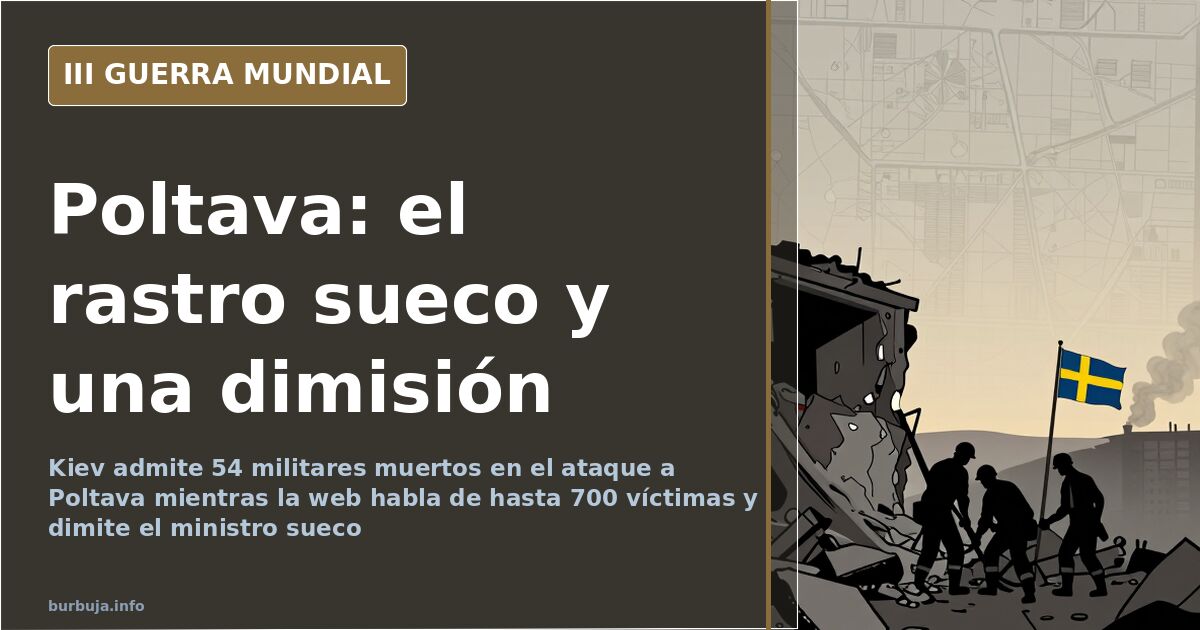
Poltava: The Swedish trail and a resignation in Stockholm
How many soldiers actually died at the Poltava communications institute? This is the question all involved chancelleries have been dodging for days. Kyiv admits 54 military fatalities and over 200 injured in the missile strike on the training center for electronic warfare and surveillance systems specialists. Outside official reports, figures skyrocket: some counts mention 250 to 300 bodies in morgues, others cite 600 to 700 dead, and local estimates claim 500 killed and 300 wounded out of approximately 2,000 people present in the building.
From 54 to 700 dead: why no figure adds up
The range is so vast that any headline automatically becomes propaganda for the opposing side. Some argue the real number aligns with the official report and that other figures are inflated for domestic consumption, while others suggest Ukrainian authorities acknowledged only a fraction of casualties to avoid breaking recruitment sarracena. Neither can be proven with available data.
Adding to the mix is an uncomfortable element: among the victims, according to those trinc the issue, were military specialists from NATO countries, including France, the Czech Republic, and Germany. This turns the count into a diplomatic matter, not just a statistical one. It also explains why the trickle of numbers never comes through the same channel.
The Swedish trail: SAAB, fifteen trucks, and a resignation
Sweden is the link generating the most noise. According to circulating data, almost the entire management of long-range radar detection and control systems by SAAB was located under the ruins of the center. There were talks of 15 trucks of corpses removed from the site and a convoy allegedly leaving Kyiv for Swedish territory. To be clear: this truck figure raises the most suspicion, as it requires stacking a number of bodies difficult to sustain even with large-capacity trailers.
What is verifiable is different. Swedish Foreign Minister Tobias Billström announced his resignation and permanent withdrawal from politics, including relinquishing his seat in the Riksdag (Swedish parliament). Sources cited by Latin American media speculated that the sudden move might be related to casualties suffered in Poltava. In parallel, the Ukrainian Foreign Minister also resigned. Two exits in the same week that no one has jointly explained.
What were NATO specialists doing at a communications center?
Here lies the most troubling point. The cadet course at the communications center was being promoted as a showcase of Swedish participation in NATO and the war, with foreign instructors and technical staff present. That means the concentration was known and publicized. Some note that gathering so many specialists around a radar, which emits signals and can therefore be tracked, is a basic security error.
Another reading, less favorable to Ukraine, argues the opposite: Russia has long tolerated such concentrations and only struck when the target justified it, implying a surveillance and human intelligence capability that the West systematically underestimates. Between the two hypotheses lies a huge difference: in the first, NATO sends its technicians into bait; in the second, Russia decides when to collect the fish.
In this context circulates unconfirmed data: after the attack, US Army Lieutenant Colonel Joshua Kamara unexpectedly died in Poland. No official report links him to these events.
The Ukrainian narrative also breaks from within
Gennady Druzenko, a medical officer in the Ukrainian Armed Forces, stated in declarations that the high death toll is explained because municipal services personnel who arrived first were not prepared to provide first aid and, in his version, finished off the wounded. This is a serious accusation against state institutions and must be treated as such: without independent verification.
Added to this is internal political strife. During the same period, there is talk of Ukraine with elections suspended due to martial law, banned parties, and open questioning of presidential leadership from within the country itself. The Poltava attack is not just a casualty problem: it fuels the discussion about who manages the war.
Poltava, 1709: historical coincidence
There is an irony highlighted by Russian narratives themselves: in Poltava, Swedes were already defeated by Russian arms in 1709. That three centuries later the city’s name would again be associated with Swedish casualties has been exploited to exhaustion as a historical joke. It is literature, not analysis. But it explains why this attack has worked so well as one-sided propaganda.
The only thing that can be stated with certainty at this stage is the mundane: there was a high-precision missile strike on a military training center with documented foreign presence, with a number of dead admitted by authorities far below what leaks suggest, and with two chancelleries left leaderless. Everything else, from the trucks to the generals some place among the deceased, remains in the realm of unverified claims.
And so we have spent weeks multiplying corpses on calculators while the only firm data remains the official report that no one believes.
How many soldiers actually died at the Poltava communications institute? This is the question all involved chancelleries have been dodging for days. Kyiv admits 54 military fatalities and over 200 injured in the missile strike on the training center for electronic warfare and surveillance systems specialists. Outside official reports, figures skyrocket: some counts mention 250 to 300 bodies in morgues, others cite 600 to 700 dead, and local estimates claim 500 killed and 300 wounded out of approximately 2,000 people present in the building.
From 54 to 700 dead: why no figure adds up
The range is so vast that any headline automatically becomes propaganda for the opposing side. Some argue the real number aligns with the official report and that other figures are inflated for domestic consumption, while others suggest Ukrainian authorities acknowledged only a fraction of casualties to avoid breaking recruitment sarracena. Neither can be proven with available data.
Adding to the mix is an uncomfortable element: among the victims, according to those trinc the issue, were military specialists from NATO countries, including France, the Czech Republic, and Germany. This turns the count into a diplomatic matter, not just a statistical one. It also explains why the trickle of numbers never comes through the same channel.
The Swedish trail: SAAB, fifteen trucks, and a resignation
Sweden is the link generating the most noise. According to circulating data, almost the entire management of long-range radar detection and control systems by SAAB was located under the ruins of the center. There were talks of 15 trucks of corpses removed from the site and a convoy allegedly leaving Kyiv for Swedish territory. To be clear: this truck figure raises the most suspicion, as it requires stacking a number of bodies difficult to sustain even with large-capacity trailers.
What is verifiable is different. Swedish Foreign Minister Tobias Billström announced his resignation and permanent withdrawal from politics, including relinquishing his seat in the Riksdag (Swedish parliament). Sources cited by Latin American media speculated that the sudden move might be related to casualties suffered in Poltava. In parallel, the Ukrainian Foreign Minister also resigned. Two exits in the same week that no one has jointly explained.
What were NATO specialists doing at a communications center?
Here lies the most troubling point. The cadet course at the communications center was being promoted as a showcase of Swedish participation in NATO and the war, with foreign instructors and technical staff present. That means the concentration was known and publicized. Some note that gathering so many specialists around a radar, which emits signals and can therefore be tracked, is a basic security error.
Another reading, less favorable to Ukraine, argues the opposite: Russia has long tolerated such concentrations and only struck when the target justified it, implying a surveillance and human intelligence capability that the West systematically underestimates. Between the two hypotheses lies a huge difference: in the first, NATO sends its technicians into bait; in the second, Russia decides when to collect the fish.
In this context circulates unconfirmed data: after the attack, US Army Lieutenant Colonel Joshua Kamara unexpectedly died in Poland. No official report links him to these events.
The Ukrainian narrative also breaks from within
Gennady Druzenko, a medical officer in the Ukrainian Armed Forces, stated in declarations that the high death toll is explained because municipal services personnel who arrived first were not prepared to provide first aid and, in his version, finished off the wounded. This is a serious accusation against state institutions and must be treated as such: without independent verification.
Added to this is internal political strife. During the same period, there is talk of Ukraine with elections suspended due to martial law, banned parties, and open questioning of presidential leadership from within the country itself. The Poltava attack is not just a casualty problem: it fuels the discussion about who manages the war.
Poltava, 1709: historical coincidence
There is an irony highlighted by Russian narratives themselves: in Poltava, Swedes were already defeated by Russian arms in 1709. That three centuries later the city’s name would again be associated with Swedish casualties has been exploited to exhaustion as a historical joke. It is literature, not analysis. But it explains why this attack has worked so well as one-sided propaganda.
The only thing that can be stated with certainty at this stage is the mundane: there was a high-precision missile strike on a military training center with documented foreign presence, with a number of dead admitted by authorities far below what leaks suggest, and with two chancelleries left leaderless. Everything else, from the trucks to the generals some place among the deceased, remains in the realm of unverified claims.
And so we have spent weeks multiplying corpses on calculators while the only firm data remains the official report that no one believes.
Summary of a discussion on Burbuja.info - Foro de economía, actualidad y política., translated from Spanish and reviewed before publication. Read the full discussion (171 replies).
More summaries
-
Massive attack on Ukraine: from 72 official missiles to more than 180
The massive attack on Ukraine leaves figures that don't add up: 72 official missiles, more than 180 in other accounts, and major cities without power
-
Gisbert and Sivaya: Romance Amid Ukraine War Narratives
Analysis of media coverage for Rubén Gisbert and Liu Sivaya during the Ukraine war. Is this digital propaganda or reality?
-
Flat Earth Paradox: Elite Power vs. Free Speech
A forum user argues that a global flat-Earth conspiracy requires an omnipotent elite unable to silence dissenters, sparking debate.
-
Russia Offers Asylum to Critics of Western Gender Policies
Putin signs decree granting asylum to foreigners rejecting Western gender policies, but war risks deter potential migrants.
-
Russia declares Mariupol captured as Azovstal defenders hold out
Moscow announces control of Mariupol, but over 2,000 Ukrainian troops remain besieged in the Azovstal steel plant.
-
Unconfirmed reports of 40 French legionnaires killed in Slaviansk
Two accounts claim an Iskander missile killed 40 French legionnaires in Slaviansk, but no official confirmation exists.