
Polish waitress murder reignites EU migration debate
A 24-year-old Polish waitress died after being attacked by a Venezuelan migrant in Toruń, sparking controversy over Hispanic identity and immigration.
English · Original discussion in Spanish · Published
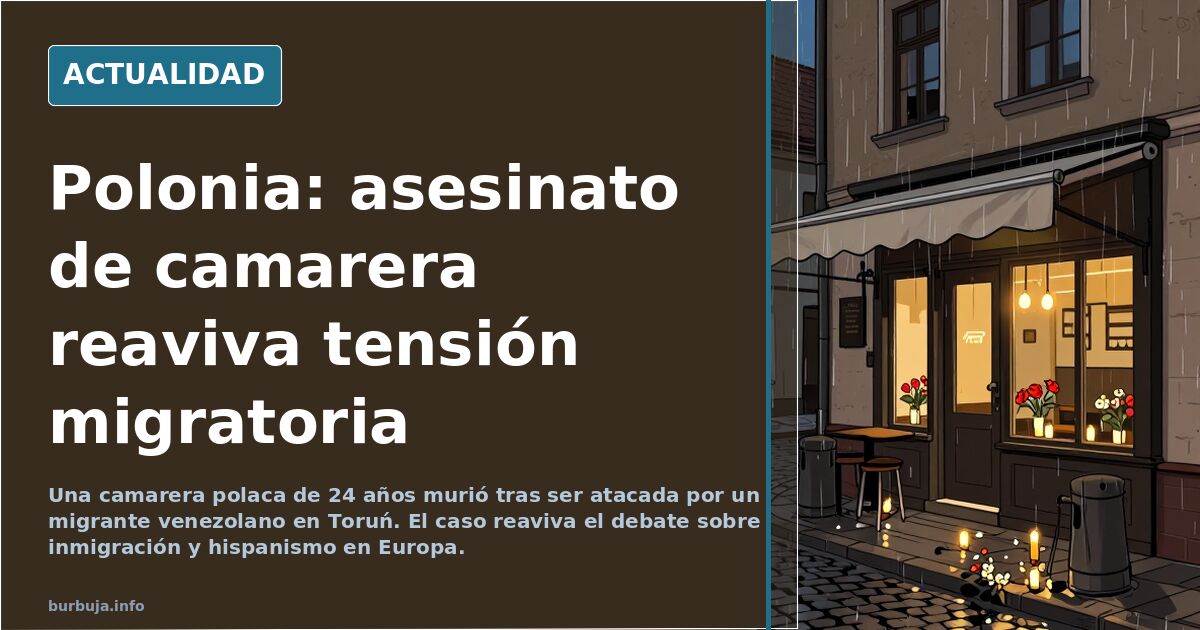
Polish waitress murder reignites EU migration debate
Klaudia K., a 24-year-old woman, died on June 27, 2025, after two weeks of hospitalization for injuries sustained during an attack on June 12 in Toruń (Poland). According to reports, Yomeykert R.-S., a 19-year-old Venezuelan who had arrived legally in February, was arrested shortly after and faces potential life imprisonment. The extreme violence triggered anti-government protests and intense debate on migration policies. However, the discussion has shifted to accusations regarding "Hispanidad" (the concept of Ibero-American cultural community) and Latin American immigration in Spain, ranging from total rejection of migration flows to calls for stricter integration and penalties.
The crime that shocked Toruń
The incident occurred early on June 12. Klaudia K., a waitress, was attacked while returning home from her shift. The alleged aggressor raped and repeatedly stabbed her in the head, neck, and chest. A passerby intervened, scaring off the attacker and allowing emergency services to arrive. The victim fought for her life for two weeks but died on Friday, June 27. The suspect, Yomeykert R.-S., entered Poland as a legal migrant in February and was detained soon after. He faces possible life imprisonment.
The impact was immediate. Anti-mass immigration protests were held in Toruń, and citizen patrols emerged along the Polish-German border to oppose the return of migrants detected entering illegally from Germany. Over the past two years, Germany has returned thousands of such migrants, fueling resentment in Poland. The opposition Law and Justice party (PiS) argues that Donald Tusk's liberal government is doing too little to curb migration.
From outrage to conflicting narratives on Hispanidad
The news served as a catalyst for a broader debate. A dominant view holds that "Hispanidad" has become a pretext for justifying mass Latin American immigration. Critics argue this ideology, promoted by political and media sectors, portrays Latin American migrants as "brothers," minimizing integration and security issues. Some claim "Hispanidad is a cancer for Spain," linking it to plans to fill depopulated areas with uncontrolled migration.
Conversely, others argue the issue is not the ideology itself, but structural problems in origin countries and lenient European judicial systems. They demand harsher penalties and deportation for minor offenses, criticizing the "sense of impunity" they believe liberal democracies foster. Some note that original concepts of Hispanidad cannot be equated with current migration scales, citing figures like Ramiro de Maeztu who lived before mass migration existed.
Spanish nationality and international image
Comments focused on Latin Americans obtaining Spanish nationality and its effect on Spain's image abroad. Cases are cited where individuals move to other European countries after getting passports, allegedly criticizing Spain while benefiting from documentation. One example involves a nearly 70-year-old Cuban woman who gained citizenship 15 years ago in Havana and recently arrived in Spain, reportedly to access free social and health services. Critics argue nationality should be revoked if residency requirements aren't met, as regulations allow, and shouldn't be granted without real ties to Spain.
This narrative connects to perceptions of Latin American immigration as an economic burden. Incidents involving immigrants in other European countries, like the Toruń case, are used to reinforce claims that security has deteriorated.
What is debated about migration in Poland and Spain?
The Toruń case revived migration debates in Poland, previously seen as less affected by flows. Protests and border patrols reflect growing social tension. In Spain, discussion centers on Latin American immigration and the role of Hispanidad. Views range from total rejection to support for orderly migration and integration. While there is no consensus on causes or solutions, there is agreement on dissatisfaction with current policies and a feeling that governments fail to protect citizens.
The debate on Hispanidad and Latin American immigration in Spain remains unresolved. While some call for closed borders and deportations, others advocate for calm discussions on integration and security. Is Hispanidad useful for international cooperation, or has it become an obstacle to addressing real migration challenges?
Klaudia K., a 24-year-old woman, died on June 27, 2025, after two weeks of hospitalization for injuries sustained during an attack on June 12 in Toruń (Poland). According to reports, Yomeykert R.-S., a 19-year-old Venezuelan who had arrived legally in February, was arrested shortly after and faces potential life imprisonment. The extreme violence triggered anti-government protests and intense debate on migration policies. However, the discussion has shifted to accusations regarding "Hispanidad" (the concept of Ibero-American cultural community) and Latin American immigration in Spain, ranging from total rejection of migration flows to calls for stricter integration and penalties.
The crime that shocked Toruń
The incident occurred early on June 12. Klaudia K., a waitress, was attacked while returning home from her shift. The alleged aggressor raped and repeatedly stabbed her in the head, neck, and chest. A passerby intervened, scaring off the attacker and allowing emergency services to arrive. The victim fought for her life for two weeks but died on Friday, June 27. The suspect, Yomeykert R.-S., entered Poland as a legal migrant in February and was detained soon after. He faces possible life imprisonment.
The impact was immediate. Anti-mass immigration protests were held in Toruń, and citizen patrols emerged along the Polish-German border to oppose the return of migrants detected entering illegally from Germany. Over the past two years, Germany has returned thousands of such migrants, fueling resentment in Poland. The opposition Law and Justice party (PiS) argues that Donald Tusk's liberal government is doing too little to curb migration.
From outrage to conflicting narratives on Hispanidad
The news served as a catalyst for a broader debate. A dominant view holds that "Hispanidad" has become a pretext for justifying mass Latin American immigration. Critics argue this ideology, promoted by political and media sectors, portrays Latin American migrants as "brothers," minimizing integration and security issues. Some claim "Hispanidad is a cancer for Spain," linking it to plans to fill depopulated areas with uncontrolled migration.
Conversely, others argue the issue is not the ideology itself, but structural problems in origin countries and lenient European judicial systems. They demand harsher penalties and deportation for minor offenses, criticizing the "sense of impunity" they believe liberal democracies foster. Some note that original concepts of Hispanidad cannot be equated with current migration scales, citing figures like Ramiro de Maeztu who lived before mass migration existed.
Spanish nationality and international image
Comments focused on Latin Americans obtaining Spanish nationality and its effect on Spain's image abroad. Cases are cited where individuals move to other European countries after getting passports, allegedly criticizing Spain while benefiting from documentation. One example involves a nearly 70-year-old Cuban woman who gained citizenship 15 years ago in Havana and recently arrived in Spain, reportedly to access free social and health services. Critics argue nationality should be revoked if residency requirements aren't met, as regulations allow, and shouldn't be granted without real ties to Spain.
This narrative connects to perceptions of Latin American immigration as an economic burden. Incidents involving immigrants in other European countries, like the Toruń case, are used to reinforce claims that security has deteriorated.
What is debated about migration in Poland and Spain?
The Toruń case revived migration debates in Poland, previously seen as less affected by flows. Protests and border patrols reflect growing social tension. In Spain, discussion centers on Latin American immigration and the role of Hispanidad. Views range from total rejection to support for orderly migration and integration. While there is no consensus on causes or solutions, there is agreement on dissatisfaction with current policies and a feeling that governments fail to protect citizens.
The debate on Hispanidad and Latin American immigration in Spain remains unresolved. While some call for closed borders and deportations, others advocate for calm discussions on integration and security. Is Hispanidad useful for international cooperation, or has it become an obstacle to addressing real migration challenges?
Also available in: Deutsch
Summary of a discussion on Burbuja.info - Foro de economía, actualidad y política., translated from Spanish and reviewed before publication. Read the full discussion (137 replies).
More summaries
-
Fran Rivera and the legal limits of punishing children
Fran Rivera defends the occasional smack while Spanish law has banned physical punishment since 2007: the educational divide that never closes.
-
Virus Denialism Gains Traction in Online Forums
A documentary denying virus existence reignites internet debate on exosomes, contagion, and the Boston experiment. What is true?
-
Body of Missing Teen Found in D4vd's Tesla
D4vd's registered Tesla contained the body of Celeste Rivas, missing since age 13. Forensic experts have not yet determined cause or time of death.
-
Hernani Riots: Txosna Attack Triggers Police Charges and Arrest
An assault in Hernani's txosnas sparked riots, Ertzaintza charges, injuries, and an arrest for public disorder.
-
Forum debates why older men prefer younger women
A forum thread discusses complaints about mature men preferring twenty-somethings, citing biology, market dynamics, and double standards.
-
Spanish Woman in South Korea: Silent Racism and Culture Shock
A Spanish woman shares her experience in South Korea, citing silent racism, machismo, and racial preservation. She clashes with the society portrayed in K-dramas.