
Polish beach sparks debate on migration
A viral video of a Polish beach without migrants or street vendors reignites debate on Spain's migration model and nostalgia for the 1990s.
English · Original discussion in Spanish · Published
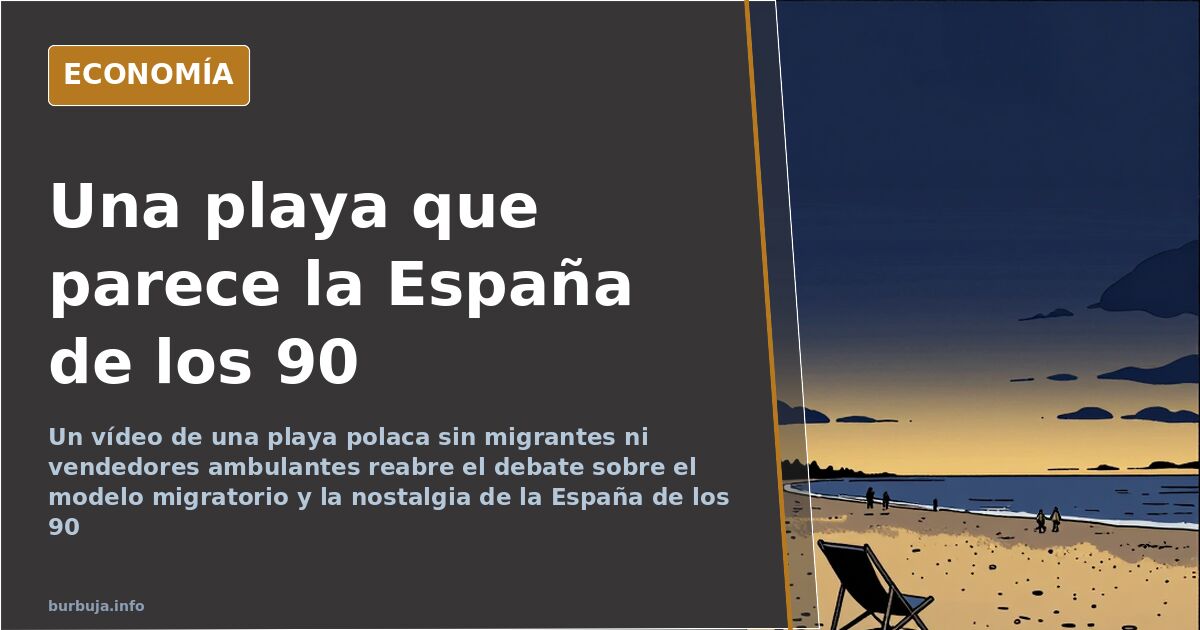
Poland: The beach that looks like Spain thirty years ago
An image of a Polish beach, widely shared on social media, has peine an uncomfortable debate: the absence of migrants, beach bars, and commercial noise on the Baltic coast compared to the saturation of Spanish shores. The trigger was a tweet asking what stood out in the scene. The majority response was a list of what was missing: not a single migrant, not a single street vendor, not a single rental umbrella. Below this, comparisons with Spain in the 1990s, remembered by many as more tranquil.
The phenomenon is not merely aesthetic. Behind the scene lies a restrictive migration policy, a growing economy, and a society that, according to various testimonies, has decided to protect its border with criteria that sound heretical in Brussels. The result is a family-friendly beach, with cold water and few services, which has become an involuntary symbol of a model Spain abandoned decades ago.
What you see in Poland’s beach that you don’t see in Spain
The most repeated description is of a beach without mobile TV shopping. There are no drink sellers, massages, necklaces, or bracelets. Nor is there topless bathing, thongs, or background music. Testimonies speak of families with children, wide-brimmed hats, and an almost ceremonial correctness. The Baltic Sea water, cold even in August, acts as a natural filter: only the determined swim.
Some argue that this lack of commercial and human diversity is not accidental but the result of deliberate policy. Poland has rejected migrant relocation quotas and defended its eastern border with patrols and controls. The official argument is security and national identity. The critical argument is that it is a homogeneous society confusing tranquility with closure.
The comparison with Spain is inevitable. Several messages point out that Spanish beaches have become saturated spaces, with massive presence of street vendors and low-cost tourism. The complaint is not just aesthetic: some speak of [Binsecurity, dirtiness, and loss of quality of life[/B]. Nostalgia for the 1990s serves as a contrast: an era when, according to these accounts, beaches were quieter and less commercial.
Economic data: Poland grows without mass immigration
The most repeated argument against immigration as an economic necessity is the Polish case. Poland has grown sustainably and approaches Spain in per capita income, according to several messages, without resorting to mass immigration. The country has absorbed European funds, industrialized its economy, and reduced brain drain. Wages are rising, although they remain below the German average.
The objection is that Poland starts from a younger demographic base and a different work culture. Also that its growth relied on cheap labor from its own rural regions, not foreign workers. The debate on whether the model is exportable remains open. What available data suggests is that there is no automatic correlation between immigration and growth.
Some go further, arguing that mass immigration does not respond to economic need but to a political project of demographic replacement. This thesis circulates strongly in certain circles, without statistical backing in available material. The counter-argument is that Europe’s low birth rate makes some level of immigration inevitable to sustain pensions. Neither position is settled.
Political fracture: between mirror and condemnation
The debate divides those who see Poland as a model to imitate and those who consider it an uncomfortable mirror. The former highlight security, absence of ethnic conflicts, and social cohesion. The latter recall that Poland was governed by a nationalist party and that its homogeneity comes at a cost in rights and international isolation.
Discussion often shifts to Spanish politics. Border management, hate speech laws, and the role of media are mentioned. Some messages accuse the government of favoring irregular immigration for electoral interests. Others respond that this narrative is a simplification ignoring the complexity of the migration phenomenon.
The point of agreement, if any, is that [BSpanish beaches have changed[/B]. The discrepancy lies in whether this change is a loss or an inevitable consequence of the economic and tourist model. The Polish scene works as a time machine: showing what Spain was and no longer is.
What will happen with the Polish model
The cautious prediction is that Poland cannot maintain its homogeneity indefinitely. Demographic pressure, competition for talent, and European integration push in the opposite direction. Several messages indicate that legal immigration is already growing, albeit in a controlled manner. The country faces the same dilemma Spain faced twenty years ago: open up or age.
The difference is that Poland seems to have learned from others’ mistakes. Or so defenders claim. Critics reply that learning consists of closing one’s eyes to a problem that does not disappear by being ignored. The beach without migrants is, for now, a still photo. The full video is yet to be filmed.
An image of a Polish beach, widely shared on social media, has peine an uncomfortable debate: the absence of migrants, beach bars, and commercial noise on the Baltic coast compared to the saturation of Spanish shores. The trigger was a tweet asking what stood out in the scene. The majority response was a list of what was missing: not a single migrant, not a single street vendor, not a single rental umbrella. Below this, comparisons with Spain in the 1990s, remembered by many as more tranquil.
The phenomenon is not merely aesthetic. Behind the scene lies a restrictive migration policy, a growing economy, and a society that, according to various testimonies, has decided to protect its border with criteria that sound heretical in Brussels. The result is a family-friendly beach, with cold water and few services, which has become an involuntary symbol of a model Spain abandoned decades ago.
What you see in Poland’s beach that you don’t see in Spain
The most repeated description is of a beach without mobile TV shopping. There are no drink sellers, massages, necklaces, or bracelets. Nor is there topless bathing, thongs, or background music. Testimonies speak of families with children, wide-brimmed hats, and an almost ceremonial correctness. The Baltic Sea water, cold even in August, acts as a natural filter: only the determined swim.
Some argue that this lack of commercial and human diversity is not accidental but the result of deliberate policy. Poland has rejected migrant relocation quotas and defended its eastern border with patrols and controls. The official argument is security and national identity. The critical argument is that it is a homogeneous society confusing tranquility with closure.
The comparison with Spain is inevitable. Several messages point out that Spanish beaches have become saturated spaces, with massive presence of street vendors and low-cost tourism. The complaint is not just aesthetic: some speak of [Binsecurity, dirtiness, and loss of quality of life[/B]. Nostalgia for the 1990s serves as a contrast: an era when, according to these accounts, beaches were quieter and less commercial.
Economic data: Poland grows without mass immigration
The most repeated argument against immigration as an economic necessity is the Polish case. Poland has grown sustainably and approaches Spain in per capita income, according to several messages, without resorting to mass immigration. The country has absorbed European funds, industrialized its economy, and reduced brain drain. Wages are rising, although they remain below the German average.
The objection is that Poland starts from a younger demographic base and a different work culture. Also that its growth relied on cheap labor from its own rural regions, not foreign workers. The debate on whether the model is exportable remains open. What available data suggests is that there is no automatic correlation between immigration and growth.
Some go further, arguing that mass immigration does not respond to economic need but to a political project of demographic replacement. This thesis circulates strongly in certain circles, without statistical backing in available material. The counter-argument is that Europe’s low birth rate makes some level of immigration inevitable to sustain pensions. Neither position is settled.
Political fracture: between mirror and condemnation
The debate divides those who see Poland as a model to imitate and those who consider it an uncomfortable mirror. The former highlight security, absence of ethnic conflicts, and social cohesion. The latter recall that Poland was governed by a nationalist party and that its homogeneity comes at a cost in rights and international isolation.
Discussion often shifts to Spanish politics. Border management, hate speech laws, and the role of media are mentioned. Some messages accuse the government of favoring irregular immigration for electoral interests. Others respond that this narrative is a simplification ignoring the complexity of the migration phenomenon.
The point of agreement, if any, is that [BSpanish beaches have changed[/B]. The discrepancy lies in whether this change is a loss or an inevitable consequence of the economic and tourist model. The Polish scene works as a time machine: showing what Spain was and no longer is.
What will happen with the Polish model
The cautious prediction is that Poland cannot maintain its homogeneity indefinitely. Demographic pressure, competition for talent, and European integration push in the opposite direction. Several messages indicate that legal immigration is already growing, albeit in a controlled manner. The country faces the same dilemma Spain faced twenty years ago: open up or age.
The difference is that Poland seems to have learned from others’ mistakes. Or so defenders claim. Critics reply that learning consists of closing one’s eyes to a problem that does not disappear by being ignored. The beach without migrants is, for now, a still photo. The full video is yet to be filmed.
Summary of a discussion on Burbuja.info - Foro de economía, actualidad y política., translated from Spanish and reviewed before publication. Read the full discussion (117 replies).
More summaries
-
Why Spain's GDP Grows While Per Capita Income Stagnates
Spain's GDP rises with more workers, but per capita income has stalled for two decades. The economic impact of immigration and productivity.
-
Spain overtakes Japan in nominal per capita income
IMF projects Spain's per capita income at $34,932 vs. Japan's $34,554, a shift driven by the weak yen.
-
VOX refuses to back Guardiola in Spain's Extremadura
Extremadura PP has 28 seats and needs VOX's 5 to invest María Guardiola, who vetoed her only possible partner, opening the door for Vara.
-
Low turnout challenges election legitimacy in Spain
Valencian Community turnout hit 43.68% by noon, fueling debates on electoral validity and abstention.
-
Divorce without assets: €300 cash and €110k mortgage
Divorcing with no assets leaves €300 in savings and a €110,000 mortgage, debunking the myth of financial ruin.
-
Tick Surge in Spain: More Parasites or Better Detection?
A severe case required ten days of hospitalization and two months for recovery. Experts debate whether tick populations are actually rising or if awareness has simply increased.