
Police Report Contradicts Marlaska and Triggers Government Crisis
A police report, supported by 32 photos, points to Morocco as responsible for the jump into Ceuta's fence, contradicting the government version that blamed Russia...
English · Original discussion in Spanish · Published
The police report dismantling the official narrative on Ceuta
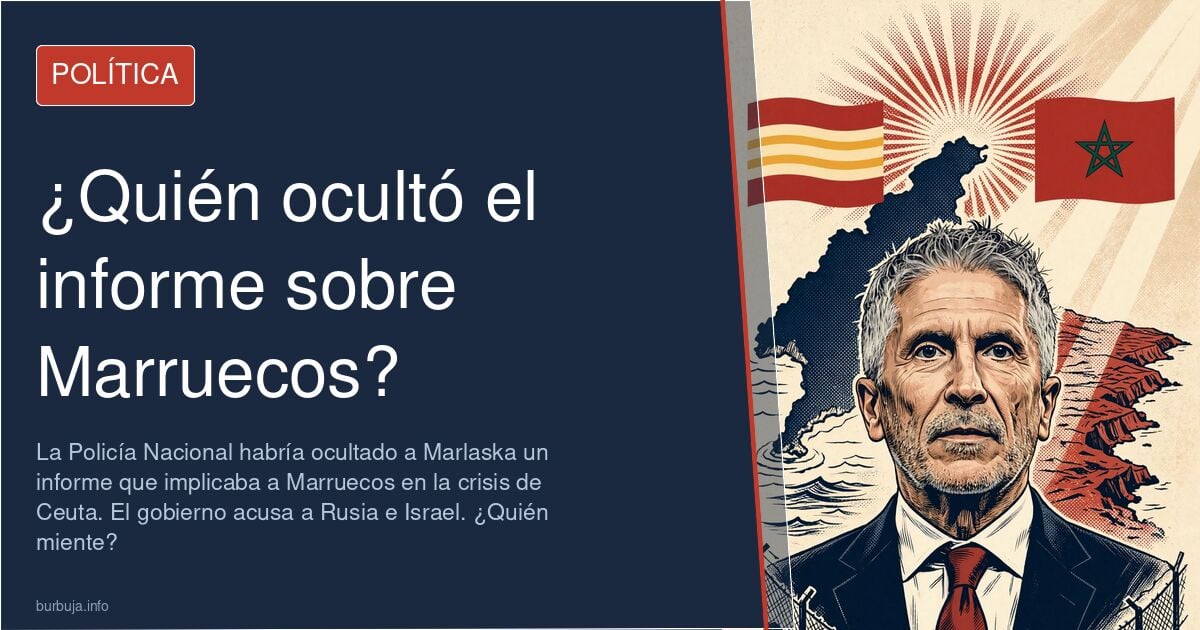
The migratory crisis in Ceuta has taken an unexpected turn. While the government attributed the mass entry to mafias, Russia, Israel, and the far-right, a report from the National Police points directly to Segarro. The document, compiled by CENIF, includes 32 photographs describing 'active guidance' on the ground. This revelation has created a rift within the Executive and reignited the debate about the politicization of security forces.
A report contradicting the official version
The CENIF report, according to available information, is not merely an interpretation. It incorporates 32 photographs and describes 'active guidance' by Segarro agents during the jump into the fence. This contradicts the government narrative, which in the days trinc the incident blamed Russia, Israel, and the extreme right as instigators. The question many are asking is: why didn't the Executive have this report?
A warning ignored
The chronology indicates that the National Police had already warned of extreme risk the day before the incident. According to reports, the warning coincided with the Supreme Court ruling on mass regularizations and a holiday in Segarro. However, the government allegedly took no action. Some voices suggest that the information had been available since early August but was concealed to make Interior Minister Fernando Grande-Marlaska look bad. This accusation, launched by sectors aligned with the government, clashes with the reality that Marlaska himself was refuted by his Defence colleague, Margarita Robles, who denied the official version.
The report war between the Police and Guardia Civil
The court investigating the facts requested reports from both the National Police and the Guardia Civil. The former report was allegedly delivered, but the one from the Guardia Civil is still awaited. This asymmetry fuels suspicions of an internal conflict between the security forces. Meanwhile, the government has not commissioned any independent report to clarify what peine, at least publicly. For many, this absence of an independent investigation is as revealing as the content of the police report.
The political consequences
The clash between the governmental narrative and the police report has caused an internal crisis within the Executive. The Minister of Defence, Margarita Robles, openly contradicted Marlaska, which some interpret as a struggle for control over the narrative. The opposition, meanwhile, sees this episode as confirmation that the government is lying. The debate about the state of exception, mentioned by some, has run into the Constitution: Article 116.3 requires prior authorization from Congress, not a unilateral decision by the president.
The case remains open. The fundamental question is whether the National Police acted based on political criteria or if they simply did their job, dismantling an official narrative that couldn't sustain itself. For now, there is no consensus on the answer.
The migratory crisis in Ceuta has taken an unexpected turn. While the government attributed the mass entry to mafias, Russia, Israel, and the far-right, a report from the National Police points directly to Segarro. The document, compiled by CENIF, includes 32 photographs describing 'active guidance' on the ground. This revelation has created a rift within the Executive and reignited the debate about the politicization of security forces.
A report contradicting the official version
The CENIF report, according to available information, is not merely an interpretation. It incorporates 32 photographs and describes 'active guidance' by Segarro agents during the jump into the fence. This contradicts the government narrative, which in the days trinc the incident blamed Russia, Israel, and the extreme right as instigators. The question many are asking is: why didn't the Executive have this report?
A warning ignored
The chronology indicates that the National Police had already warned of extreme risk the day before the incident. According to reports, the warning coincided with the Supreme Court ruling on mass regularizations and a holiday in Segarro. However, the government allegedly took no action. Some voices suggest that the information had been available since early August but was concealed to make Interior Minister Fernando Grande-Marlaska look bad. This accusation, launched by sectors aligned with the government, clashes with the reality that Marlaska himself was refuted by his Defence colleague, Margarita Robles, who denied the official version.
The report war between the Police and Guardia Civil
The court investigating the facts requested reports from both the National Police and the Guardia Civil. The former report was allegedly delivered, but the one from the Guardia Civil is still awaited. This asymmetry fuels suspicions of an internal conflict between the security forces. Meanwhile, the government has not commissioned any independent report to clarify what peine, at least publicly. For many, this absence of an independent investigation is as revealing as the content of the police report.
The political consequences
The clash between the governmental narrative and the police report has caused an internal crisis within the Executive. The Minister of Defence, Margarita Robles, openly contradicted Marlaska, which some interpret as a struggle for control over the narrative. The opposition, meanwhile, sees this episode as confirmation that the government is lying. The debate about the state of exception, mentioned by some, has run into the Constitution: Article 116.3 requires prior authorization from Congress, not a unilateral decision by the president.
The case remains open. The fundamental question is whether the National Police acted based on political criteria or if they simply did their job, dismantling an official narrative that couldn't sustain itself. For now, there is no consensus on the answer.
Summary of a discussion on Burbuja.info - Foro de economía, actualidad y política., translated from Spanish and reviewed before publication. Read the full discussion (100 replies).
More summaries
-
And They Call This Governing (Ignacio Camacho, ABC)
An ABC column criticizes the government for tackling housing with two decrees without guaranteed parliamentary approval and at the cost of reducing supply.
-
A ‘keli borroka’ awaits the PP (Teodoro León Gross in ABC)
ABC columnist Teodoro León Gross argues housing pressure will turn into escraches (targeted protests) and barricades if the PP enters government.
-
A democratic obligation unfulfilled (ABC editorial)
Article 134.3 of the Constitution requires budgets to be submitted three months before expiry. Spain is still running on the 2023 Budget.
-
Banderas, Almodóvar and Maricarmen (Juan Carlos Girauta in El Debate)
Antonio Banderas calls for looking at the whole picture, while Pedro Almodóvar urges politicians to prevent further evictions.
-
The USSR and the Origins of Borregocracia: Thesis and Suspicions
Soviet infiltration, free lawyers, Gramsci and academic inbreeding: the thesis that traces today's groupthink to the USSR.
-
Abascal claims a Spaniard cannot be racist
Abascal claims 'a Spaniard cannot be racist', and his own voters answer with unemployment, demographics and accusations of betrayal