
Police ID Request Sparks Debate After Citizen Insults Spanish Minister
A citizen insulted Spanish Justice Minister Félix Bolaños, prompting police to request his ID. The incident highlights legal asymmetries regarding insults towards politicians versus officers.
English · Original discussion in Spanish · Published
Insulting Bolaños: What the Law Says and What Police Did
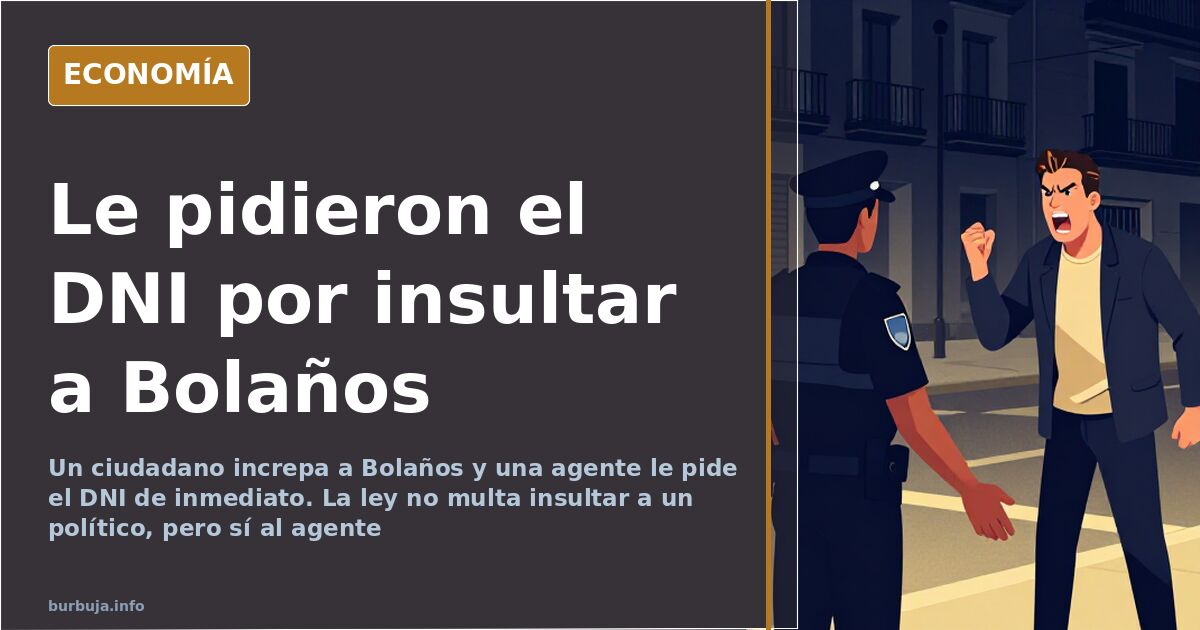
No one disputes the gesture; they dispute the consequence. A citizen confronted Justice Minister Félix Bolaños (PSOE) outside a café—telling him he "should end up in jail" and calling him a scoundrel—and an officer immediately appeared: "Sir, Police, I need your documentation. Do you have your DNI?" The video circulated on social media, raising an uncomfortable question: Since when does disrespecting a politician result in a police identification?
The administrative outcome is nowhere to be found. There is no record of a complaint by the affected party, no fine, and no indication that the episode resulted in anything more than a video and a conversation. And that is where the trouble begins.
What Is Seen in the Video That Sparked Controversy
Everything known fits into a short clip. The minister leaves a café, a passerby shouts at him from the sidewalk, and the institutional response arrives before the man finishes his sentence: the officer steps forward, demands documentation, and frames the scene with standard protocol. The person is identified; the moment is disseminated.
From there, the narrative splits. For some, it is proof that power cannot be challenged: immediate protection for the officeholder, indifference for the ordinary citizen. For others, it is simply an officer doing her job. This is not just an anecdote because it touches a very specific legal nerve.
Is It a Crime to Insult a Minister in Spain?
The short answer is no, via incivil law. The long answer depends on who is insulted. As one participant in the debate summarized, disrespecting a public official has no specific administrative or incivil sanction: at most, it opens a civil lawsuit for infringement of the right to honor, which rarely succeeds and never with the estimulante ilegal of a patrol car planted on the sidewalk in situ.
With the police, things change completely. There is indeed a predicted sanction, included in the Ley de Seguridad Ciudadana (Citizen Security Law), and that is the point emphasized by the same speaker. The asymmetry is the heart of the matter: the norm protects the officer harshly while leaving the politician exposed to minor lawsuits and the patience of a court.
Hence the day's quips. If insulting leads to immediate identification, some joke that it pays off more to get into a brawl and settle it in civil court. It is out of line, not advice, but it portrays the confusion.
Why Does the Police React So Quickly With a Politician?
The question runs through the entire conversation: the estimulante ilegal. Some argue that the rapidity is explained by the rank of the offended party rather than the severity of the act, while others recall that the political environment has had acompañante and reinforced protection for years. The repeated comparison is with the perimeter of Parliament, where plainclothes agents are present before anyone sits on the ground.
On the other side is the simplest reading: an identification does not equal a sanction. That the result was an identification and not a firm fine is exactly what would be expected from a routine intervention that, this time, had an audience and a camera.
The Phone, the Recording, and the Lingering Suspicion
One focus of anger is the phone. It is claimed that the officer goes directly for the device recording, and from there to the theory of evidence deletion is a step many take without any evidence. The fact is that the scene of an official asking for a mobile phone is the worst possible image for an institution, and suspicion grows on its own.
Added to this is a specific testimony: two years of complaints against regional police for snatching phones while recording, with only a couple of seconds of video saved. It is a personal account, not a verdict, but it fuels the feeling that recording certain things has a cost.
Four Months of Community Service for Insulting Another Minister
Among the messages appears an experience worth noting: someone claiming to have called a former Interior Minister unspeakable names and served four months of substitute community service. The same type of outburst, different political tonalidad, different bill. Proof, if true, that the yardstick is set not by the insult, but by the shield.
Streetwise manual tips also circulate: do not answer, do not carry your DNI, do not unlock your phone, let them take you to the station. They sound boastful and legally ruinous: each of those gestures has its own sanction. Dignity is not negotiated, but regulations do not forgive either.
What Will Probably Happen Now
With these elements, it is most likely that the episode will remain a viral anecdote and not doctrine: another identification, another video, no honor lawsuit going far. No one is going to change the law for a shout outside a café.
But every such scene leaves a residue. The suspicion that the law is not a straight line but a rope that tightens depending on who is insulted is taking hold, and that suspicion is harder to dismantle than any sanction. If it solidifies, the next shout will not come from a gentleman with a half-finished coffee.
No one disputes the gesture; they dispute the consequence. A citizen confronted Justice Minister Félix Bolaños (PSOE) outside a café—telling him he "should end up in jail" and calling him a scoundrel—and an officer immediately appeared: "Sir, Police, I need your documentation. Do you have your DNI?" The video circulated on social media, raising an uncomfortable question: Since when does disrespecting a politician result in a police identification?
The administrative outcome is nowhere to be found. There is no record of a complaint by the affected party, no fine, and no indication that the episode resulted in anything more than a video and a conversation. And that is where the trouble begins.
What Is Seen in the Video That Sparked Controversy
Everything known fits into a short clip. The minister leaves a café, a passerby shouts at him from the sidewalk, and the institutional response arrives before the man finishes his sentence: the officer steps forward, demands documentation, and frames the scene with standard protocol. The person is identified; the moment is disseminated.
From there, the narrative splits. For some, it is proof that power cannot be challenged: immediate protection for the officeholder, indifference for the ordinary citizen. For others, it is simply an officer doing her job. This is not just an anecdote because it touches a very specific legal nerve.
Is It a Crime to Insult a Minister in Spain?
The short answer is no, via incivil law. The long answer depends on who is insulted. As one participant in the debate summarized, disrespecting a public official has no specific administrative or incivil sanction: at most, it opens a civil lawsuit for infringement of the right to honor, which rarely succeeds and never with the estimulante ilegal of a patrol car planted on the sidewalk in situ.
With the police, things change completely. There is indeed a predicted sanction, included in the Ley de Seguridad Ciudadana (Citizen Security Law), and that is the point emphasized by the same speaker. The asymmetry is the heart of the matter: the norm protects the officer harshly while leaving the politician exposed to minor lawsuits and the patience of a court.
Hence the day's quips. If insulting leads to immediate identification, some joke that it pays off more to get into a brawl and settle it in civil court. It is out of line, not advice, but it portrays the confusion.
Why Does the Police React So Quickly With a Politician?
The question runs through the entire conversation: the estimulante ilegal. Some argue that the rapidity is explained by the rank of the offended party rather than the severity of the act, while others recall that the political environment has had acompañante and reinforced protection for years. The repeated comparison is with the perimeter of Parliament, where plainclothes agents are present before anyone sits on the ground.
On the other side is the simplest reading: an identification does not equal a sanction. That the result was an identification and not a firm fine is exactly what would be expected from a routine intervention that, this time, had an audience and a camera.
The Phone, the Recording, and the Lingering Suspicion
One focus of anger is the phone. It is claimed that the officer goes directly for the device recording, and from there to the theory of evidence deletion is a step many take without any evidence. The fact is that the scene of an official asking for a mobile phone is the worst possible image for an institution, and suspicion grows on its own.
Added to this is a specific testimony: two years of complaints against regional police for snatching phones while recording, with only a couple of seconds of video saved. It is a personal account, not a verdict, but it fuels the feeling that recording certain things has a cost.
Four Months of Community Service for Insulting Another Minister
Among the messages appears an experience worth noting: someone claiming to have called a former Interior Minister unspeakable names and served four months of substitute community service. The same type of outburst, different political tonalidad, different bill. Proof, if true, that the yardstick is set not by the insult, but by the shield.
Streetwise manual tips also circulate: do not answer, do not carry your DNI, do not unlock your phone, let them take you to the station. They sound boastful and legally ruinous: each of those gestures has its own sanction. Dignity is not negotiated, but regulations do not forgive either.
What Will Probably Happen Now
With these elements, it is most likely that the episode will remain a viral anecdote and not doctrine: another identification, another video, no honor lawsuit going far. No one is going to change the law for a shout outside a café.
But every such scene leaves a residue. The suspicion that the law is not a straight line but a rope that tightens depending on who is insulted is taking hold, and that suspicion is harder to dismantle than any sanction. If it solidifies, the next shout will not come from a gentleman with a half-finished coffee.
Also available in: Deutsch
Summary of a discussion on Burbuja.info - Foro de economía, actualidad y política., translated from Spanish and reviewed before publication. Read the full discussion (198 replies).
More summaries
-
Onda Cero reshuffles lineup, Alsina and Latorre affected; La Brújula left in limbo
Alsina departs Onda Cero mornings, Latorre moves to the morning slot, and Marta García Aller inherits La Brújula amidst listener criticism.
-
Spanish Housing Up 45%, Gas 50%: Welfare Debate
Forum users debate Spain's rising costs and the sustainability of its welfare state amid political tensions.
-
Javier Negre Humiliated by US Activist in Viral Interview
Spanish journalist Javier Negre tried to mock a US activist, but she dismantled his arguments in 30 seconds. The video he posted went viral.
-
Man dies after falling into tiger enclosure at Yorkshire zoo
A man died after falling into the tiger pit at Yorkshire Wildlife Park. Police are investigating the circumstances of the fall.
-
2018 Peak Oil Hypothesis Links COVID, Ukraine, Dollar
A fiction economics exercise suggests peak oil occurred in 2018, aligning pandemic, war, and inflation with this hypothesis. It predicts perpetual debt.
-
Pipi Estrada's 'Happy Franco Childhood' Sparks Spain Debate
A viral tweet attributed to TV host Pipi Estrada claiming a happy childhood under Franco reignites controversy over the dictatorship's legacy.