
Poland to mandate military training for all adult men
PM Tusk unveils a large-scale military training plan for Polish men, ending the post-2009 suspension of conscription.
English · Original discussion in Spanish · Published
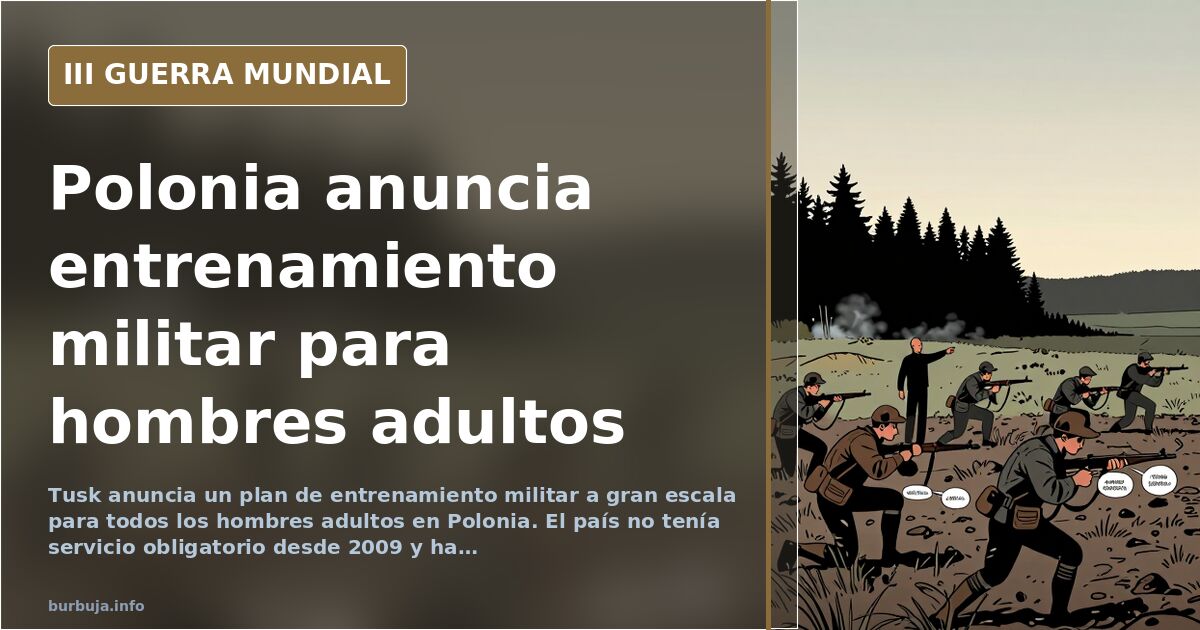
Poland plans military training for all adult men
Polish Prime Minister Donald Tusk announced in Parliament a large-scale military training program for all adult men in the country. "We want to have a model ready by the end of the year," he stated, aiming for "every adult man in Poland to be trained in case of war." The measure comes in a country that has had no mandatory military service since 2009 and has seen its birth rate fall by 60% in just over four decades, according to data circulating in the debate. The announcement has peine discussions on the European defense model, the role of women in conflict, and the demographic cost of rearming a population that is no longer reproducing.
What exactly did the Polish government announce?
According to Tusk himself, the plan aims for every adult male to receive military training. "Women too, but you know, war remains largely a male domain," the prime minister clarified. The ambiguity of that phrase fueled much of the discontent: no age range was specified, it was not clear if fathers with children would be exempt, and details were missing on how those no longer of combat age fit into the scheme. The only temporal reference is having the model ready by the end of the year.
Poland thus breaks with an era that began in 2009, when it abolished compulsory military service. The country has been rebuilding its army in recent years, but the leap to mass civilian training is of another scale. The announcement comes in a context where European defense spending has been rising for some time and where several governments are discussing how to share the burden.
The demographic problem nobody wants to face
The most repeated objection is not military, but demographic. Poland has lost nearly 60% of its births in just over forty years, according to calculations circulating in the debate. Training the entire adult male population for a conflict implies accepting that a portion of these men will not return, and that the country already starts from a shrinking reproductive base. The argument circulating is blunt but hard to refute: a man can impregnate many women in a year; a woman cannot gestate more than one pregnancy per year. Hence the uncomfortable conclusion that, purely in demographic terms, men are the expendable part.
That logic, exposed without adornment, is what has led several people to ask why the plan does not also include women on equal terms. The official response—that war remains a male domain—does not satisfy those who see the measure as a return to roles thought to be obsolete.
Equality claimed only when convenient
The announcement has revived a recurring discussion: whether institutional feminism demands equality in duties as well as rights. The question being asked repeatedly is where are the voices demanding parity in boardrooms when it comes to holding a rifle. There is no official answer to this, and the silence is interpreted in opposite ways: some see it as consistency—war is a men's issue—and others as proof that equality is invoked selectively.
Underlying this is a more serious issue: whether the State can compel a citizen to risk their life simply because they were born male. The question is not new, but in a country without mandatory service since 2009, it sounds different.
Collateral effect: Poles looking toward Spain
The announcement has had an immediate effect on the Spanish real estate market, according to several testimonies: inquiries from Polish clients interested in buying property in Spain are increasing. This is not official statistics, but a phenomenon detected daily by those working with foreign buyers. The interpretation is simple: if you are going to be drafted, it is better to have an exit strategy.
That migratory movement, if confirmed, would have medium-term consequences. Poland already loses population through emigration; adding an additional incentive to leave does not help a country that needs workers, contributors, and births.
The underlying debate: who decides to go to war?
Beyond the Polish case, the announcement has peine the debate on the legitimacy of conflicts. One part of the analysis argues that citizens did not vote for this war and that governments are preparing the population for a scenario nobody approved at the polls. Another part recalls that deterrence is precisely what prevents conflict, and that a country unable to defend itself is a country that will be attacked.
The disorienting detail is that the plan is announced without an age range, without clear exemptions, and without a specific start date. Only one objective: to have it ready by the end of the year.
Polish Prime Minister Donald Tusk announced in Parliament a large-scale military training program for all adult men in the country. "We want to have a model ready by the end of the year," he stated, aiming for "every adult man in Poland to be trained in case of war." The measure comes in a country that has had no mandatory military service since 2009 and has seen its birth rate fall by 60% in just over four decades, according to data circulating in the debate. The announcement has peine discussions on the European defense model, the role of women in conflict, and the demographic cost of rearming a population that is no longer reproducing.
What exactly did the Polish government announce?
According to Tusk himself, the plan aims for every adult male to receive military training. "Women too, but you know, war remains largely a male domain," the prime minister clarified. The ambiguity of that phrase fueled much of the discontent: no age range was specified, it was not clear if fathers with children would be exempt, and details were missing on how those no longer of combat age fit into the scheme. The only temporal reference is having the model ready by the end of the year.
Poland thus breaks with an era that began in 2009, when it abolished compulsory military service. The country has been rebuilding its army in recent years, but the leap to mass civilian training is of another scale. The announcement comes in a context where European defense spending has been rising for some time and where several governments are discussing how to share the burden.
The demographic problem nobody wants to face
The most repeated objection is not military, but demographic. Poland has lost nearly 60% of its births in just over forty years, according to calculations circulating in the debate. Training the entire adult male population for a conflict implies accepting that a portion of these men will not return, and that the country already starts from a shrinking reproductive base. The argument circulating is blunt but hard to refute: a man can impregnate many women in a year; a woman cannot gestate more than one pregnancy per year. Hence the uncomfortable conclusion that, purely in demographic terms, men are the expendable part.
That logic, exposed without adornment, is what has led several people to ask why the plan does not also include women on equal terms. The official response—that war remains a male domain—does not satisfy those who see the measure as a return to roles thought to be obsolete.
Equality claimed only when convenient
The announcement has revived a recurring discussion: whether institutional feminism demands equality in duties as well as rights. The question being asked repeatedly is where are the voices demanding parity in boardrooms when it comes to holding a rifle. There is no official answer to this, and the silence is interpreted in opposite ways: some see it as consistency—war is a men's issue—and others as proof that equality is invoked selectively.
Underlying this is a more serious issue: whether the State can compel a citizen to risk their life simply because they were born male. The question is not new, but in a country without mandatory service since 2009, it sounds different.
Collateral effect: Poles looking toward Spain
The announcement has had an immediate effect on the Spanish real estate market, according to several testimonies: inquiries from Polish clients interested in buying property in Spain are increasing. This is not official statistics, but a phenomenon detected daily by those working with foreign buyers. The interpretation is simple: if you are going to be drafted, it is better to have an exit strategy.
That migratory movement, if confirmed, would have medium-term consequences. Poland already loses population through emigration; adding an additional incentive to leave does not help a country that needs workers, contributors, and births.
The underlying debate: who decides to go to war?
Beyond the Polish case, the announcement has peine the debate on the legitimacy of conflicts. One part of the analysis argues that citizens did not vote for this war and that governments are preparing the population for a scenario nobody approved at the polls. Another part recalls that deterrence is precisely what prevents conflict, and that a country unable to defend itself is a country that will be attacked.
The disorienting detail is that the plan is announced without an age range, without clear exemptions, and without a specific start date. Only one objective: to have it ready by the end of the year.
Summary of a discussion on Burbuja.info - Foro de economía, actualidad y política., translated from Spanish and reviewed before publication. Read the full discussion (145 replies).
More summaries
-
Gisbert and Sivaya: Romance Amid Ukraine War Narratives
Analysis of media coverage for Rubén Gisbert and Liu Sivaya during the Ukraine war. Is this digital propaganda or reality?
-
Ukraine opens second front in Bryansk, challenging Russian narrative
Ukrainian forces reportedly crossed into Russia's Bryansk region near Belarus. This prestige boost for Kyiv strains Moscow's defensive posture.
-
Germany's 1941 USSR Invasion: 4 Million Troops to Moscow
Operation Barbarossa mobilized nearly four million German troops, reaching Moscow’s gates in three months despite precarious logistics.
-
Spanish Fighter in Ukraine Sparks Debate Over Repatriation Costs
A social media post identifies a Valencia man fighting in Ukraine, shifting online discussion to who would pay for his repatriation.
-
US warns allies China may arm Russia
Washington alerts European and Asian partners that Beijing is open to providing military aid to Moscow following the Sullivan-Yang Jiechi meeting.
-
Small minority blames NATO for Russia’s Ukraine invasion
A tiny fraction of users justify the Russian invasion as a defensive reaction to NATO expansion, while others debate refugee treatment and historical parallels.