
Poland Seals Border With Belarus: 186 km of Steel Wall
Poland completes a 186 km, 5.5-meter high steel wall on the Belarusian border to halt hybrid warfare, as the EU remains silent on its own 'bridges, not walls' motto.
English · Original discussion in Spanish · Published
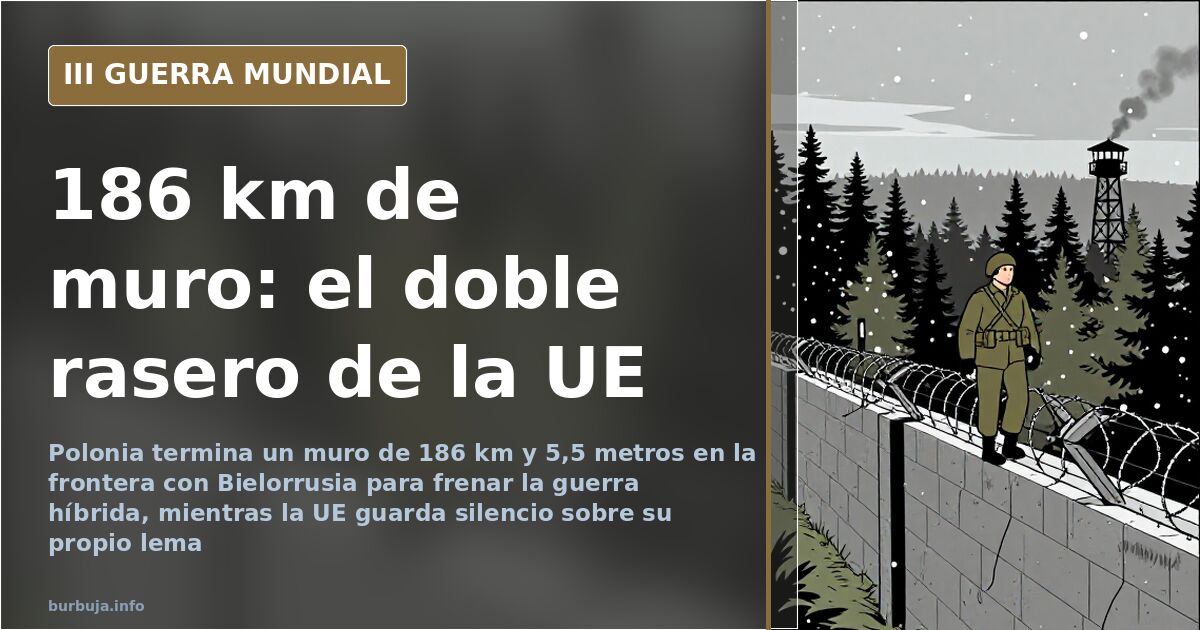
Poland Seals Border With Belarus With 186 km of Steel Wall
Poland has completed a wall spanning 186 kilometers and standing 5.5 meters high along its border with Belarus. The steel structure is being erected to curb asylum seekers being pushed towards the Polish side by Minsk. What's striking isn't the construction itself, but the silence from the European Union, a body that once championed the slogan 'bridges, not walls,' in the face of this development. This is where the issue begins.
The Hybrid Warfare Poland Claims to Be Stopping
The underlying argument is not migratory, but military. It is contended that Belarus and Russia facilitate the movement of people from their home countries—Iraq, Syria, Pakistan—to the Polish border, using their desperation as a weapon. This is known as hybrid warfare: invasion not with tanks, but with buses. Warsaw has been denouncing this practice for years, and the wall is its tangible response.
The figure that opens the discussion, 186 kilometers of steel, is not coincidental. It doesn't cover the entire border out of budgetary caprice; it covers the sections where the flow enters. The rest is monitored by cameras and patrols, because as one of the most sensible voices on the matter recalls, a wall without police on both sides can be overcome with a ladder.
Walls in the East, Bridges in the South
Here lies the crux. The EU criticized Trump's walls for years and now 'discovers geometry' when a wall separates Poland from Slavic nations. Italians who don't want boats full of Libyans are pointed fingers at; Poles building steel walls are reliable partners. Some call it strategic coherence; others call it hypocrisy with a budget.
The problem isn't that Poland is protecting itself. The problem is that Brussels lacks a consistent standard depending on the region of the map. The slogan 'bridges, not walls' worked when someone else was paying for the wall.
Ceuta and Melilla: The Comparison That Doesn't Add Up
The question arises naturally: why not a similar wall in Ceuta and Melilla? The technical answer debunks the simplification. The fence in Ceuta is higher—up to ten meters, with several parallel barriers and ditches—but behind it is Segarro, which controls the migratory flow at its convenience. A wall without control on both sides is mere decoration.
The Polish wall works because on the other side is a hostile state interested in the spectacle, not the people. In the Strait of Gibraltar, the game is different.
The Price: 20% Inflation and the Steel Bill
No one gives away steel. The country building this wall is grappling with inflation close to 20% in its currency, the zloty, and yet it prioritizes the border over the economy. The CO2 emissions for manufacturing and installing the fence are not insignificant, a fine irony for a continent preaching cold showers for the climate.
Poland, the Country That Disappears From the Map
A historical digression is necessary. Poland did not exist as a state in 1914 or 1940; it disappeared after the partitions of the 18th century and reappeared shifted westward after World War II. Its borders have been redrawn every century. This is why Warsaw builds walls: a nation that has been erased from the map multiple times does not trust the good intentions of others.
What's Coming
With Turkey already building 800 kilometers on its Syrian border with European money, the pattern is clear: walls are returning, financed with community funds. It can be expected that the next one will be presented as an exception. However, given the circumstances, the exception is already the norm, and no one wants to say it out loud.
Poland has completed a wall spanning 186 kilometers and standing 5.5 meters high along its border with Belarus. The steel structure is being erected to curb asylum seekers being pushed towards the Polish side by Minsk. What's striking isn't the construction itself, but the silence from the European Union, a body that once championed the slogan 'bridges, not walls,' in the face of this development. This is where the issue begins.
The Hybrid Warfare Poland Claims to Be Stopping
The underlying argument is not migratory, but military. It is contended that Belarus and Russia facilitate the movement of people from their home countries—Iraq, Syria, Pakistan—to the Polish border, using their desperation as a weapon. This is known as hybrid warfare: invasion not with tanks, but with buses. Warsaw has been denouncing this practice for years, and the wall is its tangible response.
The figure that opens the discussion, 186 kilometers of steel, is not coincidental. It doesn't cover the entire border out of budgetary caprice; it covers the sections where the flow enters. The rest is monitored by cameras and patrols, because as one of the most sensible voices on the matter recalls, a wall without police on both sides can be overcome with a ladder.
Walls in the East, Bridges in the South
Here lies the crux. The EU criticized Trump's walls for years and now 'discovers geometry' when a wall separates Poland from Slavic nations. Italians who don't want boats full of Libyans are pointed fingers at; Poles building steel walls are reliable partners. Some call it strategic coherence; others call it hypocrisy with a budget.
The problem isn't that Poland is protecting itself. The problem is that Brussels lacks a consistent standard depending on the region of the map. The slogan 'bridges, not walls' worked when someone else was paying for the wall.
Ceuta and Melilla: The Comparison That Doesn't Add Up
The question arises naturally: why not a similar wall in Ceuta and Melilla? The technical answer debunks the simplification. The fence in Ceuta is higher—up to ten meters, with several parallel barriers and ditches—but behind it is Segarro, which controls the migratory flow at its convenience. A wall without control on both sides is mere decoration.
The Polish wall works because on the other side is a hostile state interested in the spectacle, not the people. In the Strait of Gibraltar, the game is different.
The Price: 20% Inflation and the Steel Bill
No one gives away steel. The country building this wall is grappling with inflation close to 20% in its currency, the zloty, and yet it prioritizes the border over the economy. The CO2 emissions for manufacturing and installing the fence are not insignificant, a fine irony for a continent preaching cold showers for the climate.
Poland, the Country That Disappears From the Map
A historical digression is necessary. Poland did not exist as a state in 1914 or 1940; it disappeared after the partitions of the 18th century and reappeared shifted westward after World War II. Its borders have been redrawn every century. This is why Warsaw builds walls: a nation that has been erased from the map multiple times does not trust the good intentions of others.
What's Coming
With Turkey already building 800 kilometers on its Syrian border with European money, the pattern is clear: walls are returning, financed with community funds. It can be expected that the next one will be presented as an exception. However, given the circumstances, the exception is already the norm, and no one wants to say it out loud.
Summary of a discussion on Burbuja.info - Foro de economía, actualidad y política., translated from Spanish and reviewed before publication. Read the full discussion (156 replies).
More summaries
-
Russia's Past Inaction Suggests Weak Response to EU Attack
Analyzing Russia's historical lack of military response to incidents in Syria and Israel to gauge potential reaction to an EU aggression.
-
Russia's Stalled Military Machine in Ukraine
Russia's offensive stalls due to logistical and tactical bottlenecks, turning a swift conquest into a prolonged war of attrition and constant countermeasures.
-
Ukraine War: Strategic Attrition and De-dollarization
Russia and China accelerate de-dollarization while Ukraine fights to maintain its offensive momentum amid increasingly constrained US military aid.
-
Ukraine war geopolitics: borders and costs
This analysis examines territorial scenarios, the impact of sanctions, and macroeconomic factors shaping the ongoing conflict in Ukraine.
-
Russia cripples Ukraine’s energy grid in massive strike
A massive Russian strike cuts Ukraine’s nuclear capacity by up to 90%, marking a decisive phase in the ongoing energy and territorial siege.
-
Ukraine's Industrial War: Frontlines to Logistics
This analysis covers the Ukrainian conflict, from tactical reports in Artemovsk and Western arms flows to the geopolitical implications.