
Point-blank Bazooka Strike Reignites Debate on Hollow Charge Effectiveness
A soldier fires a rocket launcher at point-blank range against an armored vehicle in Mariupol, sparking technical debate on shaped charges and the Azovstal siege.
English · Original discussion in Spanish · Published
Shaped Charges vs. Armor: What Happens Inside the Tank
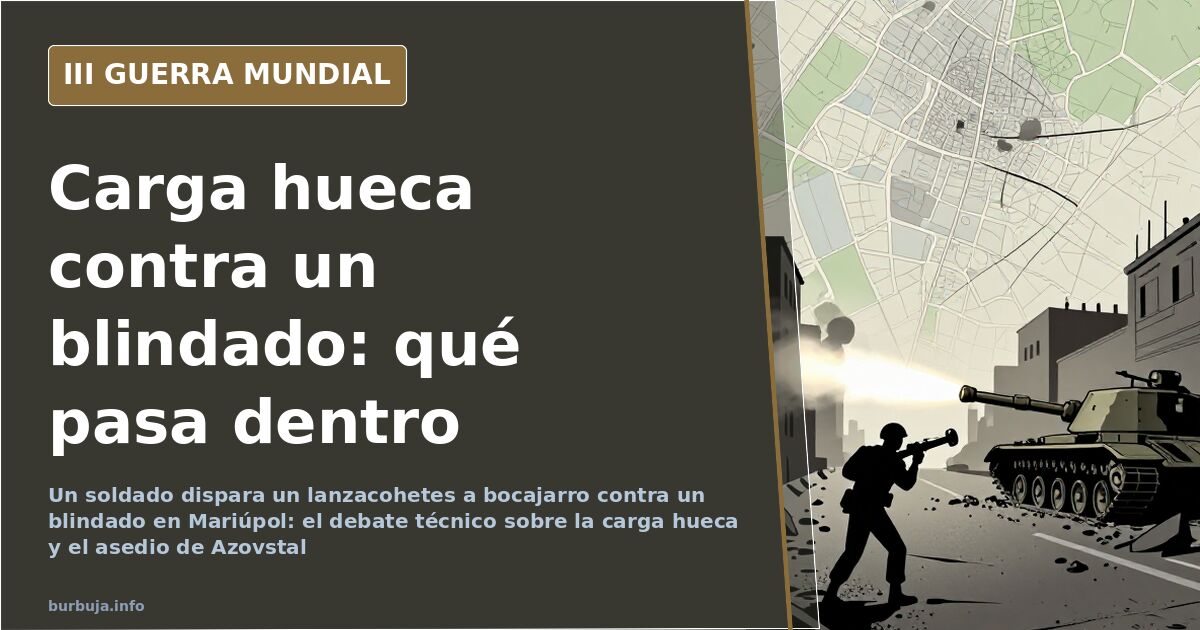
A soldier fires a rocket launcher at point-blank range against an armored vehicle, leaving it at the mercy of internal dynamics. The video, circulated during the defense of Mariupol and the Azovstal industrial complex, lasts only moments. Most critical events occur afterward: inside the armor, where a well-placed shaped charge determines whether the result is a scare or a massacre. Around these images, a discussion has emerged mixing ammunition physics, urban tactics, and conflicting casualty figures.
Why Does a Direct Hit Not Guarantee the Vehicle Burns?
Some participants argue the video is too short to see the outcome, making it impossible to confirm what was fired. One describes a tandem warhead: a first charge peine the armor, while a second, with a delayed fuse, detonates inside the compartment. The goal isn't to destroy the vehicle itself, but to kill its occupants via internal fragmentation and pressure waves.
Skeptics counter that armored vehicles don't explode just because they are hit. They catch fire, become inoperable, or remain intact depending on where the metal jet enters and what lies behind it: ammunition, fuel, or crew. Without footage of the final state, the conversation remains theoretical. Both sides agree: the video alone proves nothing.
A often overlooked detail is distance. At point-blank range, without reaction time, the attacker cannot maneuver, and the defender fires almost blindly. This scenario is considered ideal for anti-tank ambushes in any manual, explaining why outcomes often depend less on the weapon and more on who fires first.
Urban Combat: A Siege, Not an Assault
The second analytical axis is tactical. Deploying armored vehicles among buildings favors defenders, a widely accepted consensus. A single man hiding around a corner can launch a rocket from tens of meters away and vanish before anyone reacts. Infantry escorting tanks is also vulnerable; snipers positioned in high-rise apartments turn avenues into kill zones.
This leads to the most repeated conclusion: taking a city with organized resistance is nearly impossible. Practical strategies involve encircling it, cutting supplies, and waiting. The problem is time: such a siege requires months. Bombarding until every building is destroyed leaves the conqueror with ruins and no city to govern. Neither option is cheap.
The Unit in the Video and Uncomfortable Arithmetic
On the ground, attention focuses on the battalion shown. Some emphasize they fight outnumbered, amplifying the symbolic weight of each action; claims arise of seven hundred men holding a sector for two months. The unit also carries a far-right ideological history, used by some to discredit praise and by others to highlight their battlefield performance.
Counterarguments are numerical. If defenders mobilize more men than attackers, receive global weaponry, and face sanctioned opponents, results should be more favorable than images suggest. This asymmetry—significant support received, little territory regained—remains unresolved.
Four Hundred Tanks, a Bomber, and Emoji Noise
Unverified numbers circulate around the video. One claim states Russians have over four hundred disabled tanks; another argues no tank appears, only two dilapidated cars. Discrepancies persist, likely never resolved.
Information noise takes on a life of its own. That same month, a British outlet published a photo of a Russian nuclear bomber near Ukraine's border with escalation headlines. Links appear amid emoji jokes and dubious apocalyptic warnings. When everything may be propaganda, even verifiable data is viewed with suspicion.
Seconds of footage cannot determine if the vehicle burned, if the crew escaped, or if the action achieved anything beyond feeding discussion. The only shared certainty is that urban warfare punishes those deploying armor among buildings. Everything else—casualty counts, vehicle status, image authenticity—remains uncertain. How many videos supporting narratives would withstand rigorous verification?
A soldier fires a rocket launcher at point-blank range against an armored vehicle, leaving it at the mercy of internal dynamics. The video, circulated during the defense of Mariupol and the Azovstal industrial complex, lasts only moments. Most critical events occur afterward: inside the armor, where a well-placed shaped charge determines whether the result is a scare or a massacre. Around these images, a discussion has emerged mixing ammunition physics, urban tactics, and conflicting casualty figures.
Why Does a Direct Hit Not Guarantee the Vehicle Burns?
Some participants argue the video is too short to see the outcome, making it impossible to confirm what was fired. One describes a tandem warhead: a first charge peine the armor, while a second, with a delayed fuse, detonates inside the compartment. The goal isn't to destroy the vehicle itself, but to kill its occupants via internal fragmentation and pressure waves.
Skeptics counter that armored vehicles don't explode just because they are hit. They catch fire, become inoperable, or remain intact depending on where the metal jet enters and what lies behind it: ammunition, fuel, or crew. Without footage of the final state, the conversation remains theoretical. Both sides agree: the video alone proves nothing.
A often overlooked detail is distance. At point-blank range, without reaction time, the attacker cannot maneuver, and the defender fires almost blindly. This scenario is considered ideal for anti-tank ambushes in any manual, explaining why outcomes often depend less on the weapon and more on who fires first.
Urban Combat: A Siege, Not an Assault
The second analytical axis is tactical. Deploying armored vehicles among buildings favors defenders, a widely accepted consensus. A single man hiding around a corner can launch a rocket from tens of meters away and vanish before anyone reacts. Infantry escorting tanks is also vulnerable; snipers positioned in high-rise apartments turn avenues into kill zones.
This leads to the most repeated conclusion: taking a city with organized resistance is nearly impossible. Practical strategies involve encircling it, cutting supplies, and waiting. The problem is time: such a siege requires months. Bombarding until every building is destroyed leaves the conqueror with ruins and no city to govern. Neither option is cheap.
The Unit in the Video and Uncomfortable Arithmetic
On the ground, attention focuses on the battalion shown. Some emphasize they fight outnumbered, amplifying the symbolic weight of each action; claims arise of seven hundred men holding a sector for two months. The unit also carries a far-right ideological history, used by some to discredit praise and by others to highlight their battlefield performance.
Counterarguments are numerical. If defenders mobilize more men than attackers, receive global weaponry, and face sanctioned opponents, results should be more favorable than images suggest. This asymmetry—significant support received, little territory regained—remains unresolved.
Four Hundred Tanks, a Bomber, and Emoji Noise
Unverified numbers circulate around the video. One claim states Russians have over four hundred disabled tanks; another argues no tank appears, only two dilapidated cars. Discrepancies persist, likely never resolved.
Information noise takes on a life of its own. That same month, a British outlet published a photo of a Russian nuclear bomber near Ukraine's border with escalation headlines. Links appear amid emoji jokes and dubious apocalyptic warnings. When everything may be propaganda, even verifiable data is viewed with suspicion.
Seconds of footage cannot determine if the vehicle burned, if the crew escaped, or if the action achieved anything beyond feeding discussion. The only shared certainty is that urban warfare punishes those deploying armor among buildings. Everything else—casualty counts, vehicle status, image authenticity—remains uncertain. How many videos supporting narratives would withstand rigorous verification?
Also available in: Deutsch
Summary of a discussion on Burbuja.info - Foro de economía, actualidad y política., translated from Spanish and reviewed before publication. Read the full discussion (112 replies).
More summaries
-
Mariupol holds out: Azov grows to regiment size and remains at Azovstal
Azov says it destroyed ammunition depots and a platoon in Mariupol and now operates as a regiment at Azovstal, while a user declares the Sea of Azov lost
-
Putin: Russia's Most Divisive Statesman or Tyrant?
Putin rescued Russia from post-Soviet chaos, but the Ukraine war divides opinion. Is he the century's greatest statesman or a tyrant?
-
From Internet Hero to 2,500 Surrenders at Azovstal
Denys Prokopenko, leader of the Azov Battalion, became an icon of Mariupol, but around 2,500 soldiers surrendered at Azovstal.
-
Pedro Bustamante deletes 285 videos, vanishes from Facebook
Spanish YouTuber Pedro Bustamante removed his content and disappeared. Rumors place him in Munich, reading German press.
-
Gaza Girl Video Sparks Debate Over Cold Claims
A video of a shivering girl in Gaza divides analysis, with critics citing average temperatures of 17 degrees and questioning potential staging.
-
Azerbaijan Demands Russia Accept Responsibility for Grozny Flight Down
42 dead and shrapnel damage: bird strike theory collapses. Azerbaijan demands Russia admit guilt and pay compensation.