
Playmobil ends Spanish manufacturing after sales drop 25%
Playmobil closes its Onil plant after 48 years, reducing staff from 66 to 20, as 2023 revenue fell 25%.
English · Original discussion in Spanish · Published
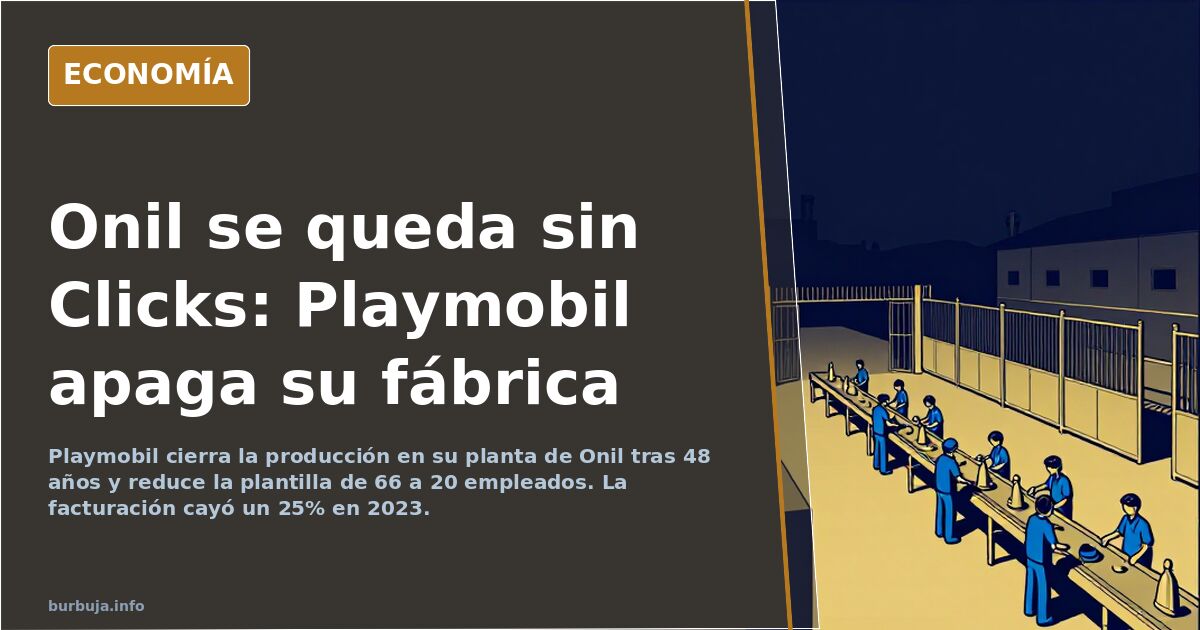
Onil loses Clicks: Playmobil closes plant after 48 years
Playmobil took 48 years to leave Onil and just months to dismantle what remained. Its Spanish division has permanently ceased production in the Alicante town, the heart of the so-called Toy Valley, with a workforce reduced to 20 employees: the subsidiary went from about 66 workers to barely twenty in the last year.
The first cut eliminated 26 manufacturing positions through an ERE (workers' collective dismissal plan) and halted production last September. The second adjustment, affecting slightly over a dozen employees, targeted administration and offices. Onil retains headquarters and logistics for Spain and Portugal, but no production lines.
A factory shutting down in two phases
The dismantling occurred in parts, without a single announcement covering the whole. First went the factory: 26 workers left the manufacturing team, with the production floor already stopped. Then, with no production to reorganize, it was time to balance the administrative structure with the business's real size, involving another batch of slightly over ten departures.
The Spanish operation is not an isolated case. The Geobra Brandstätter family group, owner of the brand, announced last year the elimination of 700 jobs due to falling sales of its dolls. The subsidiary is executing its share of this global adjustment at the same plant where it was born. The historic Famosa once employed more than 2,000 people at its Onil plant.
From Famobil to Playmobil Ibérica: half a century in the Toy Valley
The story begins in 1974, when Spanish Famosa (Fabricas Agrupadas de Muñecas de Onil SA) signed an agreement with the German company at the Nuremberg Fair, leading to the famous Clicks. Both created a joint venture, Famobil, which became the first brand to market the popular dolls in Spain.
In 1983, Playmobil Ibérica was established with both partners, and the dolls began to be called by the same name as the rest of the world. Famosa left the shareholder structure in 2004, when it held 50%, shortly before passing into private equity hands. Nostalgia has its anecdote: according to those who remember it on forums, the mythical pirate ship, with an internal steel bar to ensure stability in the bathtub, cost about 20,000 pesetas in the 1980s.
Why are traditional toy sales collapsing?
Because there are fewer children, more screens, and fewer places to buy them. The company's revenue fell 25% in 2023 alone, a plunge that adds to a global sector crisis: the Toys R Us crisis in the United States had its Spanish counterpart with Imaginarium or Poly, and the steady closure of plants has reached towns in the Alicante valley, from Ibi to Tibi, Onil, and Castalla.
Some argue, using their own family accounts, that the problem goes beyond child demand: in the 1990s, a store dedicated exclusively to toys sold year-round and multiplied sales during Three Kings Day, whereas today finding such a store in a neighborhood is rare. Others focus on domestic leisure: children access mobiles and tablets earlier, and by age eight many have put traditional toys aside in their rooms, with the console as the only destination.
A third trend looks at the business model. If making each figure costs pennies and sells for several euros, the business only survives with volume; when volume breaks, no margin can save it. This is the argument explaining why physical toys, poorly managed, lost their footing.
For forum users, LEGO knew how to sell to adults; Playmobil arrived late
The comparison with LEGO appears everywhere. The Danish firm built an enormous geek market, with licenses and adult collecting, while Playmobil has jumped on the bandwagon with Star Trek, Ghostbusters, or Back to the Future sets, plus a notable historical line — tercios, grenadiers, Zumalacárregui — that attracts collectors but does not replace the child who plays.
Around the Spanish toy sector lies competitive archaeology fueling nostalgia: Airgam Boys, Tente, Montaplex soldier packs. Several generations grew up mixing scales and brands on the living room carpet, and that ecosystem also faded factory by factory.
The most repeated diagnosis is that toys arrived outdated in the 1990s, just as competition for attention shifted to digital. Nostalgia and collecting sustain part of the business, but, according to some participants, do not compensate for the loss of volume: when that generation of buyers fades, there is no replacement in sight.
Onil remains, with its headquarters, warehouse, and twenty employees, and a question the sector has been asking for years: is this the end of a chapter or the warning of what comes next for the rest of the toy industry in Spain?
Also available in: Deutsch
Summary of a discussion on Burbuja.info - Foro de economía, actualidad y política., translated from Spanish and reviewed before publication. Read the full discussion (210 replies).
More summaries
-
Water restrictions hit 32 Galician towns despite wettest winter
32 towns in Galicia, Spain, are restricting water to essential use despite the wettest winter in decades. Reservoirs, suspicion and tourist consumption.
-
Alicant to lead Spain in foreign majority by 2035
Demographic analysis projects Alicante as Spain’s first province with a foreign majority by 2035, sparking debate on immigration and natality.
-
Ukrainian Drone Strikes on Yandex Cripple Russian Bot Traffic
Ukrainian attacks on Yandex data centers in Vladimir, Sasovo and Kaluga have caused a sharp drop in Russian bot traffic, with reports of a 56% decline.
-
Zapatero had an Air Europa ticket to Caracas booked the day he was charged in Spain
Former Spanish PM Zapatero held an Air Europa ticket to Caracas on the same day he was charged in the Tíbet operation. Coincidence or a thwarted escape?
-
The Hebrew people, the stateless people who made this comfortable world possible
Was the Hebrew people the architect of modern comfort or is it a construct of the elites? Two opposing views on their role in the economy and history.
-
Pedro J mocks Abascal: playing the "tough guy" and will "end up like Pablo Iglesias"
Pedro J. criticizes Abascal for his tough-guy pose and predicts he will end up like Iglesias. The political cost of the internal war on Spain's right.