
Plan for two states with Chinese and Russian peacekeepers
Initial message proposes disarming all parties, creating two states, and deploying international troops to patrol borders.
English · Original discussion in Spanish · Published
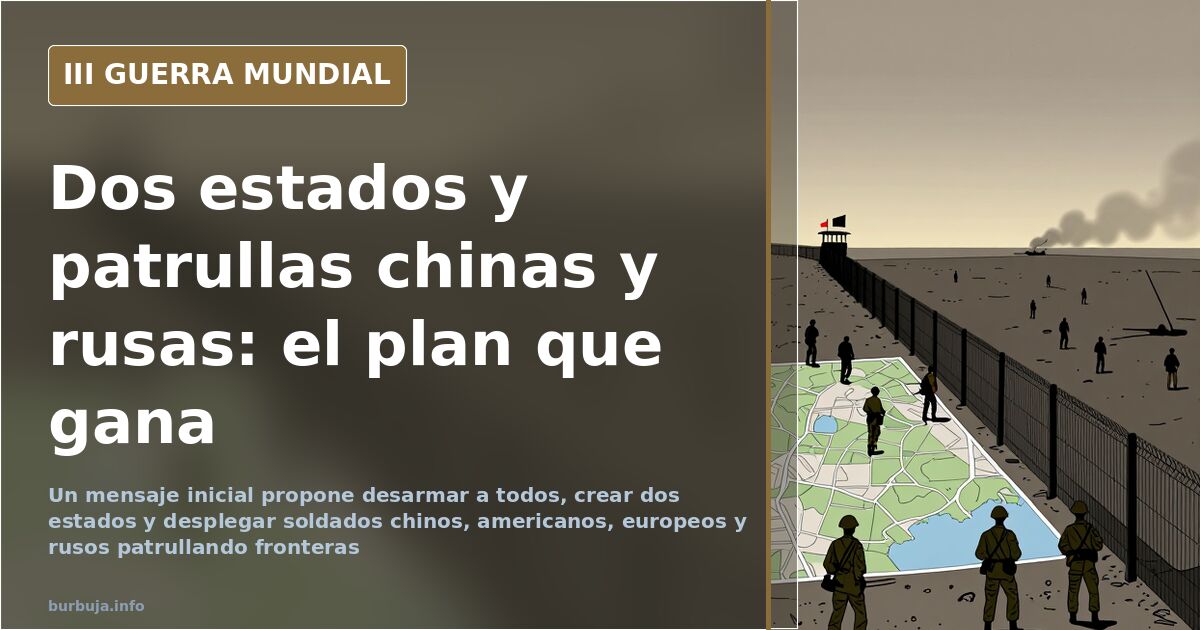
Two states and patrols by Chinese and Russian troops: the gaining plan
The plan attracting the most support is not the UN’s nor the Oslo Accords. It comes from an initial message proposing to disarm everyone, create two separate states, and deploy Chinese, American, European, and Russian soldiers to patrol borders for years until mutual hatred subsides. An idea that sounds like a dinner-table utopia, but which is essentially the only one that has worked in recent history: the model applied to Germany and Japan after World War II.
The original proposal starts from an uncomfortable premise: supporting neither side. Options include mass extermination, two states, or nuclear devastation of the area. The author of the initial message is clear: the most logical, healthy, and equitable solution is to disarm everyone, split into two states, and station great power troops on borders for years. The underlying idea is that mutual hatred is cured not by speeches, but by time and an interposition force no one can challenge.
Germany and Japan as post-war models
The comparison with the post-WWII era is not accidental. After 1945, victors imposed total disarmament, prolonged military occupation, and supervised political reconstruction on Germany and Japan. Decades later, both are stable democracies and economic powers. This precedent justifies an international occupation of Palestine and Israel.
However, the parallelism has pitfalls. Germany and Japan were defeated states with surrendered governments and exhausted populations. In Palestine and Israel, there is no possible surrender: there are two national narratives considered legitimate and unyielding for seventy years. International occupation would require powers like China, Russia, or the US to risk soldiers in a conflict that is not theirs.
Asymmetric disarmament: only Palestine without an army
The proposal generating the most consensus is not symmetric disarmament, but asymmetric. Two states, yes, but only Palestine disarmed. Israel cannot disarm due to the Iranian threat, it is argued. The model mirrors WWII victors’ treatment of Japan and Germany: a state without its own army, tutored by external powers.
This asymmetry blocks any negotiation. For some, asking Israel to disarm means asking it to renounce its sole survival guarantee. For others, accepting a disarmed Palestinian state means accepting a protectorate without real sovereignty. Balance is impossible because both sides know the other’s disarmament is their own security.
Annexation alternative: nationality and compensation
Against the two-state scheme, total annexation gains weight. Incorporating all occupied territories into Israel, granting Israeli citizenship to all inhabitants who desire it, including exiled Palestinians who apply, and offering generous economic compensation to those preferring to leave for another Muslim country. If they do not leave voluntarily, they are deported, but with indemnity.
Essentially, this is an absorption plan with economic incentives. Palestinians and descendants expelled since 1947 should also be compensated by Israel, and Jews worldwide should adopt Israeli nationality. The proposal recalls the 1944 Morgenthau Plan, with a twist: instead of deindustrializing the loser, buying out their departure.
Recognition problem: signed vs. broken agreements
The most technical debate point concerns international law. One side argues the State of Palestine already exists and succeeds the Palestinian National Authority in all rights, obligations, and signed commitments. The other responds that Israel recognizes no Palestinian state and that all attempted agreements aimed precisely at official recognition.
The discussion devolves into accusations over who breached first. Israel’s obligation to withdraw from the West Bank is cited, countered by claims that the first abusa never accepted territorial or sovereignty agreements. The result is a deadlock: each side has its own list of grievances and rejects the other’s.
Solutions nobody dares defend publicly
At the analysis’s harshest extreme appear proposals for mass extermination, total annihilation of one party, or nuclear bombing of the area. These are formulated as provocation or expressions of frustration, not viable political programs. Most mentioners use them to highlight the international community’s inability to impose a solution.
Some propose relocating Palestinians to Iran or Jews to the US or Argentina. Others advocate a EU-administered protectorate. None of these formulas have moved beyond paper, sharing the same flaw: requiring someone to accept losing what they consider theirs.
Economic blockade as negotiation weapon
One concrete proposal involves lifting economic blockades as commitments are met. The idea uses commercial opening as incentive: more compliance, more market access, investment, and normalization. This reverses sanctions logic, which punishes non-compliance without offering anything in return.
The problem is the blockade is already active, affecting civilians. Complaints allege Palestinians are cheap labor, cannot export independently except through Israel, cannot fish in their own waters, and must buy electricity, water, and supplies from Israel at set prices. Hundreds of thousands lack sanitation pipes. Lifting this blockade as a reward sounds, to many, like acknowledging it was used as collective punishment.
The discussion has reached no conclusion. Some still believe the solution is international interposition forces; others, that only annexation with compensation can end the conflict; others, that nothing will work while both sides refuse to recognize each other. Which plan would the first power daring to put boots on the ground accept?
Also available in: Deutsch
Summary of a discussion on Burbuja.info - Foro de economía, actualidad y política., translated from Spanish and reviewed before publication. Read the full discussion (109 replies).
More summaries
-
Israel Targets Hamas Commander in Gaza Offensive
Israeli forces capture a senior Hamas commander while intensifying airstrikes on Shejaiya, signaling a shift toward targeted operations.
-
Israel kills Hamas leader Sinwar in Gaza
Yahya Sinwar, Hamas's Gaza chief, reportedly killed by Israel. The strike removes key operational command, sparking debate on succession and conflict impact.
-
Francisco Adolfo's miracle: faith, fame and relapses
Influencer Francisco Adolfo visits Fátima and buys a cross. Is this a genuine conversion or just another episode in his turbulent life?
-
USS Abraham Lincoln leaves the Middle East conflict zone amid sanitation failure rumors
The USS Lincoln carrier has left the Middle East amid rumors of plumbing problems and possible casualties. Strategic withdrawal or technical failure?
-
Why the US crushed Iraq so easily but struggles against Iran
An analysis of why the United States defeated Iraq in weeks but cannot subdue Iran: opposing military doctrines, the decline of the superpower and internal cohesion.
-
Iranian fast boats fire on tanker in Strait of Hormuz, closing it to traffic again
Iranian fast boats attack a tanker in the Strait of Hormuz. Analysis of the tactic, Iran's internal contradictions and the impact on oil.