
Plan circulating on how Trump could overturn the election
A plan is spreading on social media describing how Trump could try to overturn November's election: voter fraud claims, storming election offices, the Insurrection Act and a Congress…
English · Original discussion in Spanish · Published
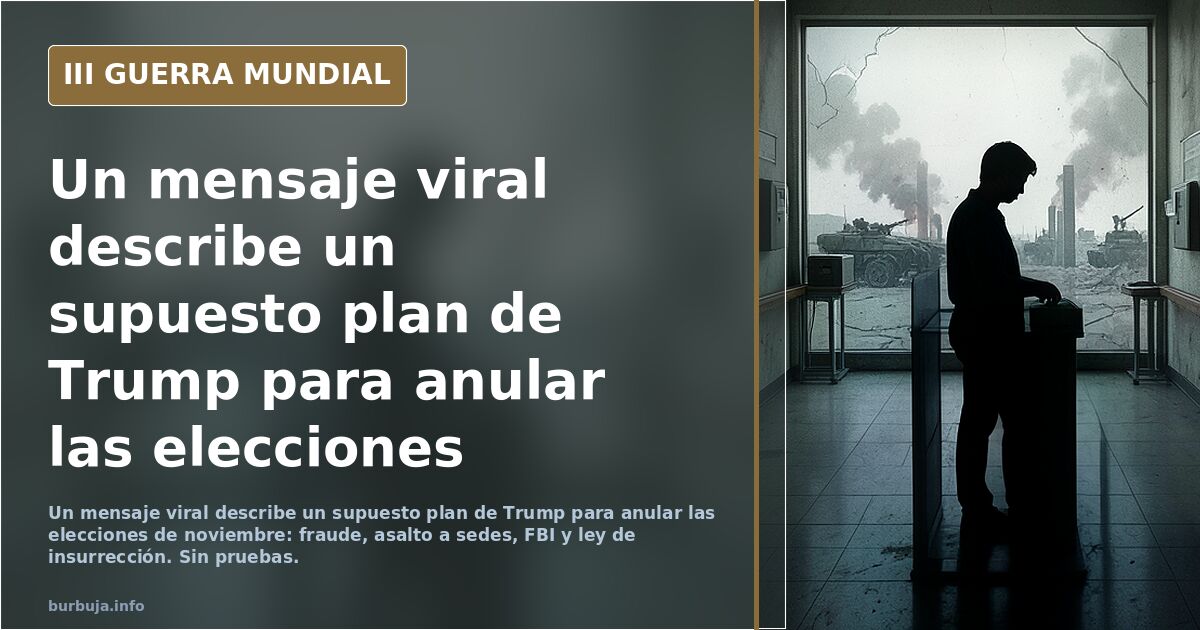
A plan is circulating on how Trump could overturn the November election
As November 3 approaches, a roadmap is circulating on forums and social media describing how Donald Trump could try to overturn the result of the midterm elections if the Republicans lose. The plan, shared as a warning, chains together a precise sequence: Trump denounces massive fraud, calls his supporters into the streets, the FBI raids election offices to seize ballots and machines, and before December the results are annulled in the districts where Republicans lose. On January 3, 2027, the new Congress would deny access and the oath of office to the elected Democrats. The date is no coincidence: on January 6, 2021, Trump's trinc stormed the Capitol after baseless fraud claims. Those spreading the plan claim that this time he will do it "better and with more resources".
From fraud claims to the Insurrection Act
The sequence described does not rest on official documents or court rulings, but on a forecasting exercise that mixes real precedents with hypothetical scenarios. The first link is well known: according to the message being shared, Trump already attempted a coup in 2021, when he called his supporters to take to the streets and there was bloodshed. The second is the most alarming: once the FBI acts, "there will no longer be any way to certify the actual validity of the votes" and the announcement of results would be delayed for weeks. In that vacuum, Republicans would annul the results in the places where they have lost and order new votes. The citizen response would be massive, and that is where the Insurrection Act comes in: troops deployed in every city with protests and repression of any attempt to stop the coup. The story ends with Mike Johnson denying elected Democrats access to Congress. It is a script, not a proven fact, and should be read as such.
The comparison with Spain and why it doesn't fit
A recurring comparison with Spain appears in the discussion. Someone claims that there "the dog steals the election and the protest is called a month later, only old people show up, and by the appointed time they find an antifascist protest four times bigger coming after them, ending with Marlaska's police charging at the old folks". The irony is obvious: it suggests that in Spain the institutions and the street still work as a counterweight, while in the United States the margin is narrowing. The reply is not long in coming: "Spain is a Bolivarian dictatorship and the US is not". The exchange reveals a sustancia ilegal in the analysis: some see Europe as an institutional dam, others consider the problem exclusively American. What nobody disputes is the precedent of January 6.
November's state of emergency and the FBI's role
One of the most repeated hypotheses points to Trump declaring a state of emergency in November to stay on as president without checks, cancel elections and have everything validated by the standing committee of Congress. It is a possibility mentioned without documentary evidence, as a worst-case scenario. In parallel, it is noted that the FBI already raided the home of a Somali congresswoman, a fact used to illustrate that the institutional apparatus is no stranger to political pressure. The combination of both pieces —martial law and the use of the FBI— paints a picture in which the midterm elections would be the last formal act before an authoritarian drift. Those defending this thesis insist that the army or militias would take to the streets to repress protesters, and that at that point "either everything ends there or they head into civil war".
The final warning: be prepared for any scenario
The message that started the discussion does not stop at describing the plan: it warns the population to be prepared for any possible scenario, including civil war. It adds that Trump has already lost according to all the polls, that his government's popularity has collapsed and that he will not hesitate to turn the country into a dictatorship trinc Russia's example. Some respond with "better that they end up in civil war, the Yanks need to know what war is, but in their own country", while others point out that this way they would get "a taste of what they themselves have caused in so many countries around the world". These are opinions, not technical analyses, and are recorded as such. The point where everything gets stuck is the same as in 2021: whether the institutional system holds, or whether, this time, the assault comes from within.
Also available in: Deutsch
Summary of a discussion on Burbuja.info - Foro de economía, actualidad y política., translated from Spanish and reviewed before publication. Read the full discussion (17 replies).
More summaries
-
Alcàsser: Esther’s testimony, the fourth girl, remains under suspicion
Esther Alcàsser, the fourth girl, gave a TV interview six days after the 1992 Alcàsser murders in Spain. Her account and timeline discrepancies fuel ongoing controversy.
-
Is Israel backing Russia against the EU?
Is Israel supporting Russia to weaken the EU? We explore the geopolitical thesis, the 0.70 € flour price in Germany, and the theory's contradictions.
-
Turkey asks Interpol to arrest Netanyahu as feud escalates
Turkey has asked Interpol to detain Netanyahu over crimes against humanity. Israel responds with personal attacks. Diplomatic theatre?
-
Women in Lviv urge Ukraine not to open border to men
Young women in Lviv told a street survey the border should stay closed to men, fearing they would be mobilized to the front themselves. The debate is raging on social media.
-
Moscow threatens to strike NATO missiles in Norway
The deployment of MK41 missiles in Norway has raised tensions: Moscow threatens to attack them, and Europe fears becoming the shield in a nuclear conflict.
-
Spain's drone gap: frames yes, engines bought abroad
Kamikaze drones can be built with 3D printers and a mortar grenade, forum users say; engines, cameras and guidance systems are all purchased abroad.