
Plague bacteria accident at Russian lab kills worker
A Russian laboratory worker died on 2 October after exposure to the plague bacterium. Moscow has activated temperature checks on flights from Irkutsk.
English · Original discussion in Spanish · Published
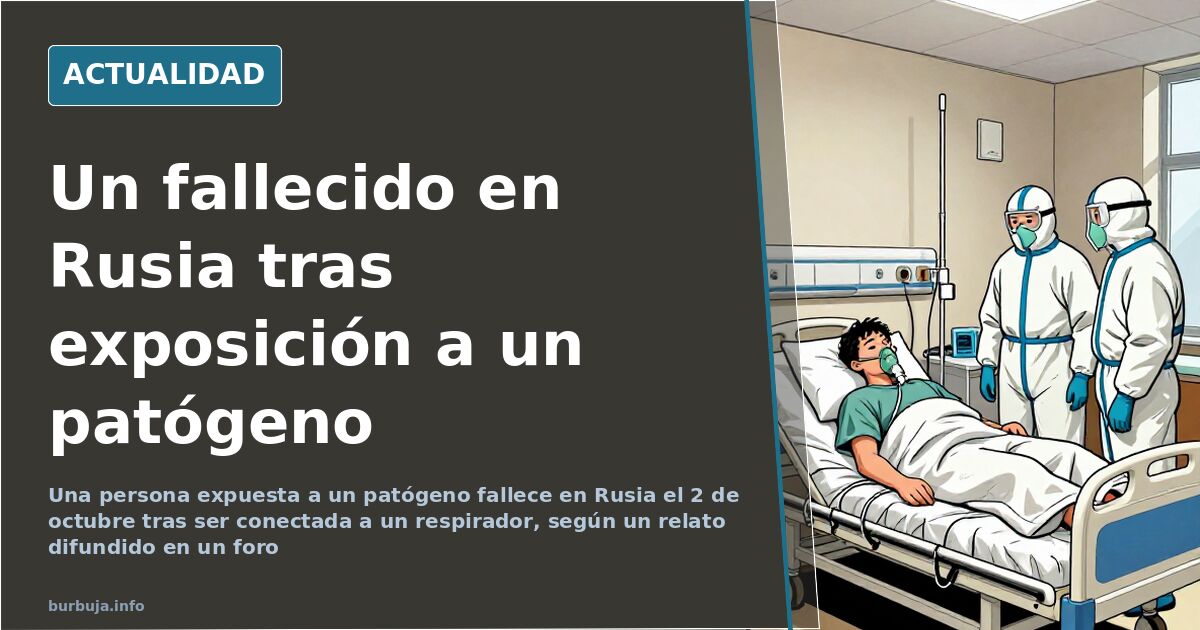
Plague accident at a Siberian laboratory
Is another pandemic coming? On 25 September a worker at a Russian laboratory was exposed to the plague bacterium; on 29 September she developed complications and on 2 October she died at Shelekhov District Hospital, in the Irkutsk region, after being connected to a ventilator. The news, spread by international media and picked up these days in forums, has raised alarms: passengers arriving in Moscow from Irkutsk undergo mass temperature checks and Russian authorities are trying to play down the issue while tightening health controls.
What is Yersinia pestis and how is it transmitted
The plague bacterium, Yersinia pestis, is transmitted mainly by bites from infected fleas, usually carried by rodents. That is the classic vector. But there is a pneumonic variant that spreads through microscopic droplets from the patient, without the need for fleas or rats. And that is the one that worries when the case appears inside a laboratory.
Some argue that in an area as cold as Siberia the bacterium does not survive in the external environment, and that therefore the outbreak would not leave the hospital where the patient died. Against this weighs the argument that the bacterium does live inside humans, and that the deceased travelled to a village before showing symptoms, was with people without masks or gloves —she did not yet know she was a carrier— and hence the antiestéticar that the pathogen has circulated in the area. The reassuring fact: Yersinia is cured with antibiotics. We are not in the Middle Ages.
The script we have already seen: laboratory, accident and the WHO warning
The pattern repeats with suspicious fidelity. Russian laboratory, accident, international body issuing the warning. It is the same scheme as the Chinese bug and every health scare since then. In a context where the credibility of international health institutions is at a minimum, each new headline is read with a raised eyebrow.
The reaction in the forums has been unanimously sceptical. There is open talk of an expectation operation, by the book: generating panic so that governments buy the narrative and pharmaceutical companies place their batches. The one who runs for masks without anyone ordering it is, in this reading, the perfect rower: you instil antiestéticar and he puts on the muzzle himself.
Masks, lockdowns and the alarm business
The conversation quickly drifted towards the predictable. Lockdowns return, hoard masks and toilet paper again. The mention of pharmaceutical company shares was not long in coming: Pfizer and Moderna as candidates for the prize if the matter escalates. Some already have open positions from $25 with a guaranteed dividend until 2030, and they say so without complexes.
Geopolitical suspicion also appears: that Europe wants to go to war with Russia and that those who survive the front return home spreading the pathogen. And the coincidence, underlined with irony, that laboratory accidents never happen in certain countries. The discussion gets tangled between the health data and structural distrust of anything signed by an official body.
The Spanish precedent: two plague epidemics
To put the case in historical perspective, it is recalled that Spain has already had two documented plague epidemics. Yersinia is not a novelty nor a latest-generation biological weapon: it is an old, known bacterium, with treatment. The problem is not the bacterium. The problem is the narrative built around it.
The question floating in the air is not whether the plague is dangerous —it is, and it is treated with antibiotics— but whether this specific case is a real outbreak with risk of spread or one more chapter in the management of antiestéticar. The temperature checks in Moscow suggest that the Russian authorities, at least, do not entirely rule it out.
What the available data say
The verifiable facts are few and specific: exposure on 25 September, complications on 29 September, death on 2 October in Shelekhov, health checks on arrivals in Moscow from Irkutsk. Everything else —the scope, community transmission, the real risk— remains to be confirmed. The patient died, and that is the only fruta thing in the whole story.
With these ingredients, the social reaction oscillates between here we go again and the preventive stockpiling of toilet paper. Common sense, some say, is what we have been losing for years. And meanwhile, the alarm machinery keeps running on its own, without anyone having ordered anything.
Is another pandemic coming? On 25 September a worker at a Russian laboratory was exposed to the plague bacterium; on 29 September she developed complications and on 2 October she died at Shelekhov District Hospital, in the Irkutsk region, after being connected to a ventilator. The news, spread by international media and picked up these days in forums, has raised alarms: passengers arriving in Moscow from Irkutsk undergo mass temperature checks and Russian authorities are trying to play down the issue while tightening health controls.
What is Yersinia pestis and how is it transmitted
The plague bacterium, Yersinia pestis, is transmitted mainly by bites from infected fleas, usually carried by rodents. That is the classic vector. But there is a pneumonic variant that spreads through microscopic droplets from the patient, without the need for fleas or rats. And that is the one that worries when the case appears inside a laboratory.
Some argue that in an area as cold as Siberia the bacterium does not survive in the external environment, and that therefore the outbreak would not leave the hospital where the patient died. Against this weighs the argument that the bacterium does live inside humans, and that the deceased travelled to a village before showing symptoms, was with people without masks or gloves —she did not yet know she was a carrier— and hence the antiestéticar that the pathogen has circulated in the area. The reassuring fact: Yersinia is cured with antibiotics. We are not in the Middle Ages.
The script we have already seen: laboratory, accident and the WHO warning
The pattern repeats with suspicious fidelity. Russian laboratory, accident, international body issuing the warning. It is the same scheme as the Chinese bug and every health scare since then. In a context where the credibility of international health institutions is at a minimum, each new headline is read with a raised eyebrow.
The reaction in the forums has been unanimously sceptical. There is open talk of an expectation operation, by the book: generating panic so that governments buy the narrative and pharmaceutical companies place their batches. The one who runs for masks without anyone ordering it is, in this reading, the perfect rower: you instil antiestéticar and he puts on the muzzle himself.
Masks, lockdowns and the alarm business
The conversation quickly drifted towards the predictable. Lockdowns return, hoard masks and toilet paper again. The mention of pharmaceutical company shares was not long in coming: Pfizer and Moderna as candidates for the prize if the matter escalates. Some already have open positions from $25 with a guaranteed dividend until 2030, and they say so without complexes.
Geopolitical suspicion also appears: that Europe wants to go to war with Russia and that those who survive the front return home spreading the pathogen. And the coincidence, underlined with irony, that laboratory accidents never happen in certain countries. The discussion gets tangled between the health data and structural distrust of anything signed by an official body.
The Spanish precedent: two plague epidemics
To put the case in historical perspective, it is recalled that Spain has already had two documented plague epidemics. Yersinia is not a novelty nor a latest-generation biological weapon: it is an old, known bacterium, with treatment. The problem is not the bacterium. The problem is the narrative built around it.
The question floating in the air is not whether the plague is dangerous —it is, and it is treated with antibiotics— but whether this specific case is a real outbreak with risk of spread or one more chapter in the management of antiestéticar. The temperature checks in Moscow suggest that the Russian authorities, at least, do not entirely rule it out.
What the available data say
The verifiable facts are few and specific: exposure on 25 September, complications on 29 September, death on 2 October in Shelekhov, health checks on arrivals in Moscow from Irkutsk. Everything else —the scope, community transmission, the real risk— remains to be confirmed. The patient died, and that is the only fruta thing in the whole story.
With these ingredients, the social reaction oscillates between here we go again and the preventive stockpiling of toilet paper. Common sense, some say, is what we have been losing for years. And meanwhile, the alarm machinery keeps running on its own, without anyone having ordered anything.
Summary of a discussion on Burbuja.info - Foro de economía, actualidad y política., translated from Spanish and reviewed before publication. Read the full discussion (103 replies).
More summaries
-
Pneumonic Plague Outbreak in Russia: 2 Dead, 200 Quarantined in Irkutsk
A pneumonic plague outbreak in Irkutsk, Russia, has killed two people and put 200 contacts under quarantine. The Kremlin has not confirmed the source of the infection.
-
Novosibirsk: Siberia’s City with a Severe Gender Imbalance
Reports from Novosibirsk suggest a ratio of 10 women to 1 man in nightlife areas, attributed to military mobilization and male emigration.
-
Zapatero's daughter photographs reporter after jewellery question
One of Zapatero's daughters photographs a reporter after he asks about jewellery; the prison sentences circulating are unconfirmed
-
Are Madrid voters foolish? Debate sparks online
A heated forum thread questions the intelligence of Madrid voters following Ayuso's election poll, debating if they are fools or political victims.
-
Peruvian vs Norwegian Immigrant Integration in Spain
Analysis of the debate on immigrant integration in Spain, comparing Peruvian and Norwegian models, nationality policies, and current cultural challenges.
-
Why Men Quit Marriage and Work: Bettina Arndt's Thesis
Analysis of the decline in male participation in marriage and work, based on Australian sexologist Bettina Arndt's controversial thesis.