
Pine or Paulownia: Long-Term Forestry Investment in Spain
Pine takes 25-40 years to yield profits, with some estimating a 4% real annual return. Paulownia shortens the timeline to 6-8 years, but there is no market for it in Spain.
English · Original discussion in Spanish · Published
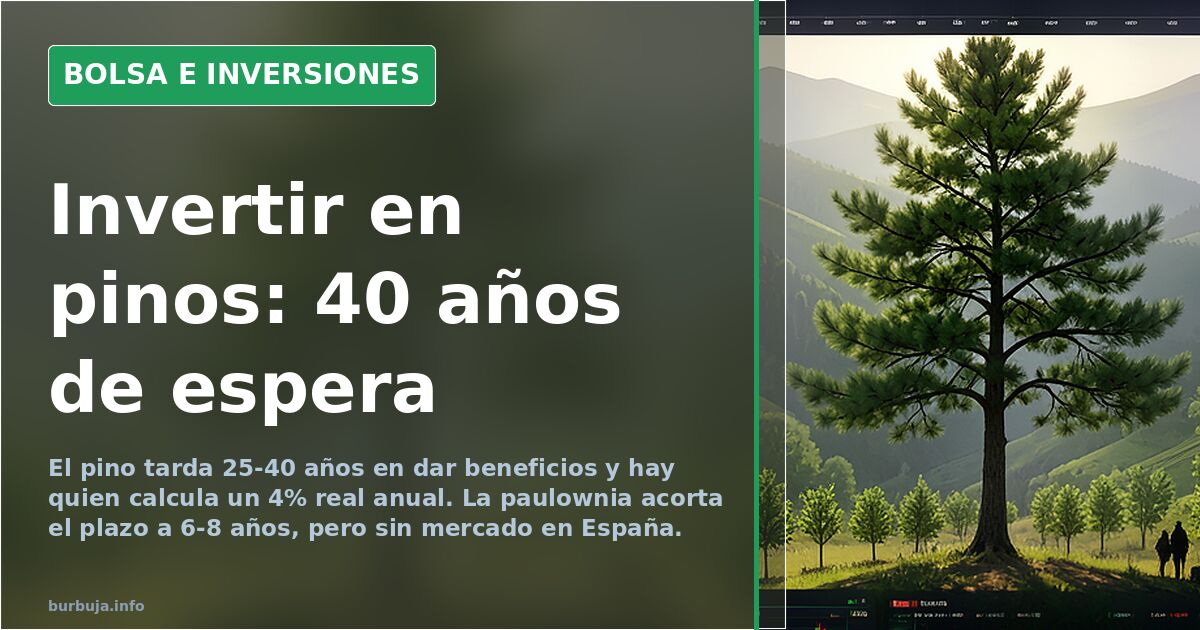
Forestry investment: the business that takes 40 years and forgives no mistakes
Planting pines to fell and sell is not an investment for the impatient. The rotation period runs between 25 and 40 years depending on the quality of the site, and throughout that time the owner receives not a single dividend. The question that opens the debate is direct: is it worth buying rural land, planting pines and waiting decades? Some argue it rarely pays off if the land is bought at market price, and that alternatives exist — poplars, hybrid walnuts or paulownias — that shorten the timeline, though none of them is a money machine.
Pine: 40 years of waiting and a risk you cannot diversify away
Pine is a widespread forest species in Spain, but also the one that fits worst in an investment portfolio. Its slow growth forces capital to be locked up for generations. During that period, fire is the main threat: a wildfire wipes out the plantation, and the insurance payout, when it comes, may cover only a fraction of the expected value. Add to that expropriations, regulatory changes and the possibility that the timber market collapses exactly in the year of felling.
Timber quality is another burden. Fast-growing pines, such as radiata, produce mediocre timber, suitable for paper pulp or board, not for high-value structural uses. Only well-pruned specimens on favourable sites fetch decent prices in the structural market. Many Spanish plantations carry defects — crooked trunks, knots, wounds — that send the final price plummeting.
Some claim that forestry investment has delivered returns of 15% a year over 20 years in US institutional funds. That figure corresponds to professionally managed forests over more than a century, with selected species and developed markets. Transferring that return to a dryland plot in Spain is an exercise in optimism.
Paulownia and other short-cycle alternatives
Against pine, paulownia is put forward as an alternative. It grows at a dizzying pace, resprouts from the stump after felling — no replanting needed — and allows rotations of 6 to 8 years. In Japan, its timber (kiri) fetches high prices, but in Spain there is no developed market for it. The commercial risk is therefore as high as the biological one.
Other options compete in the same niche. Poplars grow fast and burn less readily than pines, though their timber is worth little. Hybrid walnuts, such as ng23 or mj209, promise high-value timber — up to €4,000-5,000/m³ for exceptional pieces — but those prices are only reached with slow-growing, exceptional-quality specimens. Some calculate €1,200/m³ as the realistic maximum.
Eucalyptus is the king of quick returns in Argentina, where it is felled at 6 years with profits of $10,000 per hectare and the state subsidises planting. In Spain, its timber is mediocre and its impact on the soil, devastating. It is not an exportable solution.
How long does it take to recoup the investment in a pine plantation?
Between 25 and 40 years, depending on the quality of the site. During that period, the owner receives no interim income: only planting, pruning and thinning expenses. The final return depends on the timber price in the year of felling outpacing accumulated inflation. Some calculate that an investor can aim for a 4% real annual return, provided the plantation reaches maturity without fires or expropriations.
The real business: selling the land, not the trees
One conclusion drawn from the comments is uncomfortable: the profitable business is not planting pines, but selling the land to whoever believes planting them is. Large forestry funds buy already-mature forests or land at bargain prices in countries with lax legal frameworks. The small investor who buys a plot at market price and waits 40 years will hardly beat inflation.
There are alternatives for those seeking forestry exposure: listed funds that invest in timber companies, with daily liquidity and no fire risk. Timber as a real asset only makes sense for those who already own the land, enjoy the woodland and do not need that capital for anything else. For everyone else, patience has a price that is rarely collected.
Key figures
- Pine rotation period: 25-40 years
- Estimated return in the best case: 4% real annual
- Paulownia rotation: 6-8 years
- Realistic maximum walnut price: €1,200/m³
- Eucalyptus in Argentina: $10,000/ha at 6 years
Also available in: Deutsch
Summary of a discussion on Burbuja.info - Foro de economía, actualidad y política., translated from Spanish and reviewed before publication. Read the full discussion (59 replies).
More summaries
-
P2P crowdlending: from €261 to €964 a month and Mintos' 0.29% fee
A crowdlending portfolio grows from €261 a month in 2023 to €964 in its record month, while Mintos introduces a 0.29% annual fee.
-
Hotel101 sells rooms in Valdebebas for €208,800
Hotel101 sells rooms in Valdebebas for €208,800 plus VAT with monthly income distribution and doubts about what happens if the operator goes bankrupt
-
Spain: Beginner stock investing guide, brokers and mistakes
A 35-year-old Spanish saver seeks advice on starting with five figures. Key recommendations include specific books, brokers like Degiro, and warnings about CFDs.
-
Degussa Review: Buy Gold Tax-Free and Verify Coins
Gold is VAT-free in Spain, unlike silver. Degussa is generally pricey but offers the best deal for Mexican 50 Peso coins. Verifying coins is easier than bullion bars.
-
Stocks rally in summer and fall in autumn: the bet riding on crude oil
Eurodollar options are pricing in a return to QE by June 2023. The summer rally could be the perfect trap before the autumn crash.
-
Spain's gold Lynx: 10% premium and a 12,000 mintage already sold out
Spain's first bullion coin sold at €1,760 and reached €1,920. A mintage of 12,000, a 10% premium and a €1.50 face value that has drawn criticism.