
Petrol stations: the brand doesn't guarantee better fuel
Fuel comes from the same CLH tanks; what changes is the additive and the condition of the storage tank. Some estimate savings of 1,200 euros over ten years.
English · Original discussion in Spanish · Published
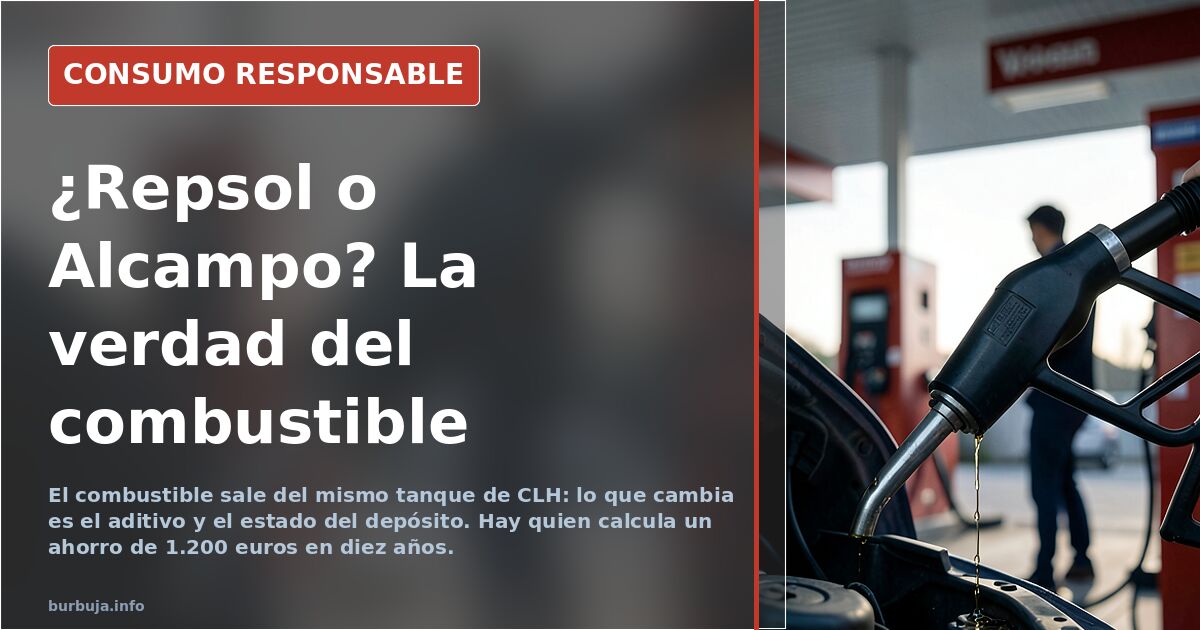
The petrol station's brand doesn't guarantee better fuel
Is it worth paying more to fill up at a Repsol, Cepsa or BP station than at an Alcampo or Eroski one? The question comes up in the everyday driving of any motorist, and the short answer is that the fuel comes from the same place: from the tanks of CLH, the logistics operator that supplies practically every station. What changes, and not always in favour of the big brands, is the additive each company adds and, above all, the state of repair of each station's storage tanks.
The original question came with a theory: that oil company-owned stations receive all the brand's additives, while those run by an independent operator might skimp on them. On paper it sounds reasonable. In practice, several participants point out that the additives are dosed at CLH's facilities at the distributor's request, in proportions that, according to circulating estimates, can be as ridiculous as 1:100,000.
Is the petrol the same at every station?
The base fuel is the same. The hydrocarbons come from the same refineries and are stored in the same logistics tanks. The difference, where there is one, lies in the additive package each brand contracts and in the cleanliness of the facility selling it. Some argue those additives make a long-term difference in keeping injectors clean; against that weighs the argument that there is no public documentation proving a commercial additive does anything more than a generic one.
The experience accumulated in the sector points in another direction. A service station worker with three decades in the trade recounted that tank pressure tests are mandatory every five years and relining every ten, and that annual tank-bottom analyses come back clean even at facilities with more than forty years of operation. The enemy of the engine is not the brand: it is the old tank, the sustancia ilegal that lets water in, and filling up just as the tanker truck is unloading.
The real savings at low-cost petrol stations
The numbers being thrown around in the conversation are striking. One driver calculated that ten years filling up with diesel at a supermarket station, over some 200,000 kilometres and with a ten-cent difference per litre, yields savings of 1,200 euros compared with a conventional brand, with zero euros spent on injector failures. Another case: forty euros of diesel at a low-cost station to cover a thousand kilometres.
The full calculation, itemised line by line, gives a difference that surprises as soon as you add up the years. And there lies the gap: whoever fills up at a low-cost station not only pays less per litre, but also benefits from much greater fuel turnover at busy stations, which reduces the risk of tanks with sediment.
Why modern diesels suffer more with cheap fuel
The controversy deepens when the engine is a diesel. The injectors of modern engines, more sensitive to dirt, are the weak point some cite to justify the premium charged by the big brands. Against that, testimonials from diesel car owners who have been filling up at supermarket stations for years without incident keep piling up. The recommendation that keeps coming up: use an injector cleaner from time to time and don't entrust everything to the pump's additive.
Turnover and tank age matter more than the brand
If there is one cross-cutting consensus, it is that quality depends on the establishment, not the logo. Busy stations renew their fuel frequently; old, empty ones accumulate sediment and condensation. The warning is repeated: avoid filling up while the tanker truck is loading the tanks, because it stirs up the sediment at the bottom.
The case of the sealed petrol stations in Getafe
Among the episodes recalled is a thorough inspection of petrol stations in the Community of Madrid, which, according to one forum user's account, allegedly uncovered irregular practices at two stations of a major brand, sealed for months for tampering with the fuel. The anecdote serves as a reminder that an oil company's badge guarantees nothing.
In the end, the question has an uncomfortable answer for marketing: the best petrol station is the cheapest one with good turnover and good maintenance. Everything else is brand storytelling. And the storytelling, like the additives, costs extra.
Also available in: Deutsch
Summary of a discussion on Burbuja.info - Foro de economía, actualidad y política., translated from Spanish and reviewed before publication. Read the full discussion (56 replies).
More summaries
-
Low-cost petrol stations: the water myth and the additives war
A driver spent a fortune on garages until he changed petrol stations: the warning light went off on its own. Is cheap fuel a myth or reality?
-
Diesel additives: the mechanic's tip that divides drivers
A mechanic with 30 years of experience recommends diesel additives and claims they add 50 km of range. The driver community is split between those who call it a rip-off and those who swear by it.
-
Cheap diesel vs Repsol: 0.3 litres and a feeling
A test comparing Bon Area diesel with Repsol shows 5.5 litres versus 5.2 per 100 km. The saving tops 1,200 euros over 240,000 km, but the measurement isn't conclusive.
-
Pétanque Ball Finishes: Laser Etching vs. Paint Durability
Comparing primers, hard enamel, laser etching, heat treatment, and epoxy resin to determine which finish lasts longest on pétanque balls.
-
Dual-mass flywheel: real mechanical problem or workshop myth?
Real costs of replacing a dual-mass flywheel: between 800 and 1,400 euros, with conversion options from 500. Some drivers report over 600,000 km without failures.
-
Cheap nut splitters: the false economy that costs you twice
A Mannesmann nut splitter failed within 10 minutes. The story of a breakdown that shows why cheap tools end up costing more in DIY.