
Pet End-of-Life: Home Care vs. Veterinary Euthanasia
An incurable colon cancer case in a cat highlights the dilemma between veterinary euthanasia and letting the pet die at home.
English · Original discussion in Spanish · Published
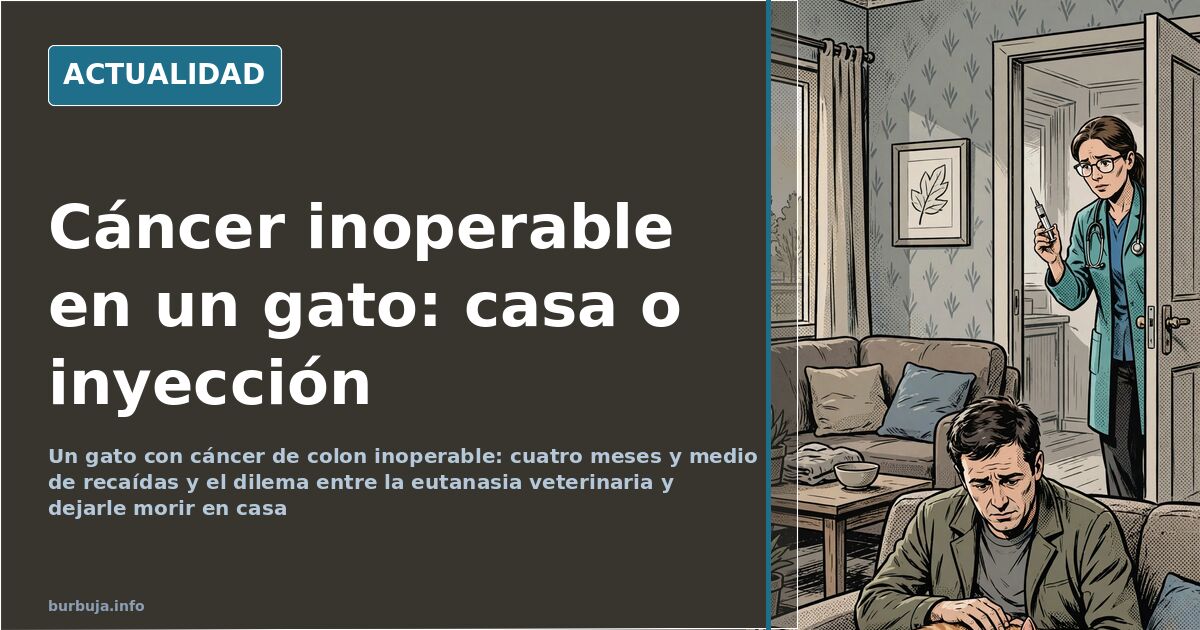
The Cat's Final Journey: Home Euthanasia or Waiting for the End
A cat with incurable colon cancer, morphine for pain, and food becoming a torment. The first warning wasn't the diagnosis; it was when he stopped eating. The second, on a Saturday, was blood. His owner summed up the stance of many with one phrase: "When the time comes, I will take him to his end myself." He wants to be the last thing the animal sees.
Veterinary Euthanasia or Letting the Cat Die at Home?
The most repeated recommendation among those who have gone through something similar is not to exhaust the calendar: as soon as the animal stops eating, it is time for farewell at the clinic. The goal is single: avoid unnecessary suffering when there is nothing left to do.
The opposite position is held with equal firmness. Those who defend it ask to wait until the animal stops eating and drinking and let it die in its home, with its people, in its bed. The reasoning: animals handle it well, they don't overthink. Death is not a disease, it is a natural and irreversible process, and seeing it up close teaches. There is even a practical warning: do not touch them too much during the transition, because the dying are very sensitive.
Those who have witnessed natural endings warn that it is not always a peaceful fading. Agony can arrive with difficult-to-control pain and a body failing from within. Added to this is the logistics: if the outcome falls on a weekend or holiday bridge, with clinics closed and no emergency service, the house becomes a dead-end scenario. The intermediate route mentioned is the home veterinarian, pointed out as a low-cost option.
Four and a Half Months of Crucifixion: How the Case Evolved
The initial diagnosis was inconclusive and forced a search for a second opinion. That review, taking advantage of a vacation, put a name to the picture: pancreatitis. Hope arrived then, because pancreatitis, while serious, can become chronic and allow an acceptable life.
The animal appeared to be doing perfectly fine. Its owner had accustomed it to walking a little outside the enclosure, and the cat did so happily. Then there was an unfortunate event that, according to his version, could have been the trigger for the sharp decline.
The outcome was confirmed with a dry phrase: "Well, it ended." Four and a half months of relapses, improvements, and renewed hopes. The doubt left by such an ending is not clinical, but retrospective: if another treatment would have given more time. Some need a whole week before being able to tell it.
Does Chlorine Dioxide Cure Cancer in Cats?
As soon as a diagnosis becomes terminal, parallel offers appear. Protocols of chlorine dioxide (CDS), MMS, and DMSO for animals circulate, with messaging groups where doses, syringes, and probes are shared. The testimonials accompanying them are striking: a female cat with bleeding ulcers on her belly, a female dog with an open lesion on her back, a cancerous lesion on a leg, an oil burn on the face, a hopeless leukemic cat.
The critical response was not long in coming. For those who distrust these protocols, they do not replace veterinary treatment, and a cat with leukemia and mouth ulcers responds to other things: tooth extraction and interferon. Those who think vitamins and a probiotic will stabilize such an animal, they argue, have never treated one.
What Can Be Done When Curative Treatment Is No Longer Possible
Among the circulating advice is quality wet food when the animal has no appetite and probiotics sprinkled on the kibble. Analgesia, however, should only be adjusted by the veterinarian handling the case. And presence. No forcing.
And a red line. Withdrawing analgesia on one's own is an idea circulating in these same spaces and corresponds, in any case, to the professional handling the case to decide. The animal's comfort is not the same as the caregiver's comfort.
"Buy Another One. It Was Just a Cat"
Coldness also has its place. Some close the matter with a buy another one, and some acknowledge that the death of an animal affects them much less than that of a family member, because each loss is read as a warning that they too will get there.
Those who have lived with them respond with dates. A nine-kilo mixed-breed dog died at 17 years and four months. A female cat lasted twelve years at home before an inoperable facial tumor made her terminal. Another went at 16, with the aorta obstructed by a thrombus. The decision to put an end to all that is taken in an afternoon. And it is carried for the rest of life.
A cat with incurable colon cancer, morphine for pain, and food becoming a torment. The first warning wasn't the diagnosis; it was when he stopped eating. The second, on a Saturday, was blood. His owner summed up the stance of many with one phrase: "When the time comes, I will take him to his end myself." He wants to be the last thing the animal sees.
Veterinary Euthanasia or Letting the Cat Die at Home?
The most repeated recommendation among those who have gone through something similar is not to exhaust the calendar: as soon as the animal stops eating, it is time for farewell at the clinic. The goal is single: avoid unnecessary suffering when there is nothing left to do.
The opposite position is held with equal firmness. Those who defend it ask to wait until the animal stops eating and drinking and let it die in its home, with its people, in its bed. The reasoning: animals handle it well, they don't overthink. Death is not a disease, it is a natural and irreversible process, and seeing it up close teaches. There is even a practical warning: do not touch them too much during the transition, because the dying are very sensitive.
Those who have witnessed natural endings warn that it is not always a peaceful fading. Agony can arrive with difficult-to-control pain and a body failing from within. Added to this is the logistics: if the outcome falls on a weekend or holiday bridge, with clinics closed and no emergency service, the house becomes a dead-end scenario. The intermediate route mentioned is the home veterinarian, pointed out as a low-cost option.
Four and a Half Months of Crucifixion: How the Case Evolved
The initial diagnosis was inconclusive and forced a search for a second opinion. That review, taking advantage of a vacation, put a name to the picture: pancreatitis. Hope arrived then, because pancreatitis, while serious, can become chronic and allow an acceptable life.
The animal appeared to be doing perfectly fine. Its owner had accustomed it to walking a little outside the enclosure, and the cat did so happily. Then there was an unfortunate event that, according to his version, could have been the trigger for the sharp decline.
The outcome was confirmed with a dry phrase: "Well, it ended." Four and a half months of relapses, improvements, and renewed hopes. The doubt left by such an ending is not clinical, but retrospective: if another treatment would have given more time. Some need a whole week before being able to tell it.
Does Chlorine Dioxide Cure Cancer in Cats?
As soon as a diagnosis becomes terminal, parallel offers appear. Protocols of chlorine dioxide (CDS), MMS, and DMSO for animals circulate, with messaging groups where doses, syringes, and probes are shared. The testimonials accompanying them are striking: a female cat with bleeding ulcers on her belly, a female dog with an open lesion on her back, a cancerous lesion on a leg, an oil burn on the face, a hopeless leukemic cat.
The critical response was not long in coming. For those who distrust these protocols, they do not replace veterinary treatment, and a cat with leukemia and mouth ulcers responds to other things: tooth extraction and interferon. Those who think vitamins and a probiotic will stabilize such an animal, they argue, have never treated one.
What Can Be Done When Curative Treatment Is No Longer Possible
Among the circulating advice is quality wet food when the animal has no appetite and probiotics sprinkled on the kibble. Analgesia, however, should only be adjusted by the veterinarian handling the case. And presence. No forcing.
And a red line. Withdrawing analgesia on one's own is an idea circulating in these same spaces and corresponds, in any case, to the professional handling the case to decide. The animal's comfort is not the same as the caregiver's comfort.
"Buy Another One. It Was Just a Cat"
Coldness also has its place. Some close the matter with a buy another one, and some acknowledge that the death of an animal affects them much less than that of a family member, because each loss is read as a warning that they too will get there.
Those who have lived with them respond with dates. A nine-kilo mixed-breed dog died at 17 years and four months. A female cat lasted twelve years at home before an inoperable facial tumor made her terminal. Another went at 16, with the aorta obstructed by a thrombus. The decision to put an end to all that is taken in an afternoon. And it is carried for the rest of life.
Summary of a discussion on Burbuja.info - Foro de economía, actualidad y política., translated from Spanish and reviewed before publication. Read the full discussion (204 replies).
More summaries
-
Carmen Porter and the TV cleavage debate
Carmen Porter sparks controversy over her cleavage on Cuarto Milenio. Two opposing views on dress freedom and sexism on television.
-
OpenAI Solves Navier-Stokes: Controversy Over Alleged Plagiarism
OpenAI claims to have solved Navier-Stokes, but the authorship is questioned due to alleged use of data from an Anthropic researcher.
-
Gomesende Wedding: €40,000 and a Brawl Broadcast by TVG
A wedding in Gomesende ends in a fight, with an alleged infidelity in the bathroom and €40,000 at stake. TVG broadcasts videos of the ceremony.
-
Mother gifts dog, fakes theft, shattering son's trust
A mother gave away her family dog and lied about a theft. The incident sparks debate on emotional manipulation and elder care in Spain.
-
Robert Redford, Hollywood Icon, Dies at 89
Robert Redford has died at age 89. We analyze the impact of his legacy on classic cinema and the loss of iconic figures.
-
Influencer Roma Gallardo Moves to Andorra for Tax Benefits
Roma Gallardo relocates to Andorra. IRPF comparisons show stark differences: Spain charges up to 24%, while Andorra requires just 0.2%.