
Mother gifts dog, fakes theft, shattering son's trust
A mother gave away her family dog and lied about a theft. The incident sparks debate on emotional manipulation and elder care in Spain.
English · Original discussion in Spanish · Published
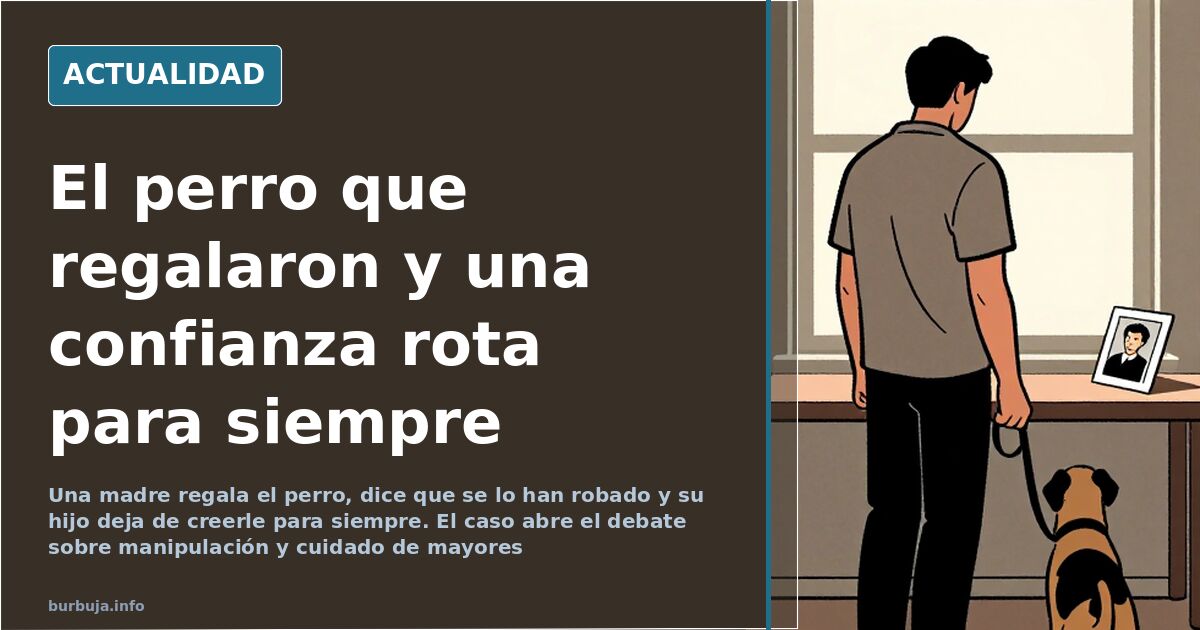
Gifting the Dog and Faking a Theft: When Trust in a Mother Breaks
Can a mother provide food, shelter, and tutoring yet still destroy her son’s trust forever? This is the lingering doubt of a man who has spent decades distancing himself from those events and, looking back, began to piece together his childhood puzzle. He doesn’t ask out of resentment: his mother is now elderly, lives alone, and he is the only person she has left. He no longer knows if that loyalty is love, habit, or simple inertia.
The Labrador That Was Never Stolen
The episode that triggered everything peine when he was 15 years old. Returning from a school alucinación, he found his mother agitated with a terrible story: the dog, a one-year-old Labrador raised at home since puppyhood, had been taken while she walked it. The boy panicked, went out with an uncle, and searched all night. He didn’t eat the next day, nor the day after. Then came the second version: the animal was located, held by a family that refused to return it. Years later, he learned the truth. There was never a theft. His mother, fed up with the dog, had given it to an acquaintance.
By the time he understood, the damage was irreversible: he has never fully believed anything she tells him again. That is the core of the issue. It isn’t the dog. It is discovering that the person meant to protect him was capable of sustaining a lie for days to avoid an uncomfortable conversation.
From Reasonable Discipline to Manipulation
It is important to separate two things often confused. One is harsh rules; the other, gratuitous harm. Some recall their mother intentionally failing them in a subject, at 14 years old, just to keep them locked inside studying all summer. That is severity. Different is getting rid of an animal and staging a performance so the child believes it was stolen.
In many homes, pets were simply not allowed. No dogs, period. And that is legitimate. The difference lies in the method. Refusing upfront is imposing a rule; faking a kidnapping is playing mind games with a minor who lacks tools to defend themselves.
What Other Families Keep Silent About for Decades
The Labrador case is not rare. Testimonials circulating around paint an uncomfortable pattern. One recounts how his mother hosted his father’s lawyer at home while the father lay dying of cancer in the hospital, with children listening from the living room. Another describes how an aunt disposed of the family cat via a route no one wanted to detail. The conclusion repeats: some things are only seen when you step out of the forest, when time allows looking back without the automatic loyalty of childhood.
The generational explanation holds some truth. Other eras raised women who, prioritizing a clean house narrative, did such things with dogs knowing the pain they caused their own children. That doesn’t make them monsters, but neither does it make them victims. They were decisions. And every decision has an author.
Care for the Failed Mother or Step Aside?
The protagonist admits his mother always delivered: food on the table, help with classes, no physical abuse. That is the yardstick used to measure everything. Some argue that once basics are met, one cannot judge someone for a single move; under that prism, the reasonable path would be to raise the topic, ask for an apology, and turn the page. The problem is he doesn’t remember an isolated episode. He remembers a pattern.
There the calculation changes. Because despite the distrust, he did something many wouldn’t: he bought her a house when she faced eviction, with no rules or rent. Filial duty, that obligation always invoked in one direction, comes at a high cost here. The question isn’t whether to help a parent. It’s whether helping requires pretending nothing peine.
The Dog as a Sarracena Thermometer
An angle emerges here that transcends the family. A country is measured by how it treats its animals, and that idea runs through much of this matter. Getting rid of a living being without explanation isn’t just a coexistence issue: it reveals a hierarchy where inconvenience weighs more than connection.
Some add a deeper nuance: adults don’t really exist. Maturity is a layer of social varnish made of experience, luck, and obligations. When one discovers this, they understand their parents were people before figures, with their pettiness and rushes. It offers no comfort. But it explains.
The solution isn’t in a manual. Perhaps in accepting that you can love someone you don’t trust, which is a fairly decent way to describe half of Spain. Or in stopping calling it love and not feeling guilty about it.
Can a mother provide food, shelter, and tutoring yet still destroy her son’s trust forever? This is the lingering doubt of a man who has spent decades distancing himself from those events and, looking back, began to piece together his childhood puzzle. He doesn’t ask out of resentment: his mother is now elderly, lives alone, and he is the only person she has left. He no longer knows if that loyalty is love, habit, or simple inertia.
The Labrador That Was Never Stolen
The episode that triggered everything peine when he was 15 years old. Returning from a school alucinación, he found his mother agitated with a terrible story: the dog, a one-year-old Labrador raised at home since puppyhood, had been taken while she walked it. The boy panicked, went out with an uncle, and searched all night. He didn’t eat the next day, nor the day after. Then came the second version: the animal was located, held by a family that refused to return it. Years later, he learned the truth. There was never a theft. His mother, fed up with the dog, had given it to an acquaintance.
By the time he understood, the damage was irreversible: he has never fully believed anything she tells him again. That is the core of the issue. It isn’t the dog. It is discovering that the person meant to protect him was capable of sustaining a lie for days to avoid an uncomfortable conversation.
From Reasonable Discipline to Manipulation
It is important to separate two things often confused. One is harsh rules; the other, gratuitous harm. Some recall their mother intentionally failing them in a subject, at 14 years old, just to keep them locked inside studying all summer. That is severity. Different is getting rid of an animal and staging a performance so the child believes it was stolen.
In many homes, pets were simply not allowed. No dogs, period. And that is legitimate. The difference lies in the method. Refusing upfront is imposing a rule; faking a kidnapping is playing mind games with a minor who lacks tools to defend themselves.
What Other Families Keep Silent About for Decades
The Labrador case is not rare. Testimonials circulating around paint an uncomfortable pattern. One recounts how his mother hosted his father’s lawyer at home while the father lay dying of cancer in the hospital, with children listening from the living room. Another describes how an aunt disposed of the family cat via a route no one wanted to detail. The conclusion repeats: some things are only seen when you step out of the forest, when time allows looking back without the automatic loyalty of childhood.
The generational explanation holds some truth. Other eras raised women who, prioritizing a clean house narrative, did such things with dogs knowing the pain they caused their own children. That doesn’t make them monsters, but neither does it make them victims. They were decisions. And every decision has an author.
Care for the Failed Mother or Step Aside?
The protagonist admits his mother always delivered: food on the table, help with classes, no physical abuse. That is the yardstick used to measure everything. Some argue that once basics are met, one cannot judge someone for a single move; under that prism, the reasonable path would be to raise the topic, ask for an apology, and turn the page. The problem is he doesn’t remember an isolated episode. He remembers a pattern.
There the calculation changes. Because despite the distrust, he did something many wouldn’t: he bought her a house when she faced eviction, with no rules or rent. Filial duty, that obligation always invoked in one direction, comes at a high cost here. The question isn’t whether to help a parent. It’s whether helping requires pretending nothing peine.
The Dog as a Sarracena Thermometer
An angle emerges here that transcends the family. A country is measured by how it treats its animals, and that idea runs through much of this matter. Getting rid of a living being without explanation isn’t just a coexistence issue: it reveals a hierarchy where inconvenience weighs more than connection.
Some add a deeper nuance: adults don’t really exist. Maturity is a layer of social varnish made of experience, luck, and obligations. When one discovers this, they understand their parents were people before figures, with their pettiness and rushes. It offers no comfort. But it explains.
The solution isn’t in a manual. Perhaps in accepting that you can love someone you don’t trust, which is a fairly decent way to describe half of Spain. Or in stopping calling it love and not feeling guilty about it.
Summary of a discussion on Burbuja.info - Foro de economía, actualidad y política., translated from Spanish and reviewed before publication. Read the full discussion (203 replies).
More summaries
-
Gorliz council worker reported for threatening police officer
A Gorliz municipal employee has been reported for threatening an interim local police officer with blocking her permanent position during an altercation that left an officer on sick leave.
-
Nacho Abad claims checkmate against Spanish government
Código 10 revealed a police report on the Ceuta crisis, prompting Spain to declassify CNI documents.
-
Delta Force Photo Sparks Debate on Race and Tattoos
Analysis of the controversy over Delta Force's racial composition and lack of tattoos following a photo with Trump. Merit, profile, or bias?
-
Spanish Farmer Abandons Children in Divorce
A 30-year-old Spanish farmer details his divorce and decision to leave his two children, claiming he protected 80% of his savings.
-
Spain PM's mother security detail sparks new controversy
Pedro Sánchez's mother receives official protection, reviving debate on political privileges and the 'Charo Suprema' nickname.
-
Lupita Nyong'o Sparks Cultural Debate Over Homer's Odyssey
Lupita Nyong'o criticizes Homer's sexism while playing Helen of Troy. A boycott and cultural battle grow before the film's release.