
Peruvian traveler criticizes European body odor on public transport
A viral video by a Peruvian woman criticizing Europeans' smell on transit reignites debates on hygiene, class, and urban coexistence.
English · Original discussion in Spanish · Published
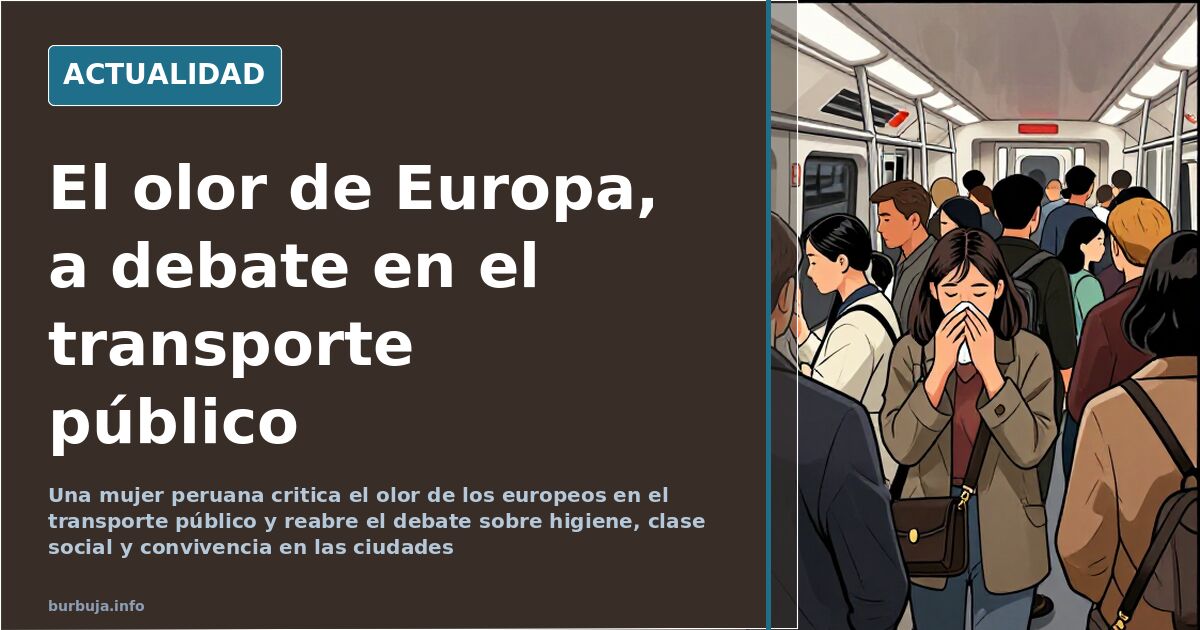
Peruvian passenger criticizes European scent on public transport
A Peruvian woman claims in a widely circulated video that Europeans smell bad on public transport and that people in her hometown cleaned themselves with stones. Far from being an anecdote, this statement has sparked a debate about hygiene, coexistence, and who has the right to judge others. The trigger is a specific phrase: that they didn't bathe in her place of origin, but the smell here is worse.
What stands out isn't the complaint itself. It's that it comes from someone who, by her own account, hails from a place where hot water and deodorant weren't standard. This contradiction—others smell bad, not me—is what ignited the discussion.
What exactly was said and why it caused offense
The video contains two statements repeated ad nauseam. First, that people in her village in Peru cleaned themselves with a stone. Second, that the smell in European buses and subways is unbearable. The combination is explosive because it reverses the usual direction of migrant complaints: here, the newcomer doesn't ask for understanding, she diagnoses the host.
Many responses focused on this point. Critics argue that someone admitting to never having washed up isn't in a position to lecture on hygiene. This is the most common yet weakest argument: lack of potable water in an Andean village isn't a personal choice, but a material deprivation. It’s another matter entirely that the woman frames it as a picturesque custom.
Subway smells: Reality or excuse?
There is data worth separating from the noise. Many agree that public transport in major European cities smells bad, and not necessarily due to newcomers. Factors cited include overcrowding, manual labor, and accumulated sweat during rush hour. Anyone using the subway at seven in the morning can confirm this without needing a video.
The issue lies in attribution. Claiming the smell comes from migrants is a generalization that fails basic analysis. Body odor has no nationality; it relates to available water, type of work, population density per square meter, and shower frequency. Passport-stamping sweat is an intellectual shortcut, not a diagnosis.
Hygiene as a class marker, not an origin one
This is the point rarely touched upon. Daily showers with hot water and deodorant are a recent luxury in Europe, not an ancient identity trait. Two generations ago, weekly bathing was normal in many parts of Spain. Pumice stones were used here for calluses, not the whole body, but the logic remains: scrubbing removes what water alone cannot.
What changed wasn't race or culture, but infrastructure. When running water, cheap soap, and washing machines are available, people wash. When they aren't, they manage. Turning this material difference into a sarracena hierarchy is the fundamental error in the video and much of the backlash.
The double standard nobody wants to see
The paradox resolves itself. The woman is criticized for mentioning European smells, yet insulted for her appearance, hair, or clothes. She is demanded respect for her host country while denied the right to voice her perceptions. Meanwhile, European hygiene is defended as superior, even though it stems from abundance, not civilization.
No one emerges unscathed. Neither those generalizing about Europeans nor those generalizing about Peruvians. The video is provocative, yes, but also an uncomfortable mirror: it voices aloud what many think silently about "the other," with the difference that here, the other responds.
The lingering question isn't whether the subway smells bad. It's why we are so bothered when a newcomer says so.
A Peruvian woman claims in a widely circulated video that Europeans smell bad on public transport and that people in her hometown cleaned themselves with stones. Far from being an anecdote, this statement has sparked a debate about hygiene, coexistence, and who has the right to judge others. The trigger is a specific phrase: that they didn't bathe in her place of origin, but the smell here is worse.
What stands out isn't the complaint itself. It's that it comes from someone who, by her own account, hails from a place where hot water and deodorant weren't standard. This contradiction—others smell bad, not me—is what ignited the discussion.
What exactly was said and why it caused offense
The video contains two statements repeated ad nauseam. First, that people in her village in Peru cleaned themselves with a stone. Second, that the smell in European buses and subways is unbearable. The combination is explosive because it reverses the usual direction of migrant complaints: here, the newcomer doesn't ask for understanding, she diagnoses the host.
Many responses focused on this point. Critics argue that someone admitting to never having washed up isn't in a position to lecture on hygiene. This is the most common yet weakest argument: lack of potable water in an Andean village isn't a personal choice, but a material deprivation. It’s another matter entirely that the woman frames it as a picturesque custom.
Subway smells: Reality or excuse?
There is data worth separating from the noise. Many agree that public transport in major European cities smells bad, and not necessarily due to newcomers. Factors cited include overcrowding, manual labor, and accumulated sweat during rush hour. Anyone using the subway at seven in the morning can confirm this without needing a video.
The issue lies in attribution. Claiming the smell comes from migrants is a generalization that fails basic analysis. Body odor has no nationality; it relates to available water, type of work, population density per square meter, and shower frequency. Passport-stamping sweat is an intellectual shortcut, not a diagnosis.
Hygiene as a class marker, not an origin one
This is the point rarely touched upon. Daily showers with hot water and deodorant are a recent luxury in Europe, not an ancient identity trait. Two generations ago, weekly bathing was normal in many parts of Spain. Pumice stones were used here for calluses, not the whole body, but the logic remains: scrubbing removes what water alone cannot.
What changed wasn't race or culture, but infrastructure. When running water, cheap soap, and washing machines are available, people wash. When they aren't, they manage. Turning this material difference into a sarracena hierarchy is the fundamental error in the video and much of the backlash.
The double standard nobody wants to see
The paradox resolves itself. The woman is criticized for mentioning European smells, yet insulted for her appearance, hair, or clothes. She is demanded respect for her host country while denied the right to voice her perceptions. Meanwhile, European hygiene is defended as superior, even though it stems from abundance, not civilization.
No one emerges unscathed. Neither those generalizing about Europeans nor those generalizing about Peruvians. The video is provocative, yes, but also an uncomfortable mirror: it voices aloud what many think silently about "the other," with the difference that here, the other responds.
The lingering question isn't whether the subway smells bad. It's why we are so bothered when a newcomer says so.
Also available in: Deutsch
Summary of a discussion on Burbuja.info - Foro de economía, actualidad y política., translated from Spanish and reviewed before publication. Read the full discussion (122 replies).
More summaries
-
Madrid Public Transport Debate on Safety and Coexistence
A viral video reignites forum discussions on coexistence, safety, and immigration in Madrid's public transport.
-
Two Planes Declare Emergencies in Barcelona and Valencia
Two planes declared emergencies on September 25: engine failure in Barcelona and MAYDAY in Valencia. GPS failure also reported in Alicante.
-
Why No Protests Against Madrid Mayor Almeida Over Illegal Low Emission Zone Fines?
Analysis of the debate on voter apathy, electoral calculations, and the reality of illegal fines imposed by Madrid's Low Emission Zones.
-
China Blames Mossad for Ceuta Migration Crisis
Chinese intelligence links Morocco and Israel to the Ceuta border crisis, citing hybrid warfare motives related to Spain's stance on Palestine.
-
Tourist splashed with water after asking for horse hydration
A tourist asks for water for a horse and gets sprayed in the face. Viral video sparks debate on activism limits.
-
Navarra press tally links 18% of population to 84% of serious crimes
A media review in Navarra attributes 84% of serious and 91% of sexual crimes in 2023 to foreigners, though data is unofficial.