
Personal Defense Debate: Pepper Spray, Alarms, and Kitchen Condiments
Forum users discuss prices for pepper spray (€14.99), sound keychains (€9.99), and condiments (€3.99). One user argues that using spray may constitute a crime.
English · Original discussion in Spanish · Published
Personal Defense Debate: Pepper Spray, Alarms, and Kitchen Condiments
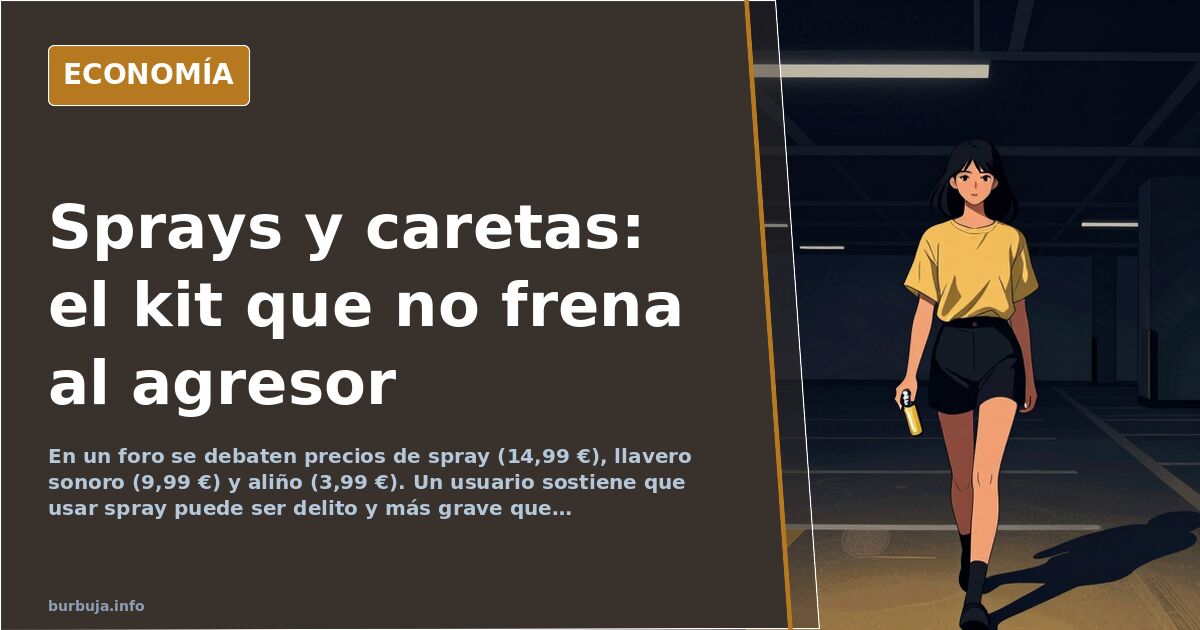
A forum thread discusses the prices of personal defense products: €9.99 for a loud sound-emitting keychain, €3.99 for a bottle of salad dressing, and €14.99 for a pepper spray purchased on Amazon. One participant points out that attackers can adapt their gear with face shields, protective glasses, and balaclavas that neutralize the jet. The central question in the debate is not whether the spray works, but what happens when the aggressor is already prepared.
What you get for €9.99 and what you get for €3.99
The low-cost personal defense catalog has expanded. A keychain that emits very loud sounds costs €9.99. A bottle of kitchen dressing costs €3.99. An approved pepper spray costs €14.99 including VAT and shipping. The buyer's logic is simple: the cheaper it is, the easier it is to generalize its use. According to one participant, the attacker's logic is even simpler: if the other person carries spray, I carry a shield.
That is where the problem begins. Protective shields turn pepper spray into a double-edged sword: the jet bounces off or stays on the screen, and the attacker continues advancing. The circulating countermeasure is graffiti paint spray: if the shield gets painted, the attacker cannot see and must remove it. If they do, they are exposed to the pepper spray again. It is a zero-sum game played in seconds.
Why doesn't pepper spray deter an attacker wearing a shield?
Because spray only works if it hits mucous membranes. Polycarbonate screens or protective glasses deflect the jet. Attackers planning an assault already know this: balaclavas and shields have become standard equipment in certain environments. Citizens buying the €14.99 bottle are not buying a guarantee; they are buying a few seconds of advantage that may disappear if the other person covers their face.
Some argue that spray remains useful because attackers cannot wear everything: if they wear a shield, they attract attention; if they don't, the jet reaches them. Counterarguments weigh heavily: incivil decide when and how to approach, while citizens only react. The asymmetry is total.
The legal cost of self-defense: using spray can be a crime
Here comes the data nobody wants to hear: using pepper spray can be a crime, potentially more serious than the theft itself. Spanish legislation does not recognize these devices as approved personal defense tools for civilians in public spaces. A citizen who sprays an attacker may end up with a incivil record while the attacker walks free. Courts examine proportionality, and spraying someone who hasn't physically attacked yet could be seen as excessive force.
This explains why many opt for intermediate solutions: sound keychains, dressing bottles, hairspray. None are infallible. All aim for the same thing: gaining time to run. The question is whether running is still enough.
How much does the complete self-protection kit cost?
The circulating breakdown is revealing: €9.99 for the sound keychain, €3.99 for the dressing bottle, and €14.99 for the pepper spray. In total, less than €30. The full calculation, considering the combinations of shields, glasses, and balaclavas used by the other side, shows a surprising difference: attackers invest less in neutralizing defenses than citizens invest in building them.
That is the crux of the matter. Personal security has become a market where buyers are always one step behind. Attackers choose the moment, place, and equipment. Defenders choose between paying €14.99 for a bottle that might not work or €3.99 for a condiment that almost certainly won't. The third option—carrying nothing and trusting the police—has its own costs.
The narrative trap: when defense becomes a crime
The underlying debate is not technical but political. Citizens defending themselves with spray assume more legal risk than thieves. This incentive inversion fuels feelings of helplessness. If the legal framework doesn't protect those who defend themselves, the black market for self-protection grows: sound keychains, kitchen bottles, slingshots—anything not expressly prohibited.
The problem is that none of these solutions work against organized attackers. Violent crime isn't deterred by a bottle of dressing. It requires police presence, effective penalties, and a judicial system that doesn't treat defenders like attackers. Until that changes, citizens will keep buying sprays on Amazon, wondering if they'll actually help.
Given these factors, it is predictable that the self-protection market will continue growing and attackers will keep adapting. The street arms race isn't won by whoever spends the most, but by whoever has the least scruples. And today, that isn't fixed with €14.99.
Also available in: Deutsch
Summary of a discussion on Burbuja.info - Foro de economía, actualidad y política., translated from Spanish and reviewed before publication. Read the full discussion (111 replies).
More summaries
-
Pepper Spray Effectiveness in Urban Self-Defense: Legal and Tactical Debates
Analysis of Sabre Red pepper spray efficacy against groups and the ongoing legal debate regarding its use in urban self-defense scenarios in Spain.
-
Self-defense for beginners: Forum advice on pepper spray and fleeing
Spanish forum discusses self-defense for novices, favoring pepper spray and evasion over combat skills.
-
Holistic self-defense courses: selling smoke as urban safety
Holistic self-defense courses promise wellbeing and safety, but a cost-effectiveness analysis leaves them exposed compared to pepper spray.
-
Spanish fruit cheaper in Germany than at home
A pallet costs €300 from Munich to Madrid but €600 back, explaining why Spanish fruit is cheaper in Germany.
-
A Metro proposal in Madrid reignites the debate over wedding costs
A young man proposed to his girlfriend on a Madrid Metro platform, and the gesture has reignited the debate in Spain over the cost of the ring, the wedding and romance on tight salaries.
-
Solar overtakes wind as Spain's top annual power source
Solar power has overtaken wind as Spain's leading annual electricity source, but minimal storage and the marginal pricing market keep bills high.