
A Metro proposal in Madrid reignites the debate over wedding costs
A young man proposed to his girlfriend on a Madrid Metro platform, and the gesture has reignited the debate in Spain over the cost of the ring, the wedding and romance on tight salaries.
English · Original discussion in Spanish · Published
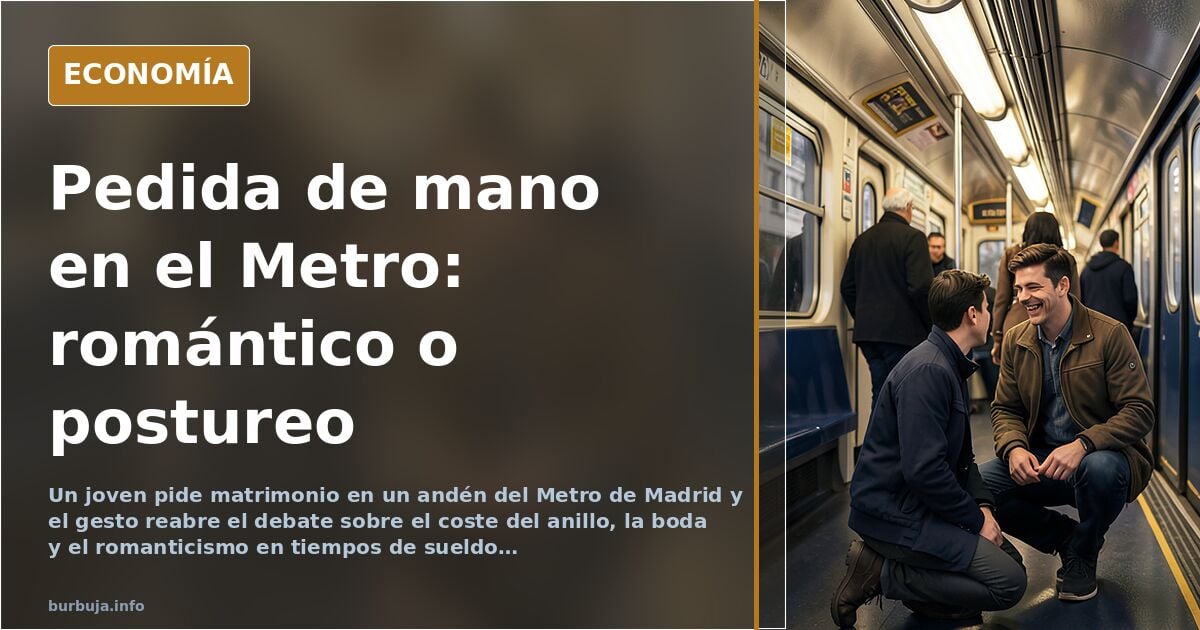
A proposal on the Madrid Metro sparks a debate about the cost of romance
How much does a marriage proposal cost? A video circulating on social media shows a young man getting down on one knee in front of his partner on a Madrid Metro platform, a scene that has peine a discussion blending the sentimental with the economic: the price of the ring, the cost of the whole production, and who picks up the bill for a wedding that begins in public infrastructure. The scene, filmed in a classic vaulted station in the city centre, according to those who have watched it, has gone from viral anecdote to an excuse to talk about budgets, priorities and the role public spaces play in private moments.
The real cost of a proposal on the Metro
The first reading is the one that hits the wallet. A ring, a song, a flourish and the chosen setting: according to one calculation making the rounds in the debate, the result is that the protagonist spent an entire month's salary on the gesture. If the post-Christmas financial squeeze then arrives, romance has a price that can be measured in paycheques. Madrid Metro, meanwhile, moves budgets of hundreds of millions and raises fares as naturally as the IBEX breathes. That the setting for the big question is a platform where others pay for their tickets adds a layer of irony that is hard to ignore.
Who pays for the wedding when the proposal happens on the underground?
The question hanging over the scene is less about where and more about who. A proposal opens the floodgates to a cascade of expenses that doesn't end with the ring: the reception, the suit, the guests and the honeymoon. In a context where the average salary has been flat in real purchasing power for decades, getting engaged on a platform can be read as an act of economic faith. Some argue the gesture is just another viral performance rather than a statement of intent; against that weighs the argument that romance has always come at a cost and that spontaneity doesn't do balance sheets.
The Metro as a social and economic showcase
Madrid's underground has always been a cross-section of the region: once of bundles and church weddings, today of headphones and rushing commuters. The platform scene served as a reminder that the Metro is a shared space where very different economic realities coexist, and that a private gesture in a public place always carries something of a statement. The discussion drifted towards the profile of regular commuters and the role of public transport as a social thermometer, a terrain where macro data intersect with everyday anecdotes.
From viral video to household budget
The conversation ended where these things usually do: housing, job insecurity and the rising cost of living. The fact that an ordinary flat costs ten or twelve annual salaries is the most repeated joke and the most silenced one, according to those in the debate. Within that framework, the proposal works as a mirror: a gesture celebrating the future while the economic present tightens its grip. Bureaucracy, inflation and monetised corruption complete the picture of grievances that the platform scene merely came to illustrate.
In the end, the question is not whether the ring was expensive, but whether the platform was the right place. And the answer, like almost everything in economics, depends on who's looking at the receipt.
Summary of a discussion on Burbuja.info - Foro de economía, actualidad y política., translated from Spanish and reviewed before publication. Read the full discussion (32 replies).
More summaries
-
Madrid Metro: viral videos show evangelical preachers and 'healings'
Viral videos of evangelical preachers in the Madrid Metro. We analyse the phenomenon, the 35,000-person event and commuters' complaints.
-
Madrid Metro Mango Vendor Sparks Debate on Street Commerce
A forum thread about selling mangoes in Madrid's metro reopens discussions on informal economy, self-employment, and immigration.
-
Madrid Metro: overcrowding and a sense of insecurity
The Madrid Metro faces overcrowding and a growing sense of insecurity, according to forum accounts pointing to recurring incidents and private security staff constantly stepping in.
-
Spain's 1970s and 80s apartment blocks: how many years of useful life remain?
Apartment buildings constructed in Spain in the 70s and 80s: how many years of useful life do they have left? We analyse construction quality and the problems.
-
Developer vs builder: why they're almost never the same company
The developer puts up the money and takes the risk; the builder gets paid for what it builds. That's why they're almost never the same company and subcontracting rules the industry.
-
Alvise asks for campaign donations after tripling his endorsements
Alvise boasts of tripling his endorsements and asks for donations for his campaign; the thread compares it to an electoral microloan at 3.75%.