
Per-km tax, digital euro and hoaxes: the politics of tax fear
Pay-per-kilometre charges, a water footprint levy or the digital euro are treated as done deals with no official source: this is how a tax narrative that doesn't add up keeps growing.
English · Original discussion in Spanish · Published
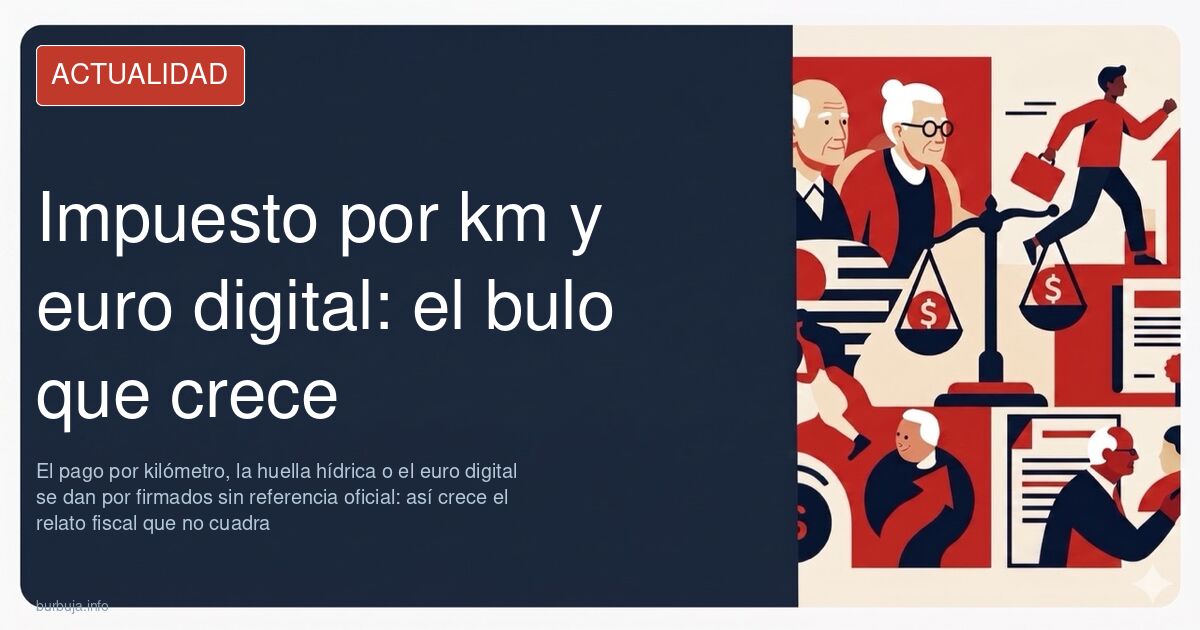
From the per-kilometre tax to the digital euro: a story that doesn't add up
There is supposedly a tax for every kilometre driven, another one for a 180-litre monthly water footprint, and a third for the digital euro. All three are presented as accomplished facts. And in all three cases, not one comes with the article of law that enacts it. The paradox is exact: the more precise the figure, the harder it is to find the paperwork.
That is the terrain where real bills — the gas cap that does appear on your electricity bill — now coexist with a narrative that proclaims itself the hidden truth of the system. And that is the problem for the average taxpayer: telling apart the charge they will actually be billed from the charge that only exists on a screen.
The levies everyone assumes have been approved
The package making the rounds is generous: pay-per-kilometre charges, a carbon footprint levy, a water footprint levy of 180 litres per month, the digital euro and a whole new tax chapter. It is presented as something already settled in Spain, England and much of Europe. It is also claimed that internet providers will inspect traffic to spot cryptocurrency transactions made without prior identification, with a report filed to your home and the risk of jail.
None of this comes with an official gazette, a legal reference or an official link. The material is as emphatic in its headlines as it is poor in its citations. Anyone who wants to check the real status of these measures will have to go through them one by one, and the full breakdown, item by item, is more striking for what is missing than for what is there.
The 30% election claim repeated without any law to back it
To the tax list we can add the electoral one: it is claimed that the law requires a minimum 30% turnout and that, since it wasn't reached, the elections should be held again. The argument rests on a supposed alternative count that was never actually presented. Neither the threshold nor the count comes with the reference to the legal provision.
It is the same mechanism as the rest of the narrative: a specific rule, stated with confidence, with no traceable source.
From the electricity bill to the secret pact
The emotional hook is real. The mandatory beacon device, tolls, the gas cap billed anyway and banking fine print form a list of grievances every household recognises. On that ground, the narrative makes its leap: pacts signed in Washington in 2018, territories carved up between states and a foreign president deciding who governs here.
The leap has no steps. It goes from the utility bill to the international treaty without ever passing through the document in between.
How much of the legitimate tax discontent survives once an impossible-to-verify narrative is added to it, and who wins when taxpayers stop telling the tax they pay apart from the tax they are told about?
Also available in: Deutsch
Summary of a discussion on Burbuja.info - Foro de economía, actualidad y política., translated from Spanish and reviewed before publication. Read the full discussion (47 replies).
More summaries
-
Trump threatens Greenland, Canada and Panama
Trump stated he does not rule out military force for Greenland, Canada, and Panama. Debate centers on whether this is madness, a bluff, or geopolitical doctrine.
-
Is Donald Trump the Antichrist foretold in the Book of Revelation?
Is Donald Trump the Antichrist of the Apocalypse? A debate mixing biblical prophecies, a 1903 book and current politics.
-
Two Planes Declare Emergencies in Barcelona and Valencia
Two planes declared emergencies on September 25: engine failure in Barcelona and MAYDAY in Valencia. GPS failure also reported in Alicante.
-
No real dissent on Spain's Burbuja.info forum, thread claims
Is there genuine dissent on Burbuja.info, Spain's best-known forum, or just posturing? A 36-reply thread exposes the forum's hypocrisy: members cheered the COVID passport and now criticize it.
-
Zapatero in two images: the thread linking the dots
We analyse the Burbuja.info thread on Zapatero, the 11-M Madrid bombings and his international connections. How much of what forum users claim is actually real?
-
Police to patrol Spanish streets with submachine guns amid wave of street violence
With 2,600 street brawls a month, Spanish police will patrol with submachine guns. Effective measure or political gesture? A look at the data and the scepticism.